First time
Belváros-LipótvárosBelváros-Lipótváros is the cleanest first base: safety 80/100, transport 95/100, and fewer avoidable arrival mistakes.
Belváros-Lipótváros is the best district for first-time visitors, with a safety score of 80 and the highest transport score (95) in the city. The excellent public transport network compensates for Budapest's sprawling layout across the Danube, making landmark access straightforward even though the city spans significant distance.
Use this shortlist to choose an area first, then compare the exact district on the map. Budapest is generally safe, but pickpocketing is common in tourist areas.
First time
Belváros-LipótvárosBelváros-Lipótváros is the cleanest first base: safety 80/100, transport 95/100, and fewer avoidable arrival mistakes.
Family
TerézvárosTerézváros gives families the stronger calm-and-access trade-off, with safety 75/100 and night score 45/100.
Budget
AngyalföldUse Angyalföld as the value check only if the exact stay keeps transport clear; do not trade down toward Kobanya for price alone.
Explore them on the map:
See safest areas on the mapBudapest safety map
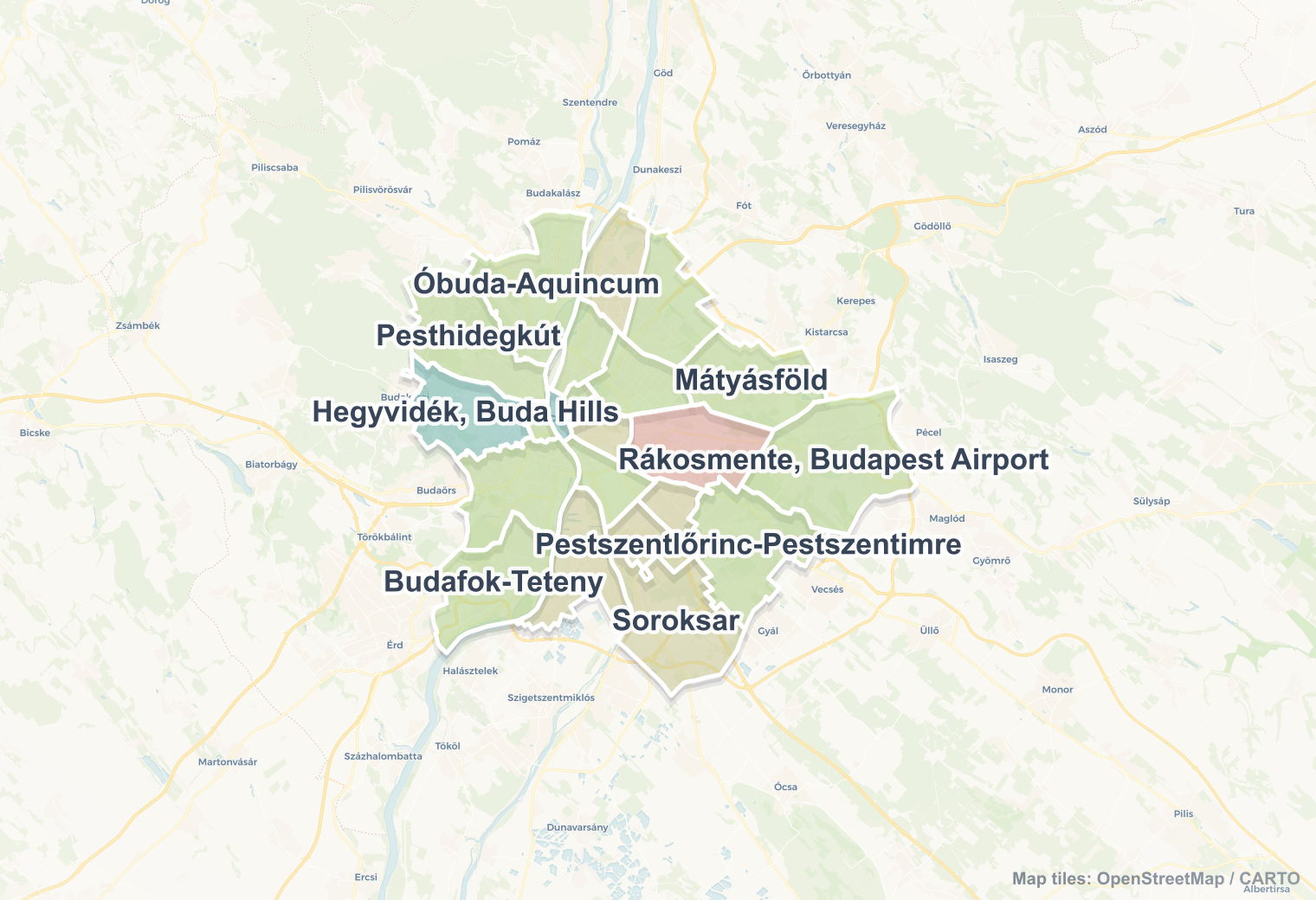
Use the map to compare districts before deciding where to book.
Stay decision guide
First time
Belváros-LipótvárosBelváros-Lipótváros is the cleanest first base: safety 80/100, transport 95/100, and fewer avoidable arrival mistakes.
Family
TerézvárosTerézváros gives families the stronger calm-and-access trade-off, with safety 75/100 and night score 45/100.
Budget
AngyalföldUse Angyalföld as the value check only if the exact stay keeps transport clear; do not trade down toward Kobanya for price alone.
Use the Budapest map as a decision tool before booking. Compare safety, transport, attraction access, and budget trade-offs district by district.
Interactive map
Click a district to see details, compare scores, and avoid booking in weaker areas. District tooltips show the neighborhood name, and the detail panel updates instantly.
Active district
Belváros-Lipótváros
Excellent | score 90
Budapest
Main tourist center with landmarks and luxury hotels.
Travel score
90
Safety
80
Transport
95
Community
90
Key strengths
Points to consider
23 results
District Comparison
Choose two districts and compare them side by side before booking. The tool highlights overall score, safety, transport, accommodation, night risk, and the practical trade-offs that matter most for a stay base.
| District | Safety | Vibe | Best for |
|---|---|---|---|
| Belváros-Lipótváros | 80/100 | Lively | Nightlife |
| Hegyvidék, Buda Hills | 95/100 | Local | Families |
| Obuda, Buda Castle | 90/100 | Lively | Families |
| Mátyásföld | 90/100 | Local | Families |
| Pesthidegkút | 92/100 | Local | Families |
Travel score 90/100
Main tourist center with landmarks and luxury hotels.
Strengths
Watch-outs
Travel score 90/100
Upscale green hills with luxury residential feel.
Strengths
Watch-outs
Overall travel score
Best single read for choosing a low-friction tourist base.
Safety
How comfortable the area is likely to feel for a typical visitor.
Sightseeing convenience
Access to major attractions, useful streets, and visitor-friendly movement.
Transport
How easy it is to arrive, leave, and move around the city.
Accommodation
Hotel and apartment practicality for a short stay.
Night risk
Lower is better. Use this when late returns matter.
Community signal
Extra signal from user reviews where enough data exists.
Stay Decision Guide
Belváros-Lipótváros is the best district for first-time visitors, with a safety score of 80 and the highest transport score (95) in the city. The excellent public transport network compensates for Budapest's sprawling layout across the Danube, making landmark access straightforward even though the city spans significant distance.
Budapest's dual-city structure (Buda and Pest) means staying central in Pest gives better transport connections than scenic Buda locations, which matters given the good-but-not-excellent transport tier. The wide 43-point safety spread between districts means choosing the wrong neighborhood has real consequences, unlike more uniformly safe European capitals.
Factor in that 65% of Budapest's districts score low for night safety, so proximity to your accommodation's metro or tram stop matters more here than in cities with better evening scores. Walking 10 minutes from a transport hub to your accommodation can shift you from an excellent-rated area into a caution zone.
Families should choose Hegyvidék in the Buda Hills, which scores 95 for safety and 25 for night risk, meaning genuinely low evening concerns in a city where most districts don't offer that. The tradeoff is a lower transport score (65), but families with children typically prioritize residential calm and green space over bar-hopping accessibility.
Solo travelers should base in Belváros-Lipótváros despite its 40 night score, because the transport score of 95 means easy late-evening returns from anywhere in the city, and the central location reduces solo walking distance. The pickpocketing risk is highest in tourist crowds here, but the infrastructure to avoid isolated situations is strongest.
Budget travelers should look at the outer parts of Terézváros or Erzsébetváros rather than crossing into Józsefváros (safety 55) or Csepel (safety 60). The price drop between excellent and caution districts is steep, but so is the functional difference in evening walkability and petty crime exposure.
Belváros-Lipótváros puts you within walking distance of Parliament, the Danube promenade, and the Chain Bridge, with a safety score of 80 and transport score of 95. Buda Castle district offers comparable landmark access from the Buda side with higher safety (90) but lower transport connectivity (75), meaning more reliance on taxis or specific bus lines.
Central location in Budapest does not cost you safety—Belváros-Lipótváros scores well above the city average of 76, unlike many European capitals where tourist centers score poorly. The cost is the 40 night score and highest pickpocket exposure, but these are manageable with basic awareness rather than structural dangers.
Basing in Óbuda or Buda Castle makes sense if you prioritize quiet evenings (safety 90, night 30) and don't mind adding 10-15 minutes to each transport journey into central Pest. You gain residential calm and castle views but give up the spontaneity that comes with Pest's denser metro network and walkable restaurant clusters.
Districts on the Pest side of Angyalföld or the quieter parts of Zugló offer budget accommodation while staying above the caution threshold, typically scoring in the 70-75 range rather than dropping below 60. These areas feel residential rather than touristy, which translates to lower nightly rates without the industrial emptiness of genuinely risky districts.
The safety-vs-price line in Budapest sits clearly between districts scoring 70+ (acceptable with awareness) and those below 60 like Józsefváros or Csepel, where the mix of rough zones and evening emptiness creates friction. Saving 30% on accommodation by moving from Belváros-Lipótváros to outer Pest is reasonable; saving 50% usually means you've crossed into caution territory.
Check that your Budapest accommodation is within 400 meters of a metro or major tram line, not just in a district with good transport scores. The 65% night risk figure means the walk from transport to your door is where exposure concentrates, and good district averages can hide dead blocks with poor lighting or weekend emptiness.
Józsefváros offers cheap accommodation but scores only 55 for safety with highly uneven block-by-block conditions, and Kőbánya (safety 50) is industrial with minimal tourist infrastructure and high evening isolation. Csepel on the Danube island scores 60 but feels disconnected from the city, turning every sightseeing trip into a committed transport journey.
If Budapest accommodation pricing seems unusually low, check whether it's in a district scoring below 60 or has a night score below 30 without corresponding transport access above 80. The gap usually signals industrial surroundings, weekday-only vibrancy that disappears evenings and weekends, or proximity to areas where tourist-targeted friction increases.
Before booking anywhere in Budapest, map the evening route from your last likely activity back to the accommodation address—not just the district average. With 65% of districts scoring low at night and transport that's good but closes or thins after midnight, a cheap room becomes expensive if it adds 15 minutes of uncomfortable walking or forces frequent taxi reliance.
FAQ
Both sides are safe in the right districts—Belváros-Lipótváros in Pest scores 80 while Buda Castle and Hegyvidék score 90-95. Pest offers better transport (95 vs 65-75) which matters for evening returns given that 65% of Budapest districts score low at night, but Buda's top districts have genuinely lower night risk (25-30) if you're staying local in evenings.
Józsefváros scores 55 with a caution verdict because it mixes renovated blocks near Corvin Quarter with rough zones that haven't transitioned, making it unpredictable for visitors unfamiliar with specific streets. If accommodation is here, verify the exact address is near Corvin metro and north of Üllői út, not in the southeastern sections where the score drops further.
Budapest's transport scores good (72.4) but not excellent, and 65% of districts score low at night, meaning the walk from your last metro to your door is where risk concentrates. Staying within 400 meters of a metro or major tram line reduces the exposure to pickpocket-prone crowds at transport hubs and cuts the isolated walking segments that inflate evening friction.
Districts scoring 50-60 like Kőbánya and Csepel aren't violently dangerous but combine low safety scores with industrial emptiness and poor night ratings, creating friction through isolation rather than confrontation. The inconvenience is the safety issue—long walks through empty areas, sparse evening transport, and lack of foot traffic that makes tourist-targeted pickpocketing and scams more likely when you do encounter others.