First time
City Centre SouthCity Centre South is the cleanest first base: safety 75/100, transport 100/100, and fewer avoidable arrival mistakes.
Donnybrook, Irishtown and Sandymount (safety 90/100) makes the strongest case for first-timers who want to balance proximity to the center with residential calm. The area sits close enough to central Dublin that the city's good transport network (74.6/100) compensates for the district's lower internal transport score, while keeping you in one of the safest parts of the city.
Use this shortlist to choose an area first, then compare the exact district on the map. Dublin is generally safe, but pickpocketing is common in tourist areas.
First time
City Centre SouthCity Centre South is the cleanest first base: safety 75/100, transport 100/100, and fewer avoidable arrival mistakes.
Family
Ranelagh, Rathmines and RathgarRanelagh, Rathmines and Rathgar gives families the stronger calm-and-access trade-off, with safety 85/100 and night score 35/100.
Budget
Clontarf, East Wall and FairviewUse Clontarf, East Wall and Fairview as the value check only if the exact stay keeps transport clear; do not trade down toward Balgriffin, Darndale and Priorswood for price alone.
Explore them on the map:
See safest areas on the mapDublin safety map
Use the map to compare districts before deciding where to book.
Stay decision guide
First time
City Centre SouthCity Centre South is the cleanest first base: safety 75/100, transport 100/100, and fewer avoidable arrival mistakes.
Family
Ranelagh, Rathmines and RathgarRanelagh, Rathmines and Rathgar gives families the stronger calm-and-access trade-off, with safety 85/100 and night score 35/100.
Budget
Clontarf, East Wall and FairviewUse Clontarf, East Wall and Fairview as the value check only if the exact stay keeps transport clear; do not trade down toward Balgriffin, Darndale and Priorswood for price alone.
Use the Dublin map as a decision tool before booking. Compare safety, transport, attraction access, and budget trade-offs district by district.
Interactive map
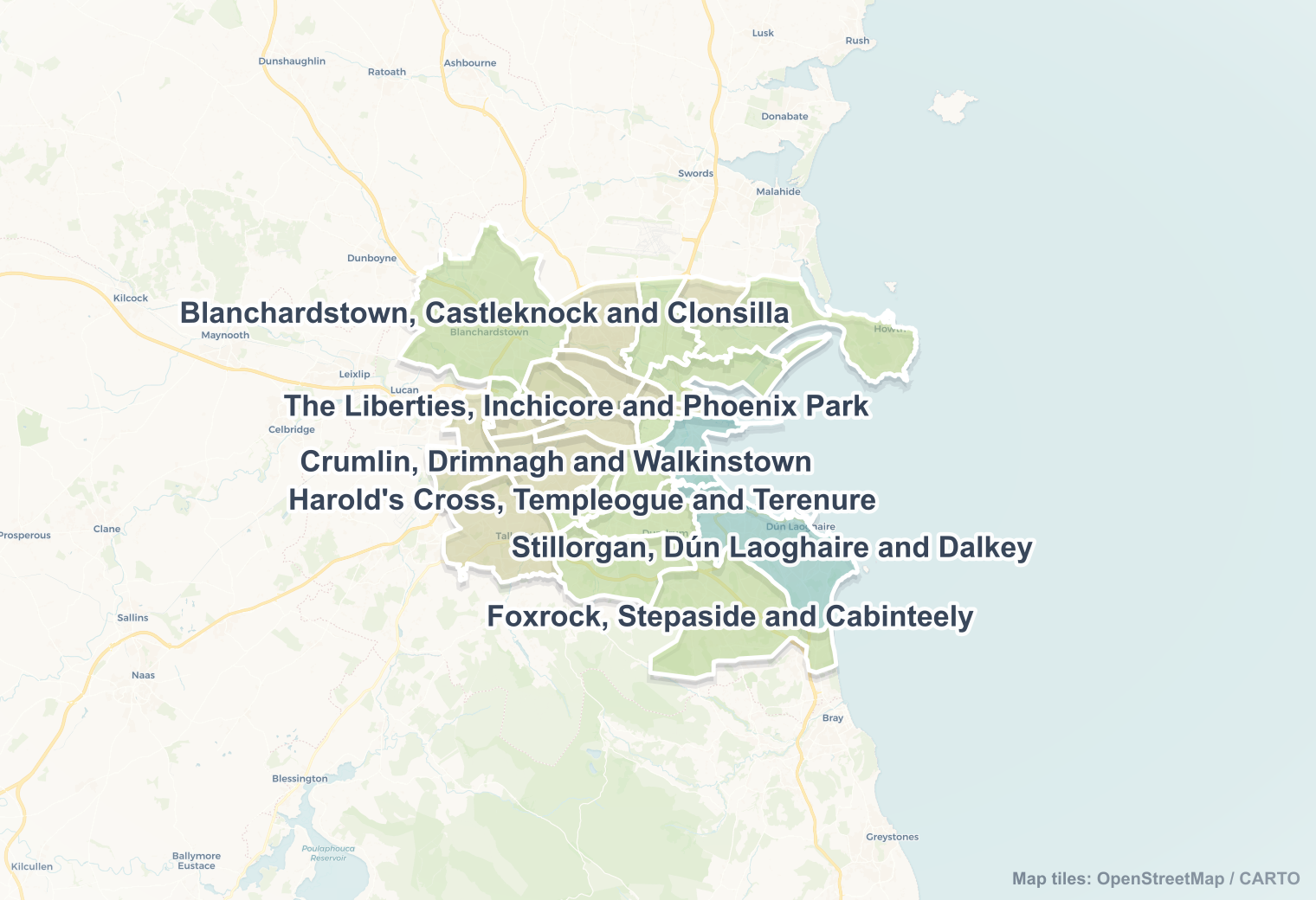
Click a district to see details, compare scores, and avoid booking in weaker areas. District tooltips show the neighborhood name, and the detail panel updates instantly.
Active district
Stillorgan, Dún Laoghaire and Dalkey
Excellent | score 90
Dublin
Coastal, upscale suburban area with scenic views.
Travel score
90
Safety
90
Transport
75
Community
90
Key strengths
Points to consider
23 results
District Comparison
Choose two districts and compare them side by side before booking. The tool highlights overall score, safety, transport, accommodation, night risk, and the practical trade-offs that matter most for a stay base.
| District | Safety | Vibe | Best for |
|---|---|---|---|
| Stillorgan, Dún Laoghaire and Dalkey | 90/100 | Quiet | Families |
| Donnybrook, Irishtown and Sandymount | 90/100 | Quiet | Families |
| Foxrock, Stepaside and Cabinteely | 90/100 | Local | Families |
| City Centre South | 75/100 | Lively | Nightlife |
| Churchtown, Clonskeagh and Dundrum | 85/100 | Local | Families |
Travel score 90/100
Coastal, upscale suburban area with scenic views.
Strengths
Watch-outs
Travel score 90/100
Affluent area near coast and close to center.
Strengths
Watch-outs
Overall travel score
Best single read for choosing a low-friction tourist base.
Safety
How comfortable the area is likely to feel for a typical visitor.
Sightseeing convenience
Access to major attractions, useful streets, and visitor-friendly movement.
Transport
How easy it is to arrive, leave, and move around the city.
Accommodation
Hotel and apartment practicality for a short stay.
Night risk
Lower is better. Use this when late returns matter.
Community signal
Extra signal from user reviews where enough data exists.
Stay Decision Guide
Donnybrook, Irishtown and Sandymount (safety 90/100) makes the strongest case for first-timers who want to balance proximity to the center with residential calm. The area sits close enough to central Dublin that the city's good transport network (74.6/100) compensates for the district's lower internal transport score, while keeping you in one of the safest parts of the city.
Dublin's layout rewards some geographic awareness: the city has sharp safety gaps between districts, with a 40-point spread between the highest and lowest scores. Good public transport means you can base yourself in safer outer areas without feeling cut off, but 57% of districts score poorly at night, so evening logistics matter more than in cities with flatter safety profiles.
Factor in your evening return route before choosing where to stay in Dublin. High night risk across most of the city means the walk or bus ride from dinner or a pub back to your accommodation deserves as much consideration as daytime access to sights.
Stillorgan, Dún Laoghaire and Dalkey (safety 90/100, transport 75/100) works best for families who want space, coastal access, and strong baseline safety even though night scores sit at 30/100 across the district. The upscale suburban character and good transport connections let families access the city center without basing in areas with higher evening risk.
Solo travelers should prioritize Donnybrook, Irishtown and Sandymount (safety 90/100) for the combination of proximity to central Dublin and consistently high safety scores. The district's closeness to the center reduces reliance on late-night transport in a city where more than half of all areas have elevated night risk, and the residential feel offers quieter evening options.
Budget travelers can look to middle-tier residential areas that sit between the premium coastal zones and the nine caution districts, but need to map the specific streets. Avoid Ballyfermot and Cherry Orchard, Balgriffin, Darndale and Priorswood, and Ballymun and Finglas (all 50-52/100 safety), where accommodation costs drop for documented reasons tied to reputation and safety profile.
Central Dublin districts put you within walking distance of Temple Bar, Trinity College, and the main tourist corridor, but this is where safety scores vary most sharply between neighboring areas. The tradeoff is immediate access versus the need to navigate district boundaries carefully, especially after dark when 57% of areas score poorly.
Central location in Dublin does not automatically mean lower safety, but it does mean higher exposure to the city's uneven district-to-district safety gaps. You gain convenience but lose the buffer that outer residential areas provide, and evening walks require more route awareness.
Basing in Donnybrook, Irishtown and Sandymount or the southern coastal districts makes sense when you value residential safety over hypercentral access. You give up some walkability to sights but gain consistently high safety scores (90/100) and good transport connections (74.6/100 citywide) that make the 15-25 minute commute manageable.
Districts in the 70-80/100 safety range offer lower accommodation costs than the top-tier coastal areas without crossing into caution territory. Look for areas between the premium Stillorgan and Donnybrook districts and the nine flagged zones, checking both the district safety score and proximity to transport stops.
The safety-versus-price line in Dublin sits clearly at the 60/100 mark: areas scoring 50-52/100 like Ballyfermot, Ballymun, and the Darndale cluster carry caution verdicts for documented reasons. Anything scoring 70/100 or above keeps you well clear of the sharp safety drop that defines the city's risk profile.
Check the evening bus or tram route from your accommodation address to central Dublin before booking. Good citywide transport (74.6/100) matters less if your specific location requires a walk through lower-scored areas to reach the nearest stop, especially given the high night risk across 57% of districts.
Ballyfermot and Cherry Orchard, Balgriffin, Darndale and Priorswood, and Ballymun and Finglas (safety 50-52/100) all carry caution verdicts due to reputation and outer positioning. The accommodation price drop in these areas reflects the 40-point safety gap between them and top-tier districts, not a geographic bargain.
When a price seems unusually low in Dublin, check the district safety score and the night rating: areas with both low overall safety and poor night scores create compounding risk. The city's sharp district-to-district gaps mean a few blocks can shift you from a 90/100 area to a 50/100 zone, and prices reflect that boundary.
Ask yourself what the evening return looks like from any address in Dublin before booking. With 57% of districts scoring low at night and a 40-point spread between safest and least safe areas, the walk or transport route back to your accommodation after dinner or drinks deserves explicit planning, not assumption.
FAQ
Nine districts carry caution or avoid verdicts, including Ballyfermot and Cherry Orchard, Balgriffin, Darndale and Priorswood, and Ballymun and Finglas (all 50-52/100 safety). These outer areas have documented reputation issues and sit at the bottom of Dublin's 40-point safety spread.
The safest districts in Dublin are outer areas like Stillorgan, Dún Laoghaire and Dalkey, and Donnybrook, Irishtown and Sandymount (all 90/100 safety). Good citywide transport (74.6/100) makes suburban basing practical, but 57% of all districts score low at night, so evening routes matter regardless of location.
Location affects safety significantly in Dublin due to sharp district-to-district gaps: the safety spread runs 40 points from top to bottom across 23 districts. Nine areas carry caution verdicts, and neighboring districts can differ by 30-40 points, making specific district choice more important than general area.
Dublin's transport scores 74.6/100 (good tier), which supports basing in outer high-safety areas like the coastal districts without isolation. The challenge is night risk: 57% of districts score low after dark, so check the specific evening transport route and frequency from your accommodation address, not just daytime connections.