First time
BelémBelém is the cleanest first base: safety 90/100, transport 85/100, and fewer avoidable arrival mistakes.
Campo de Ourique (safety 90, transport 85) works best for first-timers who want a residential feel with reliable access to central sights. The good transport network across Lisbon means you don't need to stay in the tourist core to reach attractions efficiently, and this district's strong safety score holds up better than more central options.
Use this shortlist to choose an area first, then compare the exact district on the map. Lisbon is generally safe, but pickpocketing is common in tourist areas.
First time
BelémBelém is the cleanest first base: safety 90/100, transport 85/100, and fewer avoidable arrival mistakes.
Family
Parque das NaçõesParque das Nações gives families the stronger calm-and-access trade-off, with safety 90/100 and night score 30/100.
Budget
Avenidas NovasUse Avenidas Novas as the value check only if the exact stay keeps transport clear; do not trade down toward Marvila for price alone.
Explore them on the map:
See safest areas on the mapLisbon safety map
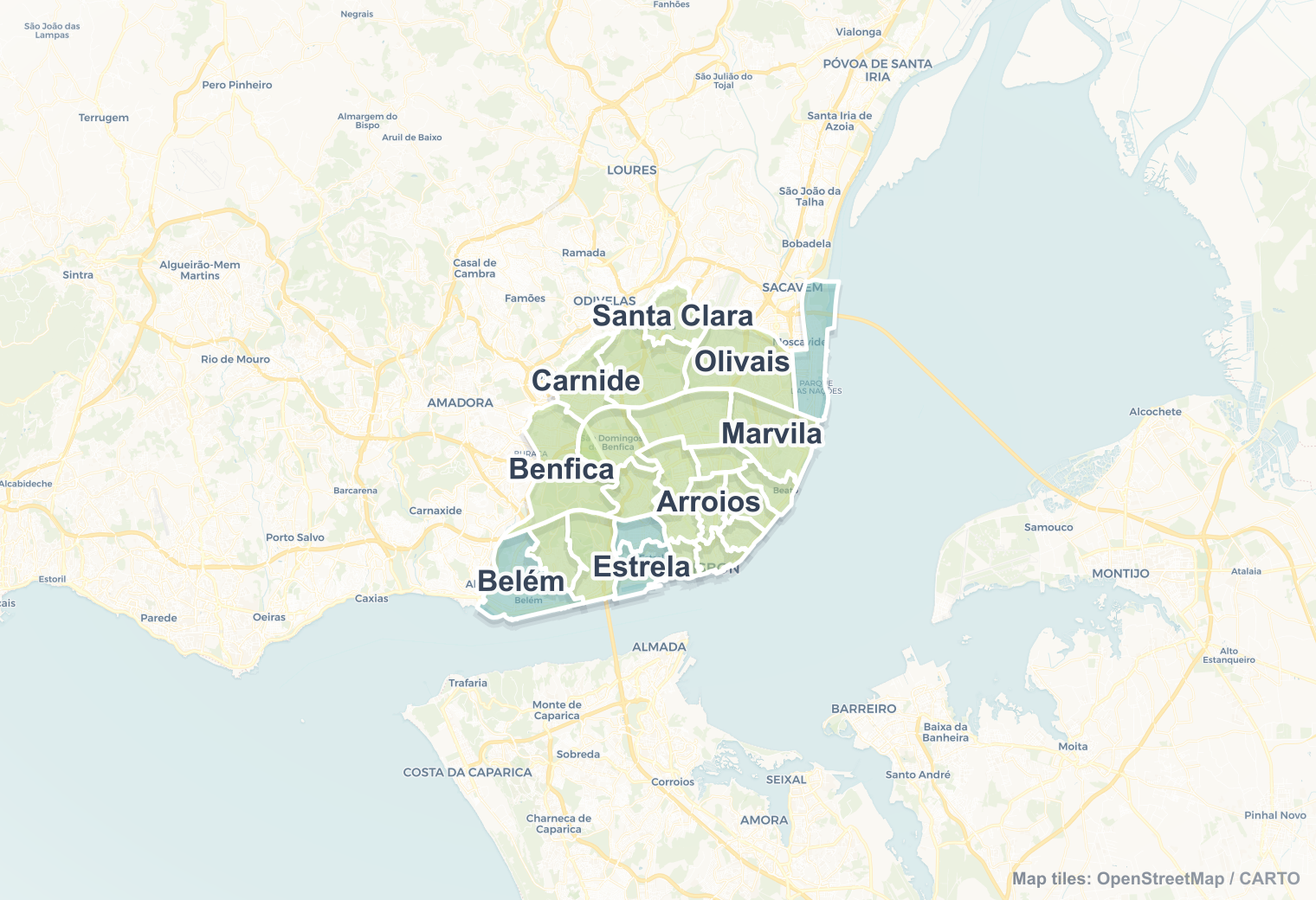
Use the map to compare districts before deciding where to book.
Stay decision guide
First time
BelémBelém is the cleanest first base: safety 90/100, transport 85/100, and fewer avoidable arrival mistakes.
Family
Parque das NaçõesParque das Nações gives families the stronger calm-and-access trade-off, with safety 90/100 and night score 30/100.
Budget
Avenidas NovasUse Avenidas Novas as the value check only if the exact stay keeps transport clear; do not trade down toward Marvila for price alone.
Use the Lisbon map as a decision tool before booking. Compare safety, transport, attraction access, and budget trade-offs district by district.
Interactive map
Click a district to see details, compare scores, and avoid booking in weaker areas. District tooltips show the neighborhood name, and the detail panel updates instantly.
Active district
Parque das Nações
Excellent | score 90
Lisbon
Modern waterfront district.
Travel score
90
Safety
90
Transport
90
Community
90
Key strengths
Points to consider
26 results
District Comparison
Choose two districts and compare them side by side before booking. The tool highlights overall score, safety, transport, accommodation, night risk, and the practical trade-offs that matter most for a stay base.
| District | Safety | Vibe | Best for |
|---|---|---|---|
| Parque das Nações | 90/100 | Lively | Families |
| Campo de Ourique | 90/100 | Local | Families |
| Belém | 90/100 | Lively | Families |
| Estrela | 90/100 | Lively | Families |
| Avenidas Novas | 85/100 | Quiet | Families |
Travel score 90/100
Modern waterfront district.
Strengths
Watch-outs
Travel score 90/100
Trendy residential district with local vibe.
Strengths
Watch-outs
Overall travel score
Best single read for choosing a low-friction tourist base.
Safety
How comfortable the area is likely to feel for a typical visitor.
Sightseeing convenience
Access to major attractions, useful streets, and visitor-friendly movement.
Transport
How easy it is to arrive, leave, and move around the city.
Accommodation
Hotel and apartment practicality for a short stay.
Night risk
Lower is better. Use this when late returns matter.
Community signal
Extra signal from user reviews where enough data exists.
Stay Decision Guide
Campo de Ourique (safety 90, transport 85) works best for first-timers who want a residential feel with reliable access to central sights. The good transport network across Lisbon means you don't need to stay in the tourist core to reach attractions efficiently, and this district's strong safety score holds up better than more central options.
Lisbon's hilly layout and dispersed attractions mean your base matters more than in flat, compact cities—good transport (83.8/100) gives you flexibility, but the 17-point score spread between districts means choosing poorly can expose you to higher pickpocketing risk in crowded tourist zones. Trams and metros connect well during the day, but 88% of districts score low at night, so evening logistics require more planning than the daytime experience suggests.
Factor in your accommodation's walking route from the nearest transport stop after dark—Lisbon's night risk is high across nearly all districts, so the specific street and final 400 meters matter more than the neighborhood's general reputation.
Estrela (safety 90, transport 85, night 30) suits families who prioritize a quieter base with parks and manageable evening walks, though the low night score still means planning return times around daylight. The combination of residential calm and solid transport links lets families avoid the pickpocket pressure of tourist-heavy districts while maintaining good daytime access.
Campo de Ourique (safety 90, transport 85) gives solo travelers a local neighborhood feel with cafés and shops where tourist-targeted friction is lower, plus transport connections that support independent exploration without relying on taxis after dark. The residential vibe reduces the constant guard-up posture required in Baixa or Alfama.
Districts east and north of the historic center offer lower accommodation costs without dropping into caution territory—none of Lisbon's 26 districts are flagged for avoidance, but the 17-point score spread means checking the specific safety and transport numbers for your shortlist matters more than neighborhood names.
Belém (safety 90, transport 85) puts you next to major landmarks like the Torre de Belém and Jerónimos Monastery but requires tram or train rides to reach Baixa and Alfama—the tradeoff is high safety near monuments versus 20-30 minute transport to evening dining areas. Staying near central sights in Baixa or Chiado means higher exposure to pickpocketing and crowds that push Lisbon's average safety down to 80/100.
Central location in Lisbon concentrates the primary risk factors—pickpocketing, crowds, and tourist-targeted friction—without offering the daytime transport advantage that matters in cities with patchy networks. The city's good transport tier (83.8/100) means proximity to sights delivers convenience, not necessity, so the safety cost of staying central is a choice, not a requirement.
Basing in Campo de Ourique or Estrela means accepting 15-25 minute commutes to main attractions in exchange for residential calm and 13% higher safety scores—you gain evening comfort and lower theft risk while giving up the ability to walk home from dinner in Bairro Alto or Cais do Sodré.
Districts slightly outside the tourist triangle—Campo de Ourique, Estrela, and residential areas north of Avenida da Liberdade—typically offer lower accommodation costs while maintaining safety scores of 85-90, well above the city average of 80. None cross into caution territory, but the 17-point spread means you're trading price for the specific combination of safety, transport, and night scores.
The safety-vs-price tradeoff in Lisbon sits between the tourist core (higher prices, lower safety due to pickpocketing and crowds) and residential districts (lower prices, higher safety, but consistently low night scores). The line is transport accessibility—districts with scores above 80 let you save money without adding commute friction that erodes the value gained.
Check the walking distance from your accommodation to the nearest metro or tram stop and map that route on street view—88% of Lisbon districts score low at night (30/100), so a 10-minute walk through quiet residential streets after dark becomes the practical constraint, not the neighborhood's daytime safety number.
Even with zero caution-flagged districts, prices significantly below neighborhood averages in central areas like Baixa or Martim Moniz should prompt checking the specific street and transport access—low prices in high-traffic zones often reflect ground-floor noise, distance from metro stops, or placement on routes with higher pickpocketing activity. The 17-point score spread means two accommodations 400 meters apart can offer meaningfully different exposure to crowds and theft risk.
Unusually low prices in Lisbon typically signal poor transport links (requiring taxis that erase savings), locations on steep hills that strain mobility, or streets that feel uncomfortable after dark despite acceptable daytime safety scores. With 88% of districts scoring 30/100 at night, cheap accommodation on poorly-lit side streets or far from transport stops creates evening logistics problems that prices don't capture.
Before booking anywhere in Lisbon, map the route from your planned evening activities back to the accommodation address after 10 PM and check transport frequency—good daytime transit (83.8/100) doesn't guarantee viable night buses or metro service, and the city's high night risk means the specific return path matters more than the district's general safety reputation.
FAQ
Central Lisbon is very safe (80/100 city average) but concentrates the primary risks—pickpocketing, crowds, and tourist-targeted friction—that lower scores relative to residential districts like Campo de Ourique or Estrela (90/100). No districts are flagged for caution, but staying central means accepting higher theft exposure in exchange for proximity to sights.
88% of Lisbon's 26 districts score low at night (30/100), including top-rated areas like Campo de Ourique, Belém, and Estrela—the issue is lighting and activity levels, not crime concentration. Focus on your accommodation's specific walking route from the nearest transport stop rather than the neighborhood's general night score, since the final 400 meters matter most.
Lisbon's good transport network (83.8/100) gives flexibility, but proximity to metro or tram stops becomes critical given the high night risk across 88% of districts—long walks after dark from poorly-connected accommodations erase the value of lower prices. Check not just station distance but evening service frequency, since some lines reduce schedules significantly after 10 PM.
None of Lisbon's 26 districts are flagged for caution or avoidance—the 17-point score spread reflects varying exposure to pickpocketing and crowds, not dangerous zones. The decision is about matching district characteristics (residential calm vs central access, transport quality, night logistics) to your trip priorities, not ruling out unsafe areas.