First time
Marseille 7e ArrondissementMarseille 7e Arrondissement is the cleanest first base: safety 85/100, transport 80/100, and fewer avoidable arrival mistakes.
Marseille 7e Arrondissement is the most reliable first-visit base, with a safety score of 85 and direct access to the Old Port and coastal landmarks. The district combines walkable attractions with good transport connections (score 80), letting you explore without constant metro dependence while staying in one of the city's safest zones.
Use this shortlist to choose an area first, then compare the exact district on the map. Marseille is generally safe, but pickpocketing is common in tourist areas.
First time
Marseille 7e ArrondissementMarseille 7e Arrondissement is the cleanest first base: safety 85/100, transport 80/100, and fewer avoidable arrival mistakes.
Family
Marseille 8e ArrondissementMarseille 8e Arrondissement gives families the stronger calm-and-access trade-off, with safety 85/100 and night score 35/100.
Budget
Marseille 1er ArrondissementUse Marseille 1er Arrondissement as the value check only if the exact stay keeps transport clear; do not trade down toward Marseille 3e Arrondissement for price alone.
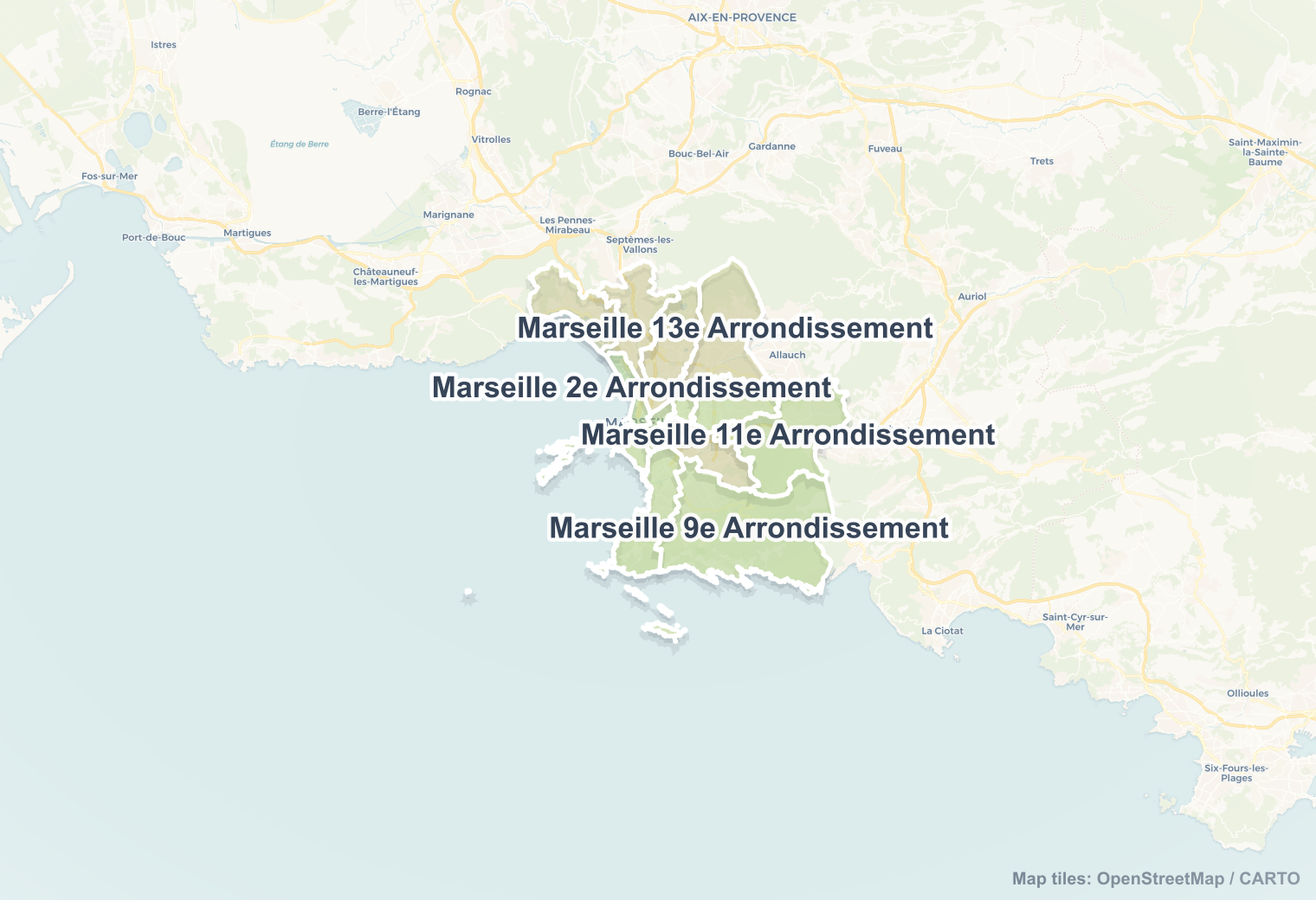
Explore them on the map:
See safest areas on the mapMarseille safety map
Use the map to compare districts before deciding where to book.
Stay decision guide
First time
Marseille 7e ArrondissementMarseille 7e Arrondissement is the cleanest first base: safety 85/100, transport 80/100, and fewer avoidable arrival mistakes.
Family
Marseille 8e ArrondissementMarseille 8e Arrondissement gives families the stronger calm-and-access trade-off, with safety 85/100 and night score 35/100.
Budget
Marseille 1er ArrondissementUse Marseille 1er Arrondissement as the value check only if the exact stay keeps transport clear; do not trade down toward Marseille 3e Arrondissement for price alone.
Use the Marseille map as a decision tool before booking. Compare safety, transport, attraction access, and budget trade-offs district by district.
Interactive map
Click a district to see details, compare scores, and avoid booking in weaker areas. District tooltips show the neighborhood name, and the detail panel updates instantly.
Active district
Marseille 12e Arrondissement
Good | score 83
Marseille
Residential and safe suburban district.
Travel score
83
Safety
85
Transport
75
Community
83
Key strengths
Points to consider
16 results
District Comparison
Choose two districts and compare them side by side before booking. The tool highlights overall score, safety, transport, accommodation, night risk, and the practical trade-offs that matter most for a stay base.
| District | Safety | Vibe | Best for |
|---|---|---|---|
| Marseille 12e Arrondissement | 85/100 | Local | Families |
| Marseille 7e Arrondissement | 85/100 | Lively | Families |
| Marseille 8e Arrondissement | 85/100 | Lively | Families |
| Marseille 9e Arrondissement | 80/100 | Local | First-time visitors |
| Marseille 11e Arrondissement | 80/100 | Local | First-time visitors |
Travel score 83/100
Residential and safe suburban district.
Strengths
Watch-outs
Travel score 83/100
Coastal district with views and landmarks.
Strengths
Watch-outs
Overall travel score
Best single read for choosing a low-friction tourist base.
Safety
How comfortable the area is likely to feel for a typical visitor.
Sightseeing convenience
Access to major attractions, useful streets, and visitor-friendly movement.
Transport
How easy it is to arrive, leave, and move around the city.
Accommodation
Hotel and apartment practicality for a short stay.
Night risk
Lower is better. Use this when late returns matter.
Community signal
Extra signal from user reviews where enough data exists.
Stay Decision Guide
Marseille 7e Arrondissement is the most reliable first-visit base, with a safety score of 85 and direct access to the Old Port and coastal landmarks. The district combines walkable attractions with good transport connections (score 80), letting you explore without constant metro dependence while staying in one of the city's safest zones.
Marseille's good transport network (79.1/100) gives first-timers flexibility to stay outside the immediate center, but the 31-point safety spread between districts means location choice genuinely matters here. The city's layout follows the coast and climbs inland, so districts further from the water tend to be residential or industrial with less tourism infrastructure and lower evening safety scores.
Check the evening route back to your accommodation before booking—38% of Marseille's districts score low at night, and good daytime transport doesn't always translate to comfortable late returns from restaurant or bar districts.
Families should prioritize Marseille 12e Arrondissement, which scores 85 for safety and 75 for transport while offering a residential environment away from tourist-crowd pickpocketing zones. The district's suburban character means fewer late-night disturbances despite its low night score (35), which matters less when traveling with children on early schedules.
Solo travelers benefit most from Marseille 8e Arrondissement, where the 85 safety score and 85 transport score combine with coastal visibility and foot traffic that reduce isolation risk. The upscale beach area provides natural gathering points and well-lit evening routes, addressing the medium night risk that affects 38% of the city's districts.
Budget travelers should target Marseille 7e Arrondissement's inland edges rather than crossing into the 14e or 15e arrondissements, where safety drops to 50 and accommodation savings come with measurable evening risk. The 7e maintains the 85 safety threshold while offering more varied price points than the beachfront 8e.
Marseille 7e Arrondissement positions visitors within walking distance of the Vieux-Port, Notre-Dame de la Garde, and coastal promenades, with transport access to the Calanques departure points. The central coastal location doesn't force safety compromises—the district maintains an 85 safety score while delivering attraction proximity.
Central location in Marseille's case means coastal rather than geographic center, and the data shows waterfront districts outperform inland ones for both safety and visitor infrastructure. The older urban core in the 3e Arrondissement drops to a 45 safety score with high social friction, making ultra-central positioning less appealing than staying along the 7e-8e coastal corridor.
Basing in Marseille 12e Arrondissement trades 15-20 minute transit rides for an 85 safety score and quieter surroundings, which works well given the city's good transport tier (79.1/100). You gain residential calm and lower pickpocketing exposure while giving up the ability to walk home from Old Port dinners.
Marseille 12e Arrondissement and the inland portions of the 7e offer budget-friendly accommodation while maintaining 85 safety scores, avoiding the steep price premiums of beachfront 8e properties. These districts stay above the safety threshold where Marseille's risk profile changes noticeably.
The safety-versus-price line in Marseille sits clearly between the 70+ scoring districts and the 50-score caution zones (14e, 15e), where accommodation costs drop alongside evening comfort and pickpocketing risk rises. The 31-point spread between top and bottom districts means cheap options in flagged areas represent genuine tradeoffs, not just aesthetic differences.
Check whether your accommodation in budget districts sits within 400 meters of a metro or tram stop with service past 21:00—Marseille's good transport score averages out patchy coverage in residential areas, and that last 10-minute walk determines whether medium night risk becomes a daily concern.
Marseille 3e, 14e, and 15e arrondissements show accommodation discounts that reflect safety scores of 45-50 and higher crime levels rather than just distance from beaches. The 3e's dense urban challenges and the 14e-15e's northern industrial character create environments where tourist-targeted friction and evening discomfort justify higher spending elsewhere.
When Marseille accommodation pricing drops significantly below coastal or 12e averages, the data shows it corresponds to districts with either high social issues (3e), industrial isolation (15e), or elevated crime reports (14e). These areas score 35 points below top districts—a gap that reflects operational risk, not just ambiance preferences.
Before booking anywhere in Marseille, map the evening return from the Old Port or restaurant districts to your accommodation address—does the route stay in well-trafficked areas, does it require bus connections that thin out after 22:00, and does it cross through any of the six caution-flagged districts where 38% of the city's night risk concentrates?
FAQ
Marseille 3e (safety score 45), 14e (safety score 50), and 15e (safety score 50) are flagged as caution zones due to higher crime levels, dense urban challenges, and industrial isolation. These northern and central districts account for much of the city's tourist-targeted friction and pickpocketing risk, making them poor accommodation bases even when prices seem attractive.
Marseille's good transport score (79.1/100) makes suburban districts like the 12e Arrondissement viable—it scores 85 for safety with 75 for transport connectivity. The challenge is evening returns rather than daytime access, since 38% of districts score low at night and transport frequency drops after 22:00 in residential areas.
The coastal 8e Arrondissement commands premium prices for its 85 safety and 85 transport scores, but the 7e and 12e arrondissements offer similar 85 safety ratings at lower costs by trading beach access for hillside views or residential quiet. The 31-point safety spread means budget options in caution districts (14e, 15e, 3e) represent genuine risk tradeoffs, not just style differences.
Pickpocketing concentrates in tourist-crowded areas and transport hubs, making accommodation choice about evening base safety rather than daytime sightseeing exposure. Staying in the 7e, 8e, or 12e arrondissements (all safety score 85) means returning to lower-friction residential zones after visiting higher-risk central attractions, reducing cumulative exposure to the city's primary crime risk.