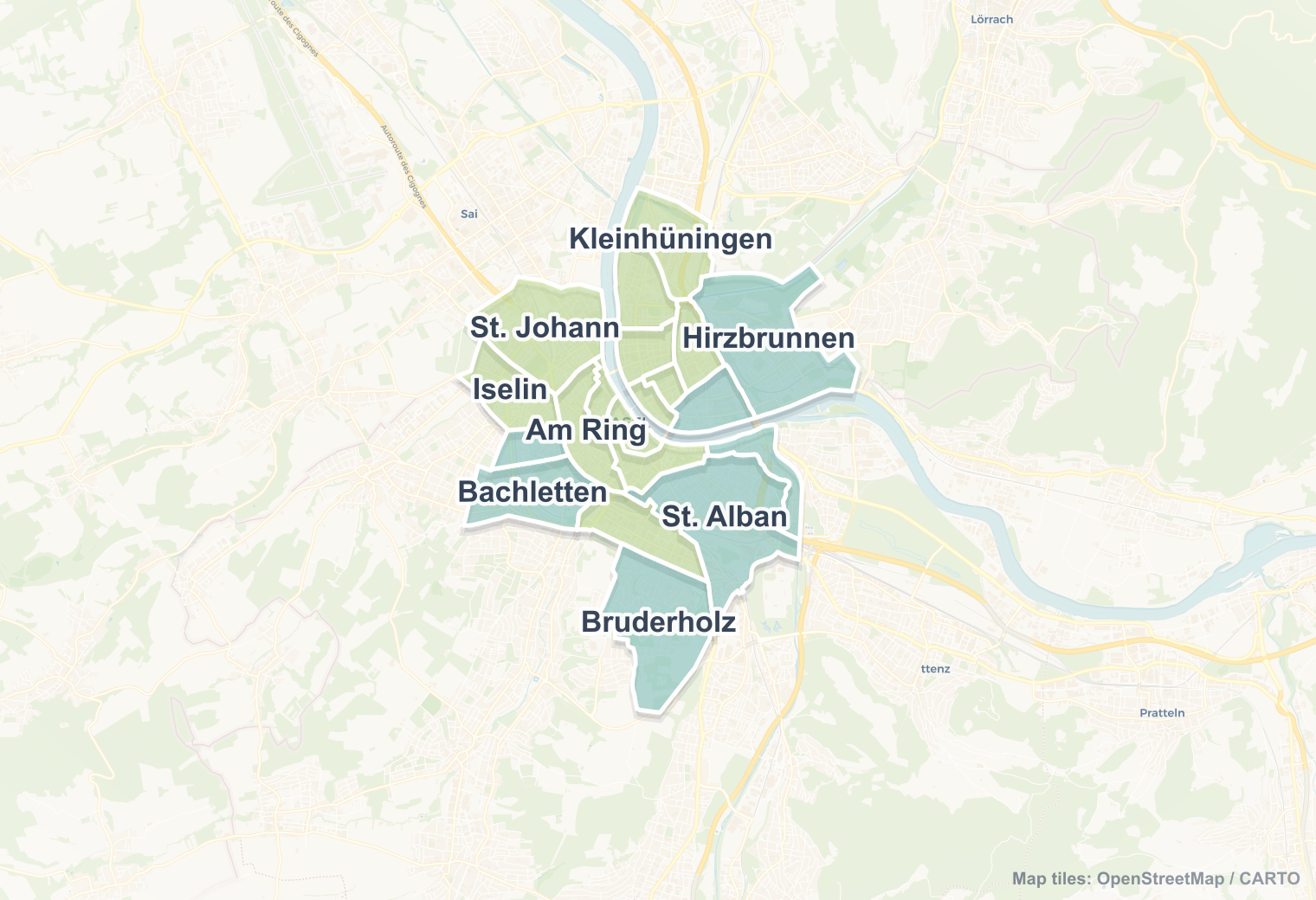
Basel scores 86.8 out of 100 for safety, placing it in the very safe category for European cities. In practice, this means street crime is rare, public spaces feel secure during the day, and most visitors complete their stays without any safety incidents.
Use this shortlist to choose an area first, then compare the exact district on the map. Basel is generally safe, but pickpocketing is common in tourist areas.
Safety posture
Score range
75/100 to 95/100
Primary risk
pickpocketing, crowds, and tourist-targeted friction
Map signals
Stable districts: Bruderholz, Hirzbrunnen, and Bachletten.
Night-risk check: Bruderholz, Hirzbrunnen, and Bachletten.
Use the Basel safety map to compare safety scores, night-risk signals, and the difference between stable districts and areas that need more caution.
Interactive map
Interactive district safety map of Basel
Click a district to see details, compare scores, and avoid booking in weaker areas. District tooltips show the neighborhood name, and the detail panel updates instantly.
Safety districts
Active district
Hirzbrunnen
Excellent | score 93
Basel
Hirzbrunnen
Excellent
Quiet residential district in the eastern part of Basel, near Badischer Bahnhof. Suburban feel with greenery, low noise, and well-maintained housing. Not tourist-focused.
Travel score
93
Safety
93
Transport
80
Community
93
Key strengths
Very high safety level (one of the safest types of areas)
Choose two districts and compare them side by side before booking. The tool highlights overall score, safety, transport, accommodation, night risk, and the practical trade-offs that matter most for a stay base.
Quiet residential district in the eastern part of Basel, near Badischer Bahnhof. Suburban feel with greenery, low noise, and well-maintained housing. Not tourist-focused.
Families
Strengths
+ Very high safety level (one of the safest types of areas)
Upscale residential district on a hillside south of Basel. Low-density, green, and very quiet. Known for villas, parks, and panoramic views. One of the most exclusive and calm areas in the city.
Families
Strengths
+ Extremely high safety level (elite residential standard)
Best single read for choosing a low-friction tourist base.
93/10092/100Hirzbrunnen +1
Safety
How comfortable the area is likely to feel for a typical visitor.
93/10095/100Bruderholz +2
Sightseeing convenience
Access to major attractions, useful streets, and visitor-friendly movement.
50/10060/100Bruderholz +10
Transport
How easy it is to arrive, leave, and move around the city.
80/10075/100Hirzbrunnen +5
Accommodation
Hotel and apartment practicality for a short stay.
70/10070/100Tie
Night risk
Lower is better. Use this when late returns matter.
27/10025/100Bruderholz +2
Community signal
Extra signal from user reviews where enough data exists.
93/10092/100Hirzbrunnen +1
Safety Guide
Basel safety overview
Basel scores 86.8 out of 100 for safety, placing it in the very safe category for European cities. In practice, this means street crime is rare, public spaces feel secure during the day, and most visitors complete their stays without any safety incidents.
The primary risk pattern in Basel is universal: 100% of districts score low for night-time comfort, with late-return routes being the main concern across the entire city. This isn't about crime hotspots but rather about reduced public activity, lighting variation, and longer walks from transport stops after dark.
The 18-point score spread between Basel's best and worst districts is moderate, meaning district choice has some impact but won't dramatically change your safety experience. You're choosing between very safe and moderately safe rather than between safe and risky.
Basel safety guide
Hirzbrunnen is Basel's highest-scoring district with a safety rating of 93 and represents the quietest option available. If you prioritize residential calm and minimal street activity, this eastern district near Badischer Bahnhof delivers, though its transport score of 80 means slightly longer connections than central areas.
In Basel, the difference between an 80+ score and a 60-70 score shows up mainly in pedestrian density and lighting consistency rather than actual danger. Districts scoring in the 80s have more predictable street patterns and maintained infrastructure, while lower-scoring areas might have industrial pockets or less foot traffic after business hours.
Many visitors assume Basel's high overall safety score means night risk is equally distributed, but the data shows otherwise: every single district scores low after dark. Even Bruderholz at 95 daytime safety drops to 25 at night, so booking location based on daytime scores alone misses the city's actual risk pattern.
Basel at night
Night safety in Basel is consistently low across all districts, but this reflects reduced comfort and accessibility rather than crime risk. No area is definitively fine after dark without planning—even top-rated Hirzbrunnen drops to 27 at night, requiring advance route checking and transport awareness.
For evening logistics, prioritize accommodation near tram stops over quiet residential appeal, especially for late arrivals or dinner returns. Districts like Bachletten (transport 85) offer better late-night connectivity than hillside areas like Bruderholz (transport 75), where taxi costs and longer walks become factors after the last scheduled services.
The score data reveals that Basel's night challenge is systemic rather than localized: you can't simply avoid certain neighborhoods and feel secure everywhere else. Factor this into booking by choosing transit-accessible locations over purely residential ones, regardless of their daytime safety ratings.
FAQ
Basel safety FAQ
Is Basel safe enough to walk alone at night?
Basel is safe from a crime perspective, but 100% of districts score low for night-time comfort, meaning reduced lighting, fewer pedestrians, and longer walks from transport stops are consistent concerns. Walking alone at night requires route planning and awareness of last transport times rather than avoiding specific dangerous areas.
Which Basel district is safest for families?
Bachletten scores 93 for safety with 85 for transport and is specifically noted as popular with families and long-term residents. It balances residential calm with practical connectivity better than higher-safety options like Bruderholz (95 safety, 75 transport), which becomes harder to navigate with children after dark.
Does it matter which district I book in Basel for safety?
The 18-point score spread means district choice has moderate impact—you're choosing between very safe and moderately safe. The bigger factor is transport accessibility for night returns, where the difference between an 85 transport score (Bachletten) and 75 (Bruderholz) affects late-evening logistics more than the safety score difference.
Are there any areas to avoid in Basel?
Basel has zero districts flagged for caution or avoidance across all 19 neighborhoods. The real consideration is matching your schedule to transport access—avoiding late returns to low-transport areas like Bruderholz (75) matters more than avoiding specific unsafe zones, which don't exist in the traditional sense.