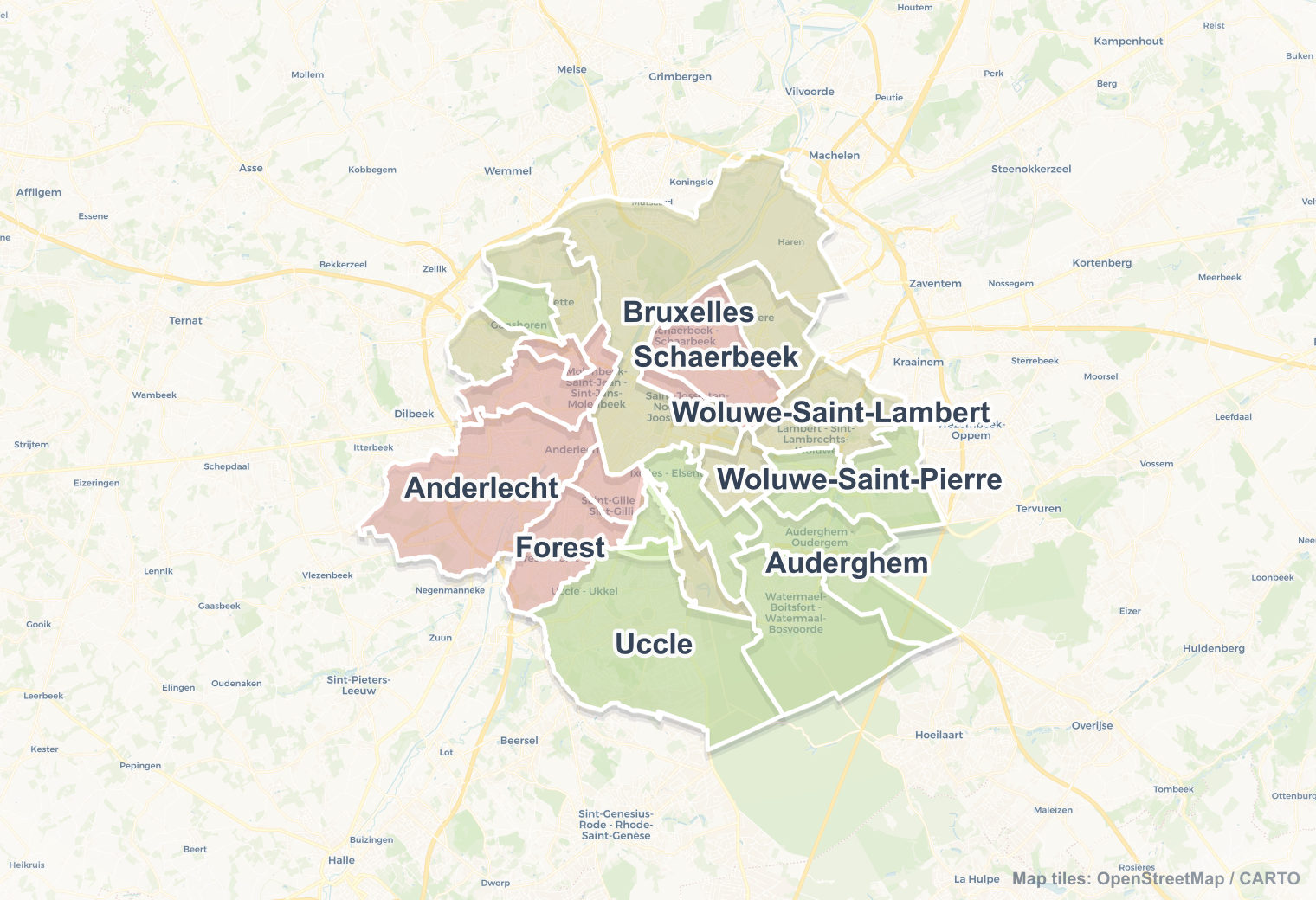
Brussels' average safety score of 56.2/100 indicates a mixed safety profile for visitors. This suggests areas of concern exist alongside relatively safer zones, making district awareness crucial for a smooth trip. It is not a city where safety can be assumed uniformly across all neighborhoods.
Use this shortlist to choose an area first, then compare the exact district on the map. Brussels is generally safe, but pickpocketing is common in tourist areas.
Safety posture
Score range
24/100 to 84/100
Primary risk
pickpocketing, crowds, and tourist-targeted friction
Map signals
Stable districts: Woluwe-Saint-Pierre, Uccle, and Auderghem.
Night-risk check: Woluwe-Saint-Pierre, Uccle, and Auderghem.
Use the Brussels safety map to compare safety scores, night-risk signals, and the difference between stable districts and areas that need more caution.
Interactive map
Interactive district safety map of Brussels
Click a district to see details, compare scores, and avoid booking in weaker areas. District tooltips show the neighborhood name, and the detail panel updates instantly.
Safety districts
Active district
Watermael-Boitsfort
Good | score 82
Brussels
Watermael-Boitsfort
Good
Watermael-Boitsfort is a quiet, leafy commune in the southeast of Brussels, bordering the Forêt de Soignes. It is one of the safest and most pleasant communes in the region, with a village-like atmosphere, low crime, and excellent access to nature. Very limited tourist infrastructure but an excellent choice for visitors prioritising safety and tranquillity.
Travel score
82
Safety
76
Transport
54
Community
82
Key strengths
one of the safest communes in the Brussels Capital Region
village-like atmosphere with low crime
direct access to Forêt de Soignes
very low night risk
quiet and family-friendly
Points to consider
poor transport links to city centre
very limited hotel options
not suitable as a base for visitors primarily focused on central Brussels sightseeing
Choose two districts and compare them side by side before booking. The tool highlights overall score, safety, transport, accommodation, night risk, and the practical trade-offs that matter most for a stay base.
Watermael-Boitsfort is a quiet, leafy commune in the southeast of Brussels, bordering the Forêt de Soignes. It is one of the safest and most pleasant communes in the region, with a village-like atmosphere, low crime, and excellent access to nature. Very limited tourist infrastructure but an excellent choice for visitors prioritising safety and tranquillity.
Sightseeing
Strengths
+ one of the safest communes in the Brussels Capital Region
+ village-like atmosphere with low crime
+ direct access to Forêt de Soignes
Watch-outs
- poor transport links to city centre
- very limited hotel options
- not suitable as a base for visitors primarily focused on central Brussels sightseeing
Woluwe-Saint-Pierre is the most affluent commune in the Brussels Capital Region and consistently one of the safest. It has a spacious, leafy character with elegant villas, large parks, and excellent quality of life. Burglaries are down 59% since 2014 according to Belgian police data. It is the closest Brussels equivalent to London's Richmond or Amsterdam's Zuid — an upscale residential area that functions well as a safe tourist base.
Sightseeing
Strengths
+ safest or joint-safest commune in the Brussels Capital Region
+ burglaries down 59% versus 2014 — second best improvement after Uccle
+ spacious, elegant streets with very low street crime
Watch-outs
- transport to Grand Place takes 30–40 minutes
- very limited hotel options; mostly short-term rentals
Best single read for choosing a low-friction tourist base.
82/10078/100Watermael-Boitsfort +4
Safety
How comfortable the area is likely to feel for a typical visitor.
76/10084/100Woluwe-Saint-Pierre +8
Sightseeing convenience
Access to major attractions, useful streets, and visitor-friendly movement.
38/10046/100Woluwe-Saint-Pierre +8
Transport
How easy it is to arrive, leave, and move around the city.
54/10062/100Woluwe-Saint-Pierre +8
Accommodation
Hotel and apartment practicality for a short stay.
50/10060/100Woluwe-Saint-Pierre +10
Night risk
Lower is better. Use this when late returns matter.
44/10036/100Woluwe-Saint-Pierre +8
Community signal
Extra signal from user reviews where enough data exists.
82/10078/100Watermael-Boitsfort +4
Safety Guide
Brussels safety overview
Brussels' average safety score of 56.2/100 indicates a mixed safety profile for visitors. This suggests areas of concern exist alongside relatively safer zones, making district awareness crucial for a smooth trip. It is not a city where safety can be assumed uniformly across all neighborhoods.
The primary risks in Brussels revolve around station-area friction and late-route checks, especially during transit. This often involves petty crime or low-level harassment around major transport hubs and when returning to accommodations at night.
With a wide safety score spread of 54 points between the best and worst districts, choosing your accommodation location in Brussels matters significantly. Staying in a higher-scoring area can drastically improve your personal safety experience compared to a lower-scoring one.
Brussels safety guide
Watermael-Boitsfort, with a safety score of 76, represents one of Brussels' safest areas, offering a tranquil environment with low crime. For visitors prioritizing peace and security, particularly those less concerned with central tourist hubs, it presents an excellent base.
A safety score of 80+ like Uccle (80) or Woluwe-Saint-Pierre (84) indicates very low crime rates and a consistently secure environment, even at night. Districts in the 60-70 range are generally safe but may have more isolated incidents or less robust night safety, requiring a bit more awareness.
Visitors often underestimate how uneven safety is across Brussels; the data reveals 13 out of 20 districts are flagged for caution or avoidance. This wide variance means that relying on general city perceptions rather than specific district research can lead to unexpected safety issues.
Brussels at night
Night safety in Brussels is mixed; while affluent districts like Woluwe-Saint-Pierre (night 36) are relatively secure, a substantial 35% of districts score low at night. This necessitates checking night safety for specific areas rather than assuming general safety across the city.
For evening logistics, prioritize using reliable ride-shares or taxis for arrivals and returns, especially from train stations or to accommodations in less familiar areas. If returning solo, stick to well-lit, busy routes and confirm your chosen district's night safety score beforehand.
The night risk data reveals a distinct divide: some areas are genuinely unsafe after dark, particularly those near transport hubs and flagged caution districts. Visitors should factor this into accommodation booking, aiming for higher-scoring districts to ensure safer evening returns.
FAQ
Brussels safety FAQ
Which Brussels districts are safest for a tourist stay?
Woluwe-Saint-Pierre (safety 84), Uccle (safety 80), and Watermael-Boitsfort (safety 76) are consistently among the safest districts in Brussels. These areas offer significantly lower crime rates and a more secure environment for visitors.
What are the primary safety concerns for visitors in Brussels?
The primary risks for visitors in Brussels are station-area friction and late-route checks. This includes petty crime around major transport hubs and potential issues when navigating back to accommodation after dark, especially in lower-scoring districts.
Which Brussels districts should tourists avoid for safety reasons?
Tourists should avoid Anderlecht (safety 32), Saint-Josse-ten-Noode (safety 26), and Molenbeek-Saint-Jean (safety 24). These districts consistently show high crime rates, drug activity, and are generally considered unsafe even during the day in parts.
Is Brussels safe to walk around at night?
Night safety in Brussels varies considerably by district; 35% of districts score low at night, meaning many areas are not safe after dark. It is advisable to research the specific district's night safety score and use caution when walking, especially outside of well-lit, higher-scoring areas.