SafetyMap

District-level city safety maps, stay-area guidance, and neighborhood summaries for travelers who want to choose better areas before booking.

© 2026 SafetyMap. All rights reserved.

HomeCitiesMethodologyRoadmapSupport
SafetyMap
United Kingdom/London
OverviewMapDistrict comparisonBooking GuideFAQ
United Kingdom

Is London Safe? Best Areas to Stay (2026 Guide)

London scores 77.1/100 for safety, placing it in the safe category for a major capital city. This means standard urban precautions apply, but violent crime against tourists is uncommon and most visits pass without incident.

Use this shortlist to choose an area first, then compare the exact district on the map. London is generally safe, but pickpocketing is common in tourist areas.

Safety posture

Score range
55/100 to 90/100
Primary risk
pickpocketing, crowds, and tourist-targeted friction

Map signals

Stable districts: Kensington and Chelsea, Richmond upon Thames, and City of London.

Night-risk check: Kensington and Chelsea, Richmond upon Thames, and City of London.

Explore them on the map:

See safest areas on the map

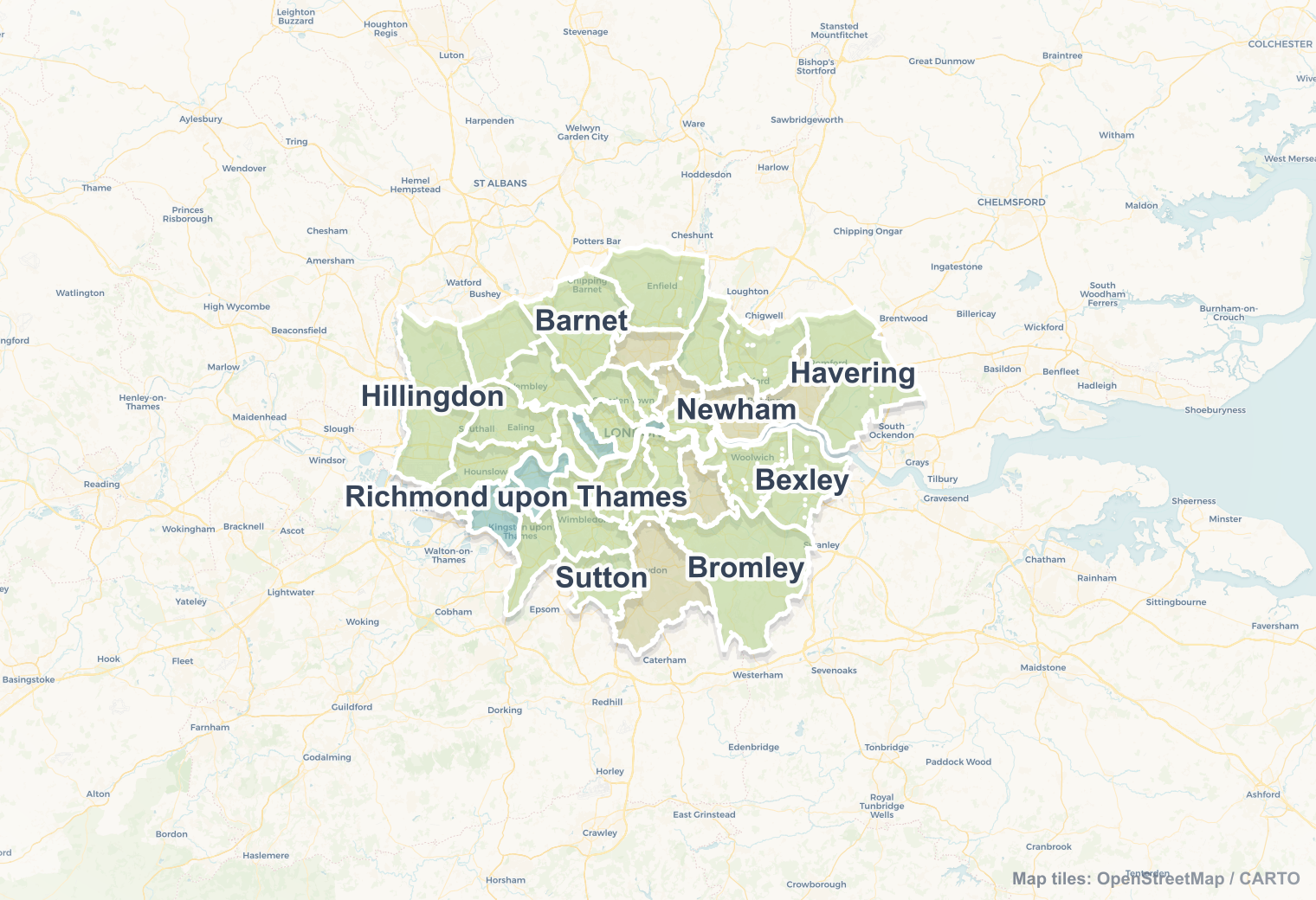
London safety map

Tap a district to see its safety score and night risk level.

London safety map showing safe areas and districts to check before booking
Excellent
Good
Use caution

Safety overview

City-level safety posture

Score range
55/100 to 90/100
Primary risk
pickpocketing, crowds, and tourist-targeted friction
Decision check
Kensington and Chelsea set the baseline, while Barking and Dagenham needs stricter exact-address checks.

Stable districts

Stronger safety signals

Kensington and Chelsea - 90/100Richmond upon Thames - 90/100City of London - 90/100

Night risk

Areas to check after dark

Kensington and Chelsea - night score 30/100Richmond upon Thames - night score 30/100City of London - night score 30/100

Map of London districts

Use the London safety map to compare safety scores, night-risk signals, and the difference between stable districts and areas that need more caution.

Interactive map

Interactive district safety map of London

Click a district to see details, compare scores, and avoid booking in weaker areas. District tooltips show the neighborhood name, and the detail panel updates instantly.

Safety districts

Active district

Kensington and Chelsea

Excellent | score 90

London

Kensington and Chelsea

Excellent

Upscale central borough with luxury living.

Travel score

90

Safety

90

Transport

90

Community

90

Key strengths

  • Very safe.
  • Top tourist area.
  • Luxury environment.

Points to consider

  • Very safe.
  • Top tourist area.
  • Luxury environment.
SightseeingFamiliesBudget staysNightlife
Open full district profileAdd your opinion

District ranking

33 results

ExpandCollapse

District Comparison

District comparison in London

Choose two districts and compare them side by side before booking. The tool highlights overall score, safety, transport, accommodation, night risk, and the practical trade-offs that matter most for a stay base.

ExpandCollapse
DistrictSafetyVibeBest for
Kensington and Chelsea90/100LivelyFamilies
Richmond upon Thames90/100LivelyFamilies
City of London90/100LocalFamilies
Kingston upon Thames85/100QuietFamilies
Bexley85/100LocalFamilies

Kensington and Chelsea

Travel score 90/100

Excellent

Upscale central borough with luxury living.

SightseeingFamiliesBudget stays

Strengths

  • + Very safe.
  • + Top tourist area.
  • + Luxury environment.

Watch-outs

  • - Very safe.
  • - Top tourist area.
  • - Luxury environment.
Open Kensington and Chelsea

Richmond upon Thames

Travel score 90/100

Excellent

Green and affluent riverside borough.

SightseeingFamiliesBudget stays

Strengths

  • + Very safe.
  • + Beautiful parks.
  • + Riverside views.

Watch-outs

  • - Expensive.
  • - Far from center.
  • - Calm nightlife.
Open Richmond upon Thames
MetricKensington and ChelseaRichmond upon ThamesGap

Overall travel score

Best single read for choosing a low-friction tourist base.

90/10090/100Tie

Safety

How comfortable the area is likely to feel for a typical visitor.

90/10090/100Tie

Sightseeing convenience

Access to major attractions, useful streets, and visitor-friendly movement.

95/10085/100Kensington and Chelsea +10

Transport

How easy it is to arrive, leave, and move around the city.

90/10080/100Kensington and Chelsea +10

Accommodation

Hotel and apartment practicality for a short stay.

95/10085/100Kensington and Chelsea +10

Night risk

Lower is better. Use this when late returns matter.

30/10030/100Tie

Community signal

Extra signal from user reviews where enough data exists.

90/10090/100Tie

Safety Guide

London safety overview

London scores 77.1/100 for safety, placing it in the safe category for a major capital city. This means standard urban precautions apply, but violent crime against tourists is uncommon and most visits pass without incident.

The primary risk pattern in London is night-time comfort rather than daytime safety—70% of districts score low after dark, making late-evening route planning more important than general neighborhood avoidance. Transport safety is strong at 82.9/100, so getting around during the day is straightforward across most areas.

The 31-point spread between best and worst districts means location choice matters significantly in London. Staying in Richmond upon Thames (safety 90) versus Barking and Dagenham (safety 55) creates a measurably different experience, so district research is worth the effort.

London safety guide

City of London scores 90 for safety with 95 for transport, making it the statistically strongest district, though its role as a financial district means limited residential appeal and extremely low night scores (30). For a pure safety-first stay with daytime focus, it's the top choice by the numbers.

In London, the gap between 80+ districts and 60-70 districts shows up in visible street conditions and policing presence—areas like Kensington and Chelsea (safety 90) have consistent patrols and well-maintained public spaces, while districts scoring 60 like Newham show more variable conditions block by block. You'll notice the difference walking around, especially after 8 PM.

Visitors often assume central London is uniformly safe, but the data shows night scores of 30 even in premium districts like Kensington and Chelsea. High daytime safety doesn't predict nighttime comfort in London—you need to check both metrics separately for any district.

Read risk by district in London

Safety risk across London's 33 districts is moderately concentrated, with 6 districts flagged for caution or avoidance and most others clustering in the 70-85 range. The gap isn't extreme, but the flagged areas are geographically clustered in east and south London rather than scattered randomly.

With 70% of districts scoring low at night (including all three top-rated areas), London presents a city-wide pattern where evening safety drops significantly after dark regardless of daytime scores. This means planning return routes from restaurants or theaters requires active thought even in supposedly safe neighborhoods, not just avoiding bad areas.

Newham (safety 60) and Croydon (safety 60) earn caution flags due to ongoing redevelopment leaving pockets of neglect and mixed street conditions, while Barking and Dagenham (safety 55) reflects lower-income demographics and fewer tourist-facing services. These aren't no-go zones, but they require more situational awareness and don't offer compelling reasons for visitors to book accommodation there.

London at night

Night safety in London is the city's weak point, with 70% of districts scoring low after dark including all top-tier areas like City of London, Richmond upon Thames, and Kensington and Chelsea (all night score 30). The safest daytime neighborhoods don't stay that way at night, so evening plans need separate vetting regardless of where you're staying.

For evening logistics, book accommodations near major transport hubs rather than assuming your safe daytime district will feel comfortable at 11 PM—late returns from central London to outer boroughs can involve long walks from stations through poorly lit areas. Solo returns after 10 PM warrant pre-booked rides or well-researched walking routes even in high-scoring districts.

The data reveals that London's night risk is structural rather than neighborhood-specific—even Richmond upon Thames with its 90 daytime safety score drops to 30 at night. This means you can't solve the night safety question purely through accommodation choice; you need tactical planning for every evening outing regardless of where you stay.

Other cities in United Kingdom

Compare London with other city safety maps and where-to-stay guides in the same country. If you are also visiting Birmingham, check where to stay in Birmingham.

Birmingham

Open the where-to-stay guide and district ranking for Birmingham.

Edinburgh

Open the where-to-stay guide and district ranking for Edinburgh.

Liverpool

Open the where-to-stay guide and district ranking for Liverpool.

Manchester

Open the where-to-stay guide and district ranking for Manchester.

Read risk by district

Do not reduce London to one safe/unsafe label. Compare the score range, night-risk pattern, and exact district profile before judging the stay area.

A lower score usually means less margin for a weak street, late return, or poorly connected address.

FAQ

London safety FAQ

Which London district is safest for first-time visitors?

City of London scores highest at 90 for safety with 95 for transport, making it statistically safest, though it's a business district with limited residential options. For a more residential feel with the same 90 safety score, Kensington and Chelsea or Richmond upon Thames offer better accommodation choices while maintaining top-tier daytime safety.

Is it safe to walk in London at night?

70% of London districts score low for night safety, including all top-rated areas like Kensington and Chelsea and Richmond upon Thames (all night score 30). Walking at night requires route-specific research and situational awareness even in high daytime safety districts, particularly after 10 PM when street activity drops off significantly.

Should I avoid Newham, Croydon, or Barking and Dagenham?

These districts score 60, 60, and 55 respectively and are flagged for caution rather than complete avoidance. They're workable for budget-conscious travelers who stay alert, but they don't offer compelling tourist draws and require more careful route planning, especially at night, compared to central options scoring 80+.

Does London's 31-point score spread mean some areas are dangerous?

The 31-point spread (from 90 in City of London to 55 in Barking and Dagenham) indicates significant variation but not extreme danger zones. Even the lowest-scoring areas are manageable with awareness; the spread mainly tells you that district choice materially affects your daily comfort level and how much active safety planning you'll need to do.