First time
VorstädteVorstädte is the cleanest first base: safety 90/100, transport 92/100, and fewer avoidable arrival mistakes.
Bachletten (safety 93, transport 85) works best for first-timers who want residential calm without sacrificing connectivity. The good transport network across Basel means you can stay in quieter areas like this and still reach the city center efficiently, unlike cities where patchy transit forces you into tourist zones.
Use this shortlist to choose an area first, then compare the exact district on the map. Basel is generally safe, but pickpocketing is common in tourist areas.
First time
VorstädteVorstädte is the cleanest first base: safety 90/100, transport 92/100, and fewer avoidable arrival mistakes.
Family
Am RingAm Ring gives families the stronger calm-and-access trade-off, with safety 90/100 and night score 30/100.
Budget
WettsteinUse Wettstein as the value check only if the exact stay keeps transport clear; do not trade down toward Matthäus for price alone.
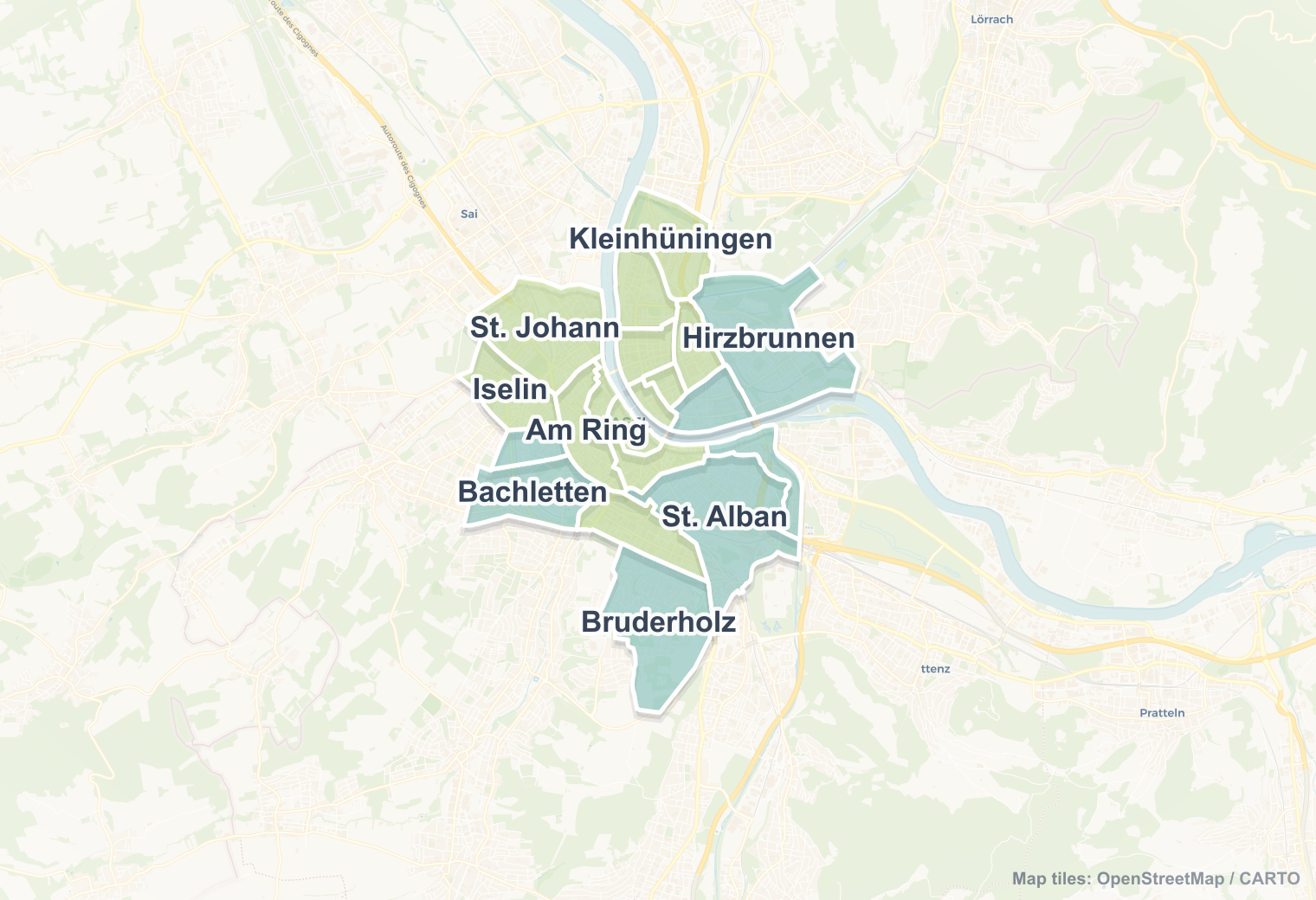
Explore them on the map:
See safest areas on the mapBasel safety map
Use the map to compare districts before deciding where to book.
Stay decision guide
First time
VorstädteVorstädte is the cleanest first base: safety 90/100, transport 92/100, and fewer avoidable arrival mistakes.
Family
Am RingAm Ring gives families the stronger calm-and-access trade-off, with safety 90/100 and night score 30/100.
Budget
WettsteinUse Wettstein as the value check only if the exact stay keeps transport clear; do not trade down toward Matthäus for price alone.
Use the Basel map as a decision tool before booking. Compare safety, transport, attraction access, and budget trade-offs district by district.
Interactive map
Click a district to see details, compare scores, and avoid booking in weaker areas. District tooltips show the neighborhood name, and the detail panel updates instantly.
Active district
Hirzbrunnen
Excellent | score 93
Basel
Quiet residential district in the eastern part of Basel, near Badischer Bahnhof. Suburban feel with greenery, low noise, and well-maintained housing. Not tourist-focused.
Travel score
93
Safety
93
Transport
80
Community
93
Key strengths
Points to consider
19 results
District Comparison
Choose two districts and compare them side by side before booking. The tool highlights overall score, safety, transport, accommodation, night risk, and the practical trade-offs that matter most for a stay base.
| District | Safety | Vibe | Best for |
|---|---|---|---|
| Hirzbrunnen | 93/100 | Local | Families |
| Bruderholz | 95/100 | Local | Families |
| Bachletten | 93/100 | Local | Families |
| Gotthelf | 92/100 | Local | Families |
| St. Alban | 92/100 | Local | Families |
Travel score 93/100
Quiet residential district in the eastern part of Basel, near Badischer Bahnhof. Suburban feel with greenery, low noise, and well-maintained housing. Not tourist-focused.
Strengths
Watch-outs
Travel score 92/100
Upscale residential district on a hillside south of Basel. Low-density, green, and very quiet. Known for villas, parks, and panoramic views. One of the most exclusive and calm areas in the city.
Strengths
Watch-outs
Overall travel score
Best single read for choosing a low-friction tourist base.
Safety
How comfortable the area is likely to feel for a typical visitor.
Sightseeing convenience
Access to major attractions, useful streets, and visitor-friendly movement.
Transport
How easy it is to arrive, leave, and move around the city.
Accommodation
Hotel and apartment practicality for a short stay.
Night risk
Lower is better. Use this when late returns matter.
Community signal
Extra signal from user reviews where enough data exists.
Stay Decision Guide
Bachletten (safety 93, transport 85) works best for first-timers who want residential calm without sacrificing connectivity. The good transport network across Basel means you can stay in quieter areas like this and still reach the city center efficiently, unlike cities where patchy transit forces you into tourist zones.
Basel's compact layout and good transport tier make district choice more about atmosphere than access logistics. The moderate 18-point safety spread across districts means most areas are viable, but the universal low night scores mean your evening return route matters more than which neighborhood you pick.
Check your accommodation's proximity to a tram or bus stop that runs late, not just daytime connections. Basel's good transport during the day doesn't fully offset the night risk factor — every district scores low after dark, so a well-lit 5-minute walk from a night-service stop matters more than being in a "better" district.
Bachletten (safety 93, transport 85, night 27) suits families best with its residential calm, green spaces near Zoo Basel, and strong daytime transport that compensates for the low night score since families typically return earlier. The family-oriented environment and organized layout make it practical for traveling with children despite Switzerland's high accommodation costs.
Solo travelers should prioritize Bachletten or Hirzbrunnen (safety 93, transport 80) where high daytime safety and decent transport connections matter most, while accepting that night exploration across Basel requires the same caution regardless of base district. The universal low night scores mean solo travelers gain nothing safety-wise by paying more for central locations after dark.
Hirzbrunnen and the residential belt east of Badischer Bahnhof offer the best value-to-safety ratio in Basel, with top-tier safety scores (93) in non-tourist areas where accommodation typically costs less. No districts are flagged for caution, so budget travelers can focus on transport connectivity (good across the city) rather than avoiding specific areas.
The central Altstadt and Grossbasel districts put you nearest to the Rhine, museums, and Old Town attractions, though the data shows these areas don't score significantly higher than outer districts for overall safety. The access advantage is real but modest given Basel's good transport tier that connects outer areas efficiently.
Central Basel doesn't carry the safety penalties seen in larger cities — the 18-point spread means staying central versus staying in Bruderholz (safety 95) is a difference in degree, not kind. The universal low night scores across all 19 districts mean even premium central locations face the same after-dark caution as residential areas.
Basing in Bachletten or Hirzbrunnen makes sense when you want residential quiet and marginally lower costs without sacrificing much access time. You gain better daytime environments and often better value, while giving up perhaps 10-15 minutes of travel time to major sights thanks to Basel's good transport network.
Hirzbrunnen near Badischer Bahnhof and the eastern residential districts offer strong safety scores (93) in areas where tourist accommodation costs less than central zones. The suburban feel and distance from tourist infrastructure typically translate to lower nightly rates without crossing into any flagged caution territory.
Basel's safety-price tradeoff is gentler than most cities — even value-focused districts like Hirzbrunnen score 93 for safety, just 2 points below top-scoring Bruderholz. The moderate score spread means you're trading atmosphere and slight transport convenience for cost savings, not trading away meaningful safety margins.
Check the evening tram or bus schedule from your specific stop before booking budget accommodation in outer districts. Basel's good daytime transport can thin out at night, and with 100% of districts scoring low for night safety, the difference between a 10-minute and 25-minute wait at a poorly-lit stop becomes your actual safety variable.
Even without flagged caution zones, unusually low prices in Basel should prompt checking the specific street's evening lighting and the walking distance to your nearest transport stop. The universal low night scores mean every district becomes less comfortable after dark, so a bargain rate five blocks from a tram line can create more night-risk exposure than a standard-priced option near a stop.
Low prices in Basel typically signal distance from tourist infrastructure or fewer evening dining options nearby, not dangerous areas — but the night-score data shows comfort drops across the city after dark. When a rate seems too good, the "why" is usually isolation or inconvenient last-leg walks, which matter more in a city where no districts score well at night.
Before booking anywhere in Basel, map your evening return from the main nightlife or restaurant areas to your specific address. The good transport tier works well until services thin out late, and with every district scoring low at night (highest is just 27), your safety perception depends more on your individual route — stop to door — than the district's overall reputation.
FAQ
Basel's 86.8 overall safety score reflects excellent daytime conditions, but all 19 districts score below 27 for night safety due to reduced foot traffic, thinner late transport service, and darker residential streets. The night-risk factor is about comfort and route planning rather than crime — even top districts like Bruderholz (safety 95) drop to 25 at night because of isolation and lighting, not danger.
The 84.6 transport score means daytime connectivity is strong across Basel's 19 districts, giving you real flexibility to base outside the center without access penalties. However, good transport doesn't eliminate the universal low night scores — late-service frequency and the walk from your stop to your door become the limiting factors for evening returns, not the district you choose.
Bruderholz scores highest for safety (95) but lowest for transport (75) among top districts because of its hillside location and residential exclusivity. It works for travelers prioritizing quiet, green surroundings and daytime safety over evening spontaneity, but the transport tradeoff and night score of 25 mean you'll plan returns more carefully than from Bachletten (transport 85).
No districts in Basel are flagged for caution or avoidance — the moderate 18-point safety spread means all 19 areas are viable for accommodation. The decision comes down to transport convenience, residential versus urban feel, and your specific evening return route rather than avoiding dangerous zones, which don't exist in Basel's data profile.