First time
Ixelles / ElseneIxelles / Elsene is the cleanest first base: safety 73/100, transport 80/100, and fewer avoidable arrival mistakes.
Watermael-Boitsfort, Woluwe-Saint-Pierre, and Uccle are excellent choices for first-time visitors prioritizing safety and a calm environment. Despite their transport scores (54-62) being average, they offer a secure base far from the city's higher-risk areas.
Use this shortlist to choose an area first, then compare the exact district on the map. Brussels is generally safe, but pickpocketing is common in tourist areas.
First time
Ixelles / ElseneIxelles / Elsene is the cleanest first base: safety 73/100, transport 80/100, and fewer avoidable arrival mistakes.
Family
Woluwe-Saint-PierreWoluwe-Saint-Pierre gives families the stronger calm-and-access trade-off, with safety 84/100 and night score 36/100.
Budget
IxellesUse Ixelles as the value check only if the exact stay keeps transport clear; do not trade down toward Molenbeek-Saint-Jean for price alone.
Explore them on the map:
See safest areas on the mapBrussels safety map
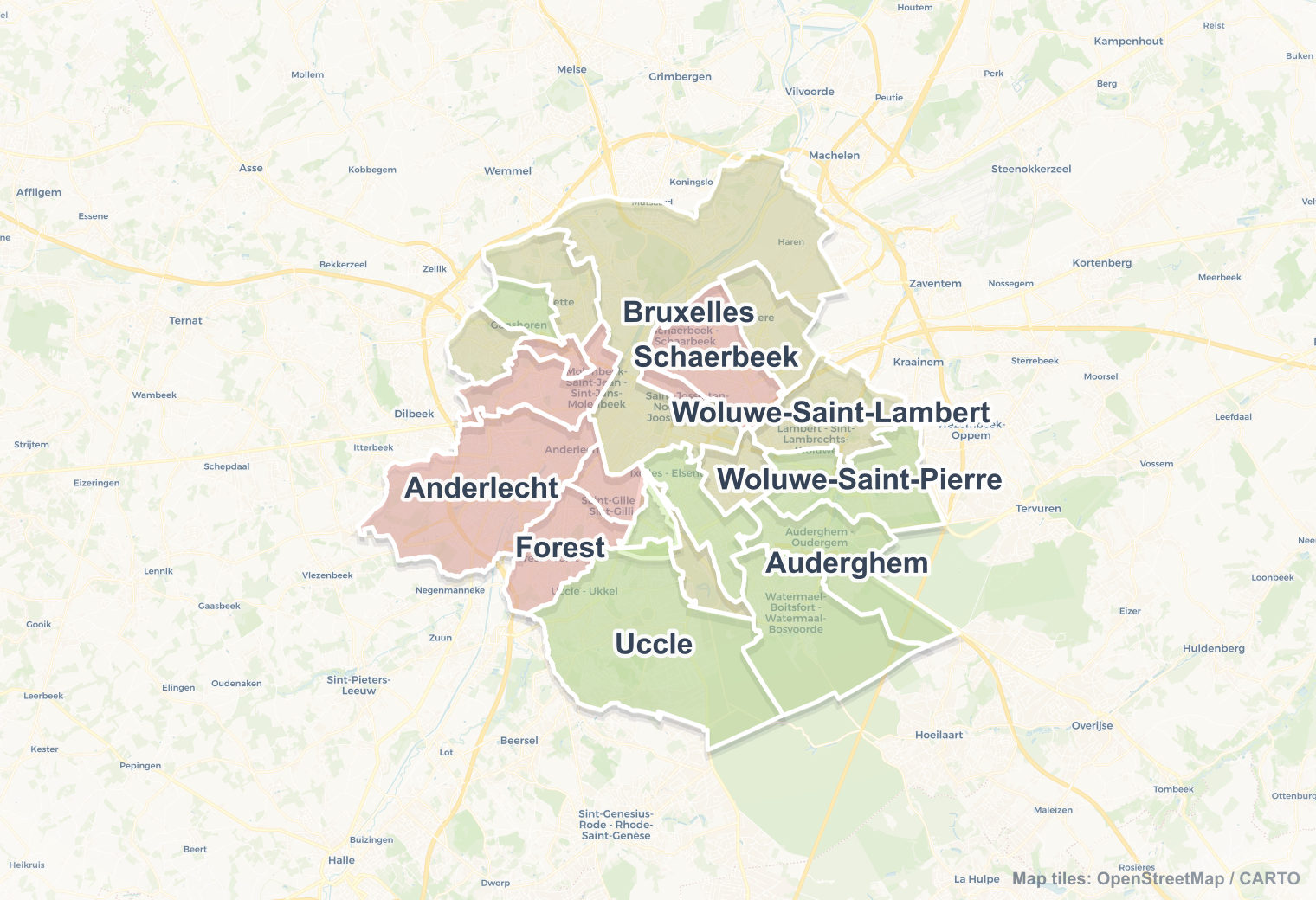
Use the map to compare districts before deciding where to book.
Stay decision guide
First time
Ixelles / ElseneIxelles / Elsene is the cleanest first base: safety 73/100, transport 80/100, and fewer avoidable arrival mistakes.
Family
Woluwe-Saint-PierreWoluwe-Saint-Pierre gives families the stronger calm-and-access trade-off, with safety 84/100 and night score 36/100.
Budget
IxellesUse Ixelles as the value check only if the exact stay keeps transport clear; do not trade down toward Molenbeek-Saint-Jean for price alone.
Use the Brussels map as a decision tool before booking. Compare safety, transport, attraction access, and budget trade-offs district by district.
Interactive map
Click a district to see details, compare scores, and avoid booking in weaker areas. District tooltips show the neighborhood name, and the detail panel updates instantly.
Active district
Watermael-Boitsfort
Good | score 82
Brussels
Watermael-Boitsfort is a quiet, leafy commune in the southeast of Brussels, bordering the Forêt de Soignes. It is one of the safest and most pleasant communes in the region, with a village-like atmosphere, low crime, and excellent access to nature. Very limited tourist infrastructure but an excellent choice for visitors prioritising safety and tranquillity.
Travel score
82
Safety
76
Transport
54
Community
82
Key strengths
Points to consider
20 results
District Comparison
Choose two districts and compare them side by side before booking. The tool highlights overall score, safety, transport, accommodation, night risk, and the practical trade-offs that matter most for a stay base.
| District | Safety | Vibe | Best for |
|---|---|---|---|
| Watermael-Boitsfort | 76/100 | Local | First-time visitors |
| Woluwe-Saint-Pierre | 84/100 | Local | First-time visitors |
| Uccle | 80/100 | Local | First-time visitors |
| Ixelles / Elsene | 73/100 | Balanced | Value stays |
| Auderghem | 78/100 | Local | First-time visitors |
Travel score 82/100
Watermael-Boitsfort is a quiet, leafy commune in the southeast of Brussels, bordering the Forêt de Soignes. It is one of the safest and most pleasant communes in the region, with a village-like atmosphere, low crime, and excellent access to nature. Very limited tourist infrastructure but an excellent choice for visitors prioritising safety and tranquillity.
Strengths
Watch-outs
Travel score 78/100
Woluwe-Saint-Pierre is the most affluent commune in the Brussels Capital Region and consistently one of the safest. It has a spacious, leafy character with elegant villas, large parks, and excellent quality of life. Burglaries are down 59% since 2014 according to Belgian police data. It is the closest Brussels equivalent to London's Richmond or Amsterdam's Zuid — an upscale residential area that functions well as a safe tourist base.
Strengths
Watch-outs
Overall travel score
Best single read for choosing a low-friction tourist base.
Safety
How comfortable the area is likely to feel for a typical visitor.
Sightseeing convenience
Access to major attractions, useful streets, and visitor-friendly movement.
Transport
How easy it is to arrive, leave, and move around the city.
Accommodation
Hotel and apartment practicality for a short stay.
Night risk
Lower is better. Use this when late returns matter.
Community signal
Extra signal from user reviews where enough data exists.
Stay Decision Guide
Watermael-Boitsfort, Woluwe-Saint-Pierre, and Uccle are excellent choices for first-time visitors prioritizing safety and a calm environment. Despite their transport scores (54-62) being average, they offer a secure base far from the city's higher-risk areas.
The city presents a challenge due to its wide safety score spread (54 points) and patchy transport system (avg 66.8/100), making careful district selection crucial. Navigating between safe, tranquil residential areas and key attractions requires awareness of specific routes and district profiles.
First-time visitors should prioritize evening routes to their accommodation, especially considering the medium night risk and issues near station areas. Verifying the safety of the specific street and immediate vicinity for late returns is advisable due to Brussels's varied district safety.
Woluwe-Saint-Pierre (safety 84, night 36) stands out for families due to its exceptional safety and tranquil, leafy character. Its high safety score and good night-time environment provide peace of mind, despite requiring more planning for transport to central attractions (transport 62).
For solo travelers, Uccle (safety 80, night 40) offers a secure and pleasant environment with a strong expat community and low crime rates. While transport (60) requires attention, particularly after dark, its overall safety profile makes it a reassuring base.
Budget travelers seeking value without entering caution territory should look for districts with safety scores above the city average of 56.2, avoiding the 13 flagged caution/avoid districts. This strategy ensures a balance between cost-efficiency and personal security, rather than opting for the absolute lowest prices in high-risk zones.
While specific central districts are not rated here, areas immediately surrounding the Grand Place offer direct access to main attractions. The trade-off for central proximity in Brussels is often a more varied safety profile and increased exposure to potential issues near major transport hubs.
Central locations can introduce safety and comfort costs, especially after dark or in areas adjacent to major transport points, as indicated by the medium night risk and primary risk of station-area friction. Districts like Saint-Josse-ten-Noode (safety 26) near Gare du Nord exemplify these concerns.
Basing slightly further out in districts like Woluwe-Saint-Pierre or Uccle makes sense for those prioritizing safety and tranquility over immediate proximity to sights. You gain significantly higher safety scores and a quieter environment, but may experience longer travel times due to patchy transport (avg 66.8/100).
To find value without dropping into caution territory, consider districts that maintain safety scores above the Brussels average of 56.2 but are not among the most affluent. These intermediate areas often exist just outside the top-tier residential zones, offering a sensible compromise.
The safety-vs-price tradeoff in Brussels is stark, with a wide score spread (54 points) and 13 out of 20 districts flagged caution or avoid. Districts with safety scores significantly below the average, such as Molenbeek-Saint-Jean (safety 24) or Anderlecht (safety 32), often present lower prices but critically higher risks.
When choosing budget accommodation, always verify the transport stop and the safety of the immediate street and evening route to the property. Given the patchy transport and medium night risk, a seemingly good price can quickly be negated by an unsafe or inconvenient return journey.
Areas like Molenbeek-Saint-Jean (safety 24), Saint-Josse-ten-Noode (safety 26), and Anderlecht (safety 32) frequently offer cheaper accommodation but come with significant safety tradeoffs. These districts are associated with high crime rates, including drug-related activity and street violence, making them unsuitable as tourist bases.
A price that seems unusually low in Brussels should trigger a check of the district's safety score and proximity to known high-risk areas. Districts with very low safety scores (e.g., below 35) or those near major stations and identified as 'avoid' in police statistics often present these enticing but misleading prices.
Before booking, critically assess what the evening return route from central attractions to the accommodation will entail, especially considering Brussels's medium night risk and patchy transport. Understanding the specific streets and public transport stops involved is crucial for ensuring personal safety after dark.
FAQ
Brussels has a mixed safety profile (avg 56.2/100) with a wide score spread. Prioritize districts like Woluwe-Saint-Pierre (safety 84), Uccle (safety 80), and Watermael-Boitsfort (safety 76) for their consistently high safety ratings and tranquil environments.
Brussels' patchy transport (avg 66.8/100) means that while central locations offer convenience to attractions, they can involve higher risks near station areas. When staying in safer, more suburban districts, careful planning of evening routes is essential due to medium night risk and potential late-route checks.
Avoid districts explicitly flagged with low safety scores such as Molenbeek-Saint-Jean (safety 24), Saint-Josse-ten-Noode (safety 26), and Anderlecht (safety 32). These areas exhibit significantly higher crime rates and are not recommended for tourist accommodation.
The primary safety concern in Brussels is station-area friction and late-route checks, particularly given the medium night risk where 35% of districts score low after dark. Always verify the safety of your route and immediate surroundings when returning to your accommodation in the evening.