First time
Kensington and ChelseaKensington and Chelsea is the cleanest first base: safety 90/100, transport 90/100, and fewer avoidable arrival mistakes.
Kensington and Chelsea (safety 90, transport 90) works best for first-timers who want central access without compromising safety standards. The combination of excellent Tube connectivity and pedestrian-friendly streets means you can reach major sights quickly while having solid transport options when returning late.
Use this shortlist to choose an area first, then compare the exact district on the map. London is generally safe, but pickpocketing is common in tourist areas.
First time
Kensington and ChelseaKensington and Chelsea is the cleanest first base: safety 90/100, transport 90/100, and fewer avoidable arrival mistakes.
Family
City of LondonCity of London gives families the stronger calm-and-access trade-off, with safety 90/100 and night score 30/100.
Budget
WestminsterUse Westminster as the value check only if the exact stay keeps transport clear; do not trade down toward Barking and Dagenham for price alone.
Explore them on the map:
See safest areas on the mapLondon safety map
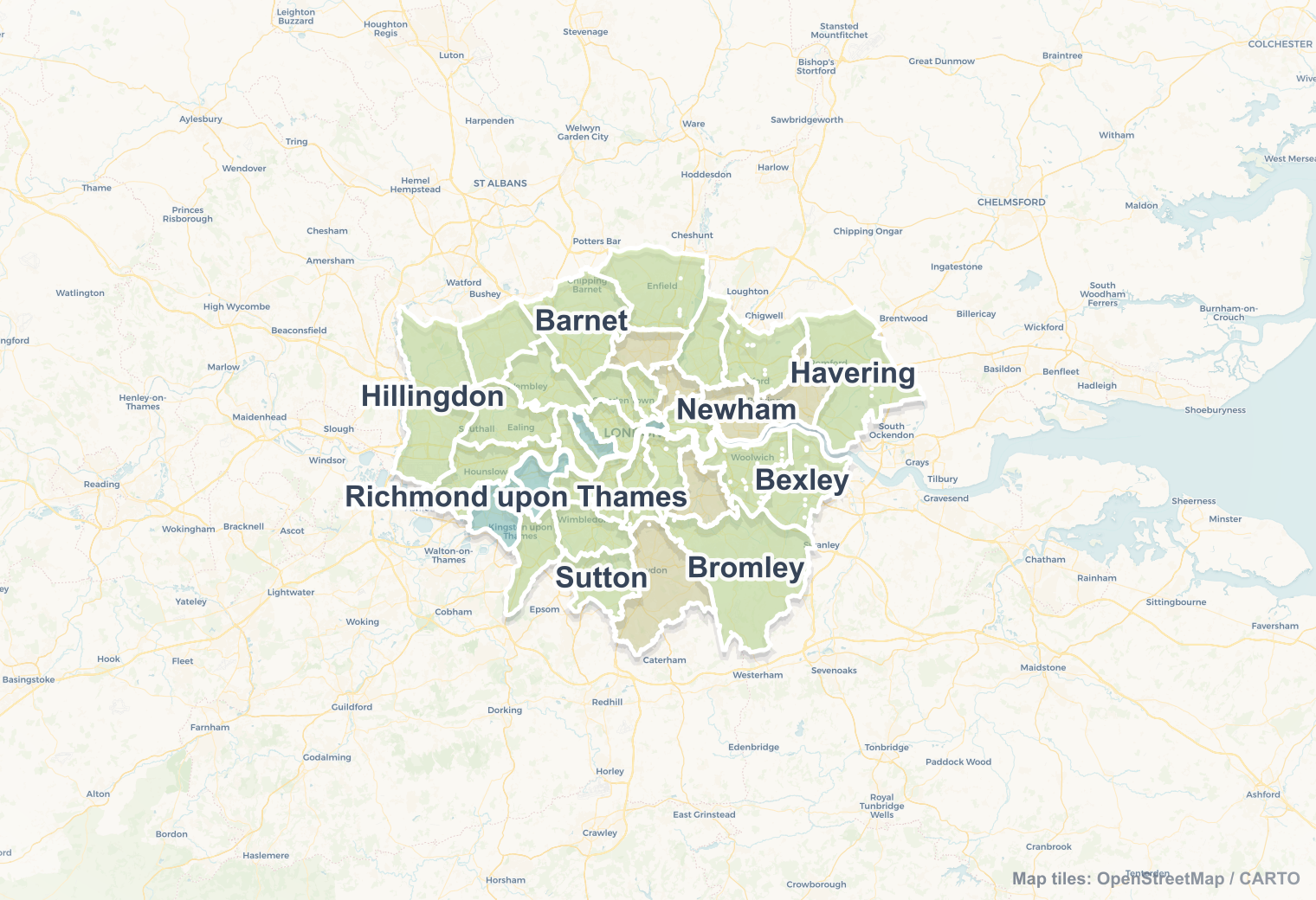
Use the map to compare districts before deciding where to book.
Stay decision guide
First time
Kensington and ChelseaKensington and Chelsea is the cleanest first base: safety 90/100, transport 90/100, and fewer avoidable arrival mistakes.
Family
City of LondonCity of London gives families the stronger calm-and-access trade-off, with safety 90/100 and night score 30/100.
Budget
WestminsterUse Westminster as the value check only if the exact stay keeps transport clear; do not trade down toward Barking and Dagenham for price alone.
Use the London map as a decision tool before booking. Compare safety, transport, attraction access, and budget trade-offs district by district.
Interactive map
Click a district to see details, compare scores, and avoid booking in weaker areas. District tooltips show the neighborhood name, and the detail panel updates instantly.
Active district
City of London
Excellent | score 90
London
Financial district with limited residential areas.
Travel score
90
Safety
90
Transport
95
Community
90
Key strengths
Points to consider
33 results
District Comparison
Choose two districts and compare them side by side before booking. The tool highlights overall score, safety, transport, accommodation, night risk, and the practical trade-offs that matter most for a stay base.
| District | Safety | Vibe | Best for |
|---|---|---|---|
| City of London | 90/100 | Local | Families |
| Richmond upon Thames | 90/100 | Lively | Families |
| Kensington and Chelsea | 90/100 | Lively | Families |
| Wandsworth | 85/100 | Local | Families |
| Kingston upon Thames | 85/100 | Quiet | Families |
Travel score 90/100
Financial district with limited residential areas.
Strengths
Watch-outs
Travel score 90/100
Green and affluent riverside borough.
Strengths
Watch-outs
Overall travel score
Best single read for choosing a low-friction tourist base.
Safety
How comfortable the area is likely to feel for a typical visitor.
Sightseeing convenience
Access to major attractions, useful streets, and visitor-friendly movement.
Transport
How easy it is to arrive, leave, and move around the city.
Accommodation
Hotel and apartment practicality for a short stay.
Night risk
Lower is better. Use this when late returns matter.
Community signal
Extra signal from user reviews where enough data exists.
Stay Decision Guide
Kensington and Chelsea (safety 90, transport 90) works best for first-timers who want central access without compromising safety standards. The combination of excellent Tube connectivity and pedestrian-friendly streets means you can reach major sights quickly while having solid transport options when returning late.
London's excellent transport network (82.9/100) gives first-timers meaningful flexibility to stay beyond Zone 1, but the city's sprawling layout means your accommodation choice directly affects how much time you spend underground. The challenge is that 70% of districts score poorly at night, so staying central isn't just about convenience—it's about limiting late-evening exposure in unfamiliar areas.
First-timers should map their accommodation to the nearest Tube station and check how many changes are required to reach their top three destinations. London's transport is good overall, but transfer points can add 15-20 minutes to journeys, and some routes require multiple changes that feel complex when you're still learning the network.
Richmond upon Thames (safety 90, transport 80, night 30) suits families prioritizing daytime safety and green space over late-night convenience. The slightly lower transport score means fewer direct Tube options, but families typically travel during peak hours when connections are frequent, and the area's residential character offsets the evening logistics challenge.
Solo travelers should consider Kensington and Chelsea (safety 90, transport 90) where high transport connectivity gives you autonomy to explore widely while maintaining safe return routes. The district's combination of excellent safety scores and multiple transport options means you're not dependent on a single line or locked into expensive late-night taxis when plans change.
Camden, Islington, and Southwark sit outside the top-scoring districts but avoid the caution category, offering budget accommodation without the safety compromises found in Newham (60) or Croydon (60). These mid-tier areas benefit from London's good transport network, meaning you can stay further from premium zones while maintaining reasonable access to the center.
City of London (safety 90, transport 95) and Westminster put you within walking distance of major landmarks, but City of London empties after business hours and has limited residential accommodation options. Westminster offers proximity to Parliament, Buckingham Palace, and major museums, though accommodation density is lower than surrounding boroughs.
Central London districts maintain strong daytime safety scores (77.1 average citywide), but the night score of 30 across top districts including Kensington and Chelsea shows that even premium areas experience comfort drops after dark. The data suggests central location doesn't eliminate evening caution—it just shortens the distance between transport stops and your door.
Basing slightly out in Richmond upon Thames (transport 80) or similar boroughs saves 20-30 minutes of total daily transit time compared to outer areas, but costs you spontaneity for evening plans. You gain residential calm and consistent safety scores, but give up the ability to walk home from West End shows or late dinners without planning your Tube route in advance.
Greenwich, Wandsworth, and Hammersmith avoid both the caution list and the premium pricing of Kensington, offering mid-range safety profiles while maintaining access to London's good transport network. These districts sit in the 70-75 safety range—below the top tier but meaningfully above the 55-60 scores that trigger caution flags.
The safety-versus-price line in London appears around the 60-point mark, where Newham and Croydon receive caution verdicts despite reasonable transport access. Districts scoring 70 or above maintain acceptable safety profiles for most visitors, while anything below 65 requires examining specific neighborhood pockets rather than relying on borough-wide averages.
Check whether your specific accommodation sits within a 5-minute walk of a Tube or Overground station with service past 11pm. London's good transport score (82.9) masks significant variation in night bus coverage, and even safe districts become problematic when your route home requires a 15-minute walk through unfamiliar streets after midnight.
Barking and Dagenham (safety 55), Newham (safety 60), and Croydon (safety 60) offer London's lowest accommodation costs but come with the widest safety gaps in a city where the spread between top and bottom districts reaches 31 points. The tradeoff isn't just statistical—these areas sit far from central London, meaning longer commutes that extend your exposure window when returning late from evening activities.
When London accommodation prices drop significantly below the area average, check the district's night score and transport connectivity together—cheap rooms in areas with good Tube access but low night scores (like parts of Newham) mean you'll face the primary risk of uncomfortable late returns despite easy daytime access. A 30-point safety score combined with transport that stops running before midnight creates real logistical constraints on your itinerary.
Before booking anywhere in London, map the specific evening route from your planned activities back to the accommodation address and count the walking minutes from the final transport stop. With 70% of districts scoring low at night, the safety question isn't whether the borough appears on the caution list—it's whether you're willing to navigate that particular street combination at 11pm after a show or dinner.
FAQ
The night score of 30 across districts like Kensington and Chelsea, Richmond, and City of London reflects comfort levels rather than crime rates—these areas are objectively safe but feel emptier after dark due to London's residential spread and early closing times outside the West End. The score indicates you'll encounter fewer people and lit shopfronts on evening walks, not that the areas become dangerous.
Newham (safety 60) and Croydon (safety 60) receive caution verdicts because they combine lower safety scores with positioning far from central London, extending your exposure time during commutes. The risk is less about specific danger and more about spending 40-60 minutes traveling through unfamiliar areas during late returns—a logistics burden that compounds the already high night-risk profile affecting 70% of London districts.
London's 82.9 transport score reflects extensive coverage, not uniform convenience—staying in outer boroughs with caution flags means potential 45+ minute journeys with multiple changes, and some areas lose direct service after 11pm despite good daytime connectivity. The transport quality gives you flexibility to avoid premium districts, but it doesn't eliminate the time cost of staying far from Zone 1 or the planning required for evening returns.
City of London's 95 reflects multiple Tube lines, frequent service, and proximity to major rail terminals, giving you 3-4 route options for most destinations. Richmond's 80 means fewer direct lines and potentially longer connection times, but for visitors making 2-3 trips daily rather than constant movement, the difference translates to an extra 10-15 minutes per journey rather than a fundamental access problem.