SafetyMap

District-level city safety maps, stay-area guidance, and neighborhood summaries for travelers who want to choose better areas before booking.

© 2026 SafetyMap. All rights reserved.

HomeCitiesMethodologyRoadmapSupport
SafetyMap
France/Paris
OverviewMapDistrict comparisonBooking GuideFAQ
France

Paris Safety Map: best areas and places to avoid in 2026

With an average safety score of 77.2/100, Paris ranks as a generally safe city for visitors, though the daytime calm masks a sharper drop after dark. Most reported issues are pickpocketing and opportunistic theft rather than violent incidents, particularly around major monuments and transit hubs.

Use this shortlist to choose an area first, then compare the exact district on the map. Paris is generally safe, but pickpocketing is common in tourist areas.

Safety posture

Score range
55/100 to 90/100
Primary risk
pickpocketing, crowds, and tourist-targeted friction

Map signals

Stable districts: Palais-Bourbon, Passy, and Luxembourg.

Night-risk check: Palais-Bourbon, Passy, and Luxembourg.

Explore them on the map:

See safest areas on the map

Paris safety map

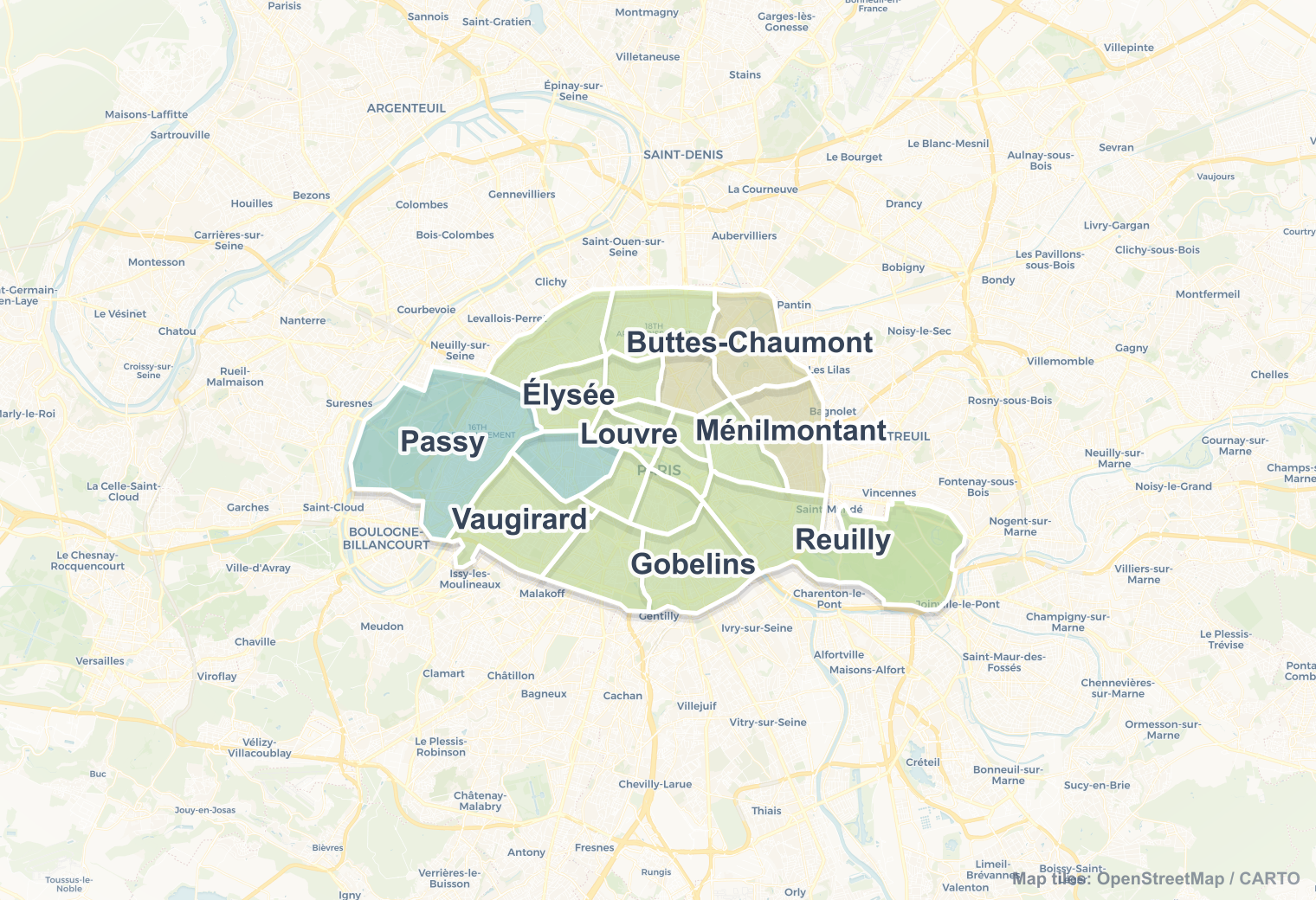
Tap a district to see its safety score and night risk level.

Paris safety map showing safe areas and districts to check before booking
Excellent
Good
Use caution

Safety overview

City-level safety posture

Score range
55/100 to 90/100
Primary risk
pickpocketing, crowds, and tourist-targeted friction
Decision check
Palais-Bourbon set the baseline, while Enclos-St-Laurent needs stricter exact-address checks.

Stable districts

Stronger safety signals

Palais-Bourbon - 90/100Passy - 90/100Luxembourg - 88/100

Night risk

Areas to check after dark

Palais-Bourbon - night score 30/100Passy - night score 30/100Luxembourg - night score 32/100

Map of Paris districts

Use the Paris safety map to compare safety scores, night-risk signals, and the difference between stable districts and areas that need more caution.

Interactive map

Interactive district safety map of Paris

Click a district to see details, compare scores, and avoid booking in weaker areas. District tooltips show the neighborhood name, and the detail panel updates instantly.

Safety districts

Active district

Palais-Bourbon

Excellent | score 90

Paris

Palais-Bourbon

Excellent

Prestigious area with government buildings and upscale residences.

Travel score

90

Safety

90

Transport

85

Community

90

Key strengths

  • Very safe and clean
  • Elegant surroundings
  • Close to landmarks

Points to consider

  • Expensive
  • Quiet nightlife
  • Less lively
SightseeingFamiliesBudget staysNightlife
Open full district profileAdd your opinion

District ranking

20 results

ExpandCollapse

District Comparison

District comparison in Paris

Choose two districts and compare them side by side before booking. The tool highlights overall score, safety, transport, accommodation, night risk, and the practical trade-offs that matter most for a stay base.

ExpandCollapse
DistrictSafetyVibeBest for
Palais-Bourbon90/100LivelyFamilies
Passy90/100LocalFamilies
Luxembourg88/100LivelyFamilies
Batignolles-Monceau88/100LocalFamilies
Temple82/100LivelyNightlife

Palais-Bourbon

Travel score 90/100

Excellent

Prestigious area with government buildings and upscale residences.

SightseeingFamiliesBudget stays

Strengths

  • + Very safe and clean
  • + Elegant surroundings
  • + Close to landmarks

Watch-outs

  • - Expensive
  • - Quiet nightlife
  • - Less lively
Open Palais-Bourbon

Passy

Travel score 90/100

Excellent

Upscale residential district near Eiffel Tower with quiet streets.

SightseeingFamiliesBudget stays

Strengths

  • + Very safe and calm
  • + High-end environment
  • + Close to landmarks

Watch-outs

  • - Expensive
  • - Quiet nightlife
  • - Less vibrant
Open Passy
MetricPalais-BourbonPassyGap

Overall travel score

Best single read for choosing a low-friction tourist base.

90/10090/100Tie

Safety

How comfortable the area is likely to feel for a typical visitor.

90/10090/100Tie

Sightseeing convenience

Access to major attractions, useful streets, and visitor-friendly movement.

85/10080/100Palais-Bourbon +5

Transport

How easy it is to arrive, leave, and move around the city.

85/10080/100Palais-Bourbon +5

Accommodation

Hotel and apartment practicality for a short stay.

90/10090/100Tie

Night risk

Lower is better. Use this when late returns matter.

30/10030/100Tie

Community signal

Extra signal from user reviews where enough data exists.

90/10090/100Tie

Safety Guide

Paris safety overview

With an average safety score of 77.2/100, Paris ranks as a generally safe city for visitors, though the daytime calm masks a sharper drop after dark. Most reported issues are pickpocketing and opportunistic theft rather than violent incidents, particularly around major monuments and transit hubs.

The pattern visitors actually encounter in Paris is crowd-based theft: organized groups working metro lines around the Eiffel Tower, Louvre, and Châtelet, plus scams targeting tourists near Sacré-Cœur. Aggressive incidents are rare, but distraction tactics are constant in heavily trafficked zones.

The 30-point spread between Paris's best and worst districts means your booking choice carries real weight. Staying in a district scoring 88-90 versus one scoring 55-65 changes both the daytime feel and how comfortable late returns will be.

Paris safety guide

Passy tops the list at safety 90, with transport at 80 — it's an upscale residential area near the Eiffel Tower with quiet streets and low foot traffic at night. For visitors who prioritize a calm base over central nightlife access, it's one of the most reliable choices in the city.

In Paris, the gap between a district scoring 80+ and one scoring 60-70 is mostly about street density and after-hours activity. The higher-scored areas like Palais-Bourbon (90) and Luxembourg (88) stay residential and well-lit; the 60-70 range means more variability block to block, especially once shops close.

One thing visitors overlook: Paris's strong overall safety score doesn't carry into the night. Even well-regarded districts like Passy and Palais-Bourbon score around 30 for night safety, so the daytime score isn't a reliable predictor of how a late evening walk will feel.

Read risk by district in Paris

Risk in Paris is not evenly spread: out of 20 districts, only 3 are flagged for caution, and they cluster in the northeast and central-east. Most central and western districts sit comfortably in the safe range, so risk is concentrated rather than citywide.

Night risk is the dominant pattern — 75% of districts score low after dark, including several daytime-safe areas. In practice this means evening returns should rely on taxis or metro rather than long walks, even from districts you'd happily explore at noon.

The three caution-flagged districts are Buttes-Chaumont (65), Ménilmontant (60), and Enclos-St-Laurent (55). Buttes-Chaumont is largely residential but uneven at its edges; Ménilmontant is an eastern district with local character but inconsistent street feel; Enclos-St-Laurent, near Gare de l'Est, is the lowest-scored and combines station-area issues with mixed urban density.

Paris at night

The data is clear: Paris at night is a different city. Even top-scoring districts like Passy, Palais-Bourbon, and Luxembourg drop to night scores around 30-32, so no area should be treated as automatically comfortable after midnight.

For evening logistics, plan late arrivals into hotels rather than long transfers, and use taxis or rideshare for dinner returns past 11pm — especially if your route passes Gare du Nord, Gare de l'Est, or Châtelet. Solo returns are workable in central western districts but worth pre-booking from eastern ones.

What the scores reveal: the night drop is uniform enough that picking a district close to where you'll eat and sightsee matters more than picking the highest-scoring district overall. A shorter return trip beats a quieter postcode you have to cross half the city to reach.

Other cities in France

Compare Paris with other city safety maps and where-to-stay guides in the same country. If you are also visiting Bordeaux, check where to stay in Bordeaux.

Bordeaux

Open the where-to-stay guide and district ranking for Bordeaux.

Lyon

Open the where-to-stay guide and district ranking for Lyon.

Marseille

Open the where-to-stay guide and district ranking for Marseille.

Nantes

Open the where-to-stay guide and district ranking for Nantes.

Strasbourg

Open the where-to-stay guide and district ranking for Strasbourg.

Toulouse

Open the where-to-stay guide and district ranking for Toulouse.

Read risk by district

Do not reduce Paris to one safe/unsafe label. Compare the score range, night-risk pattern, and exact district profile before judging the stay area.

A lower score usually means less margin for a weak street, late return, or poorly connected address.

FAQ

Paris safety FAQ

Is Paris safe for tourists in 2026?

Paris is generally manageable for tourists, but the risk is concentrated around crowded visitor routes, major sights, and transport hubs. Use safer bases such as Passy, Palais-Bourbon, and Luxembourg, then check the exact route back after dinner.

What is the main safety risk in Paris?

The main Paris risk is tourist-targeted friction: pickpocketing, distraction scams, and crowded metro or landmark areas. Violent incidents are not the normal visitor issue, but busy areas around major stations and sights need attention.

Which Paris districts need extra care at night?

Enclos-St-Laurent, Menilmontant, and Buttes-Chaumont sit on the lower side of the current safety ranking. They are not automatic no-go areas, but late returns and the walk from transit to the stay need a stricter check.

Should I choose Paris by safety score alone?

No. A high safety score helps, but Paris also has a broad night-risk pattern, so transport, the exact street, and how far you return after dinner matter as much as the district rank.