First time
EixampleEixample is the cleanest first base: safety 72/100, transport 95/100, and fewer avoidable arrival mistakes.
For a first visit, Gràcia (safety 82, transport 85) is the most balanced base. Barcelona's transport network scores 85.7/100, so you don't need to sleep on top of the Gothic Quarter to reach it quickly, and Gràcia gives you metro access to central sights while keeping you out of the highest-pickpocketing zones.
Use this shortlist to choose an area first, then compare the exact district on the map. Barcelona is generally a safe city, but pickpocketing is common in tourist areas, especially around crowded central streets and nightlife zones.
First time
EixampleEixample is the cleanest first base: safety 72/100, transport 95/100, and fewer avoidable arrival mistakes.
Family
Sarrià - Sant GervasiSarrià - Sant Gervasi gives families the stronger calm-and-access trade-off, with safety 92/100 and night score 28/100.
Budget
les CortsUse les Corts as the value check only if the exact stay keeps transport clear; do not trade down toward Ciutat Vella for price alone.
Explore them on the map:
See safest areas on the mapBarcelona safety map
Use the map to compare districts before deciding where to book.
Stay decision guide
First time
EixampleEixample is the cleanest first base: safety 72/100, transport 95/100, and fewer avoidable arrival mistakes.
Family
Sarrià - Sant GervasiSarrià - Sant Gervasi gives families the stronger calm-and-access trade-off, with safety 92/100 and night score 28/100.
Budget
les CortsUse les Corts as the value check only if the exact stay keeps transport clear; do not trade down toward Ciutat Vella for price alone.
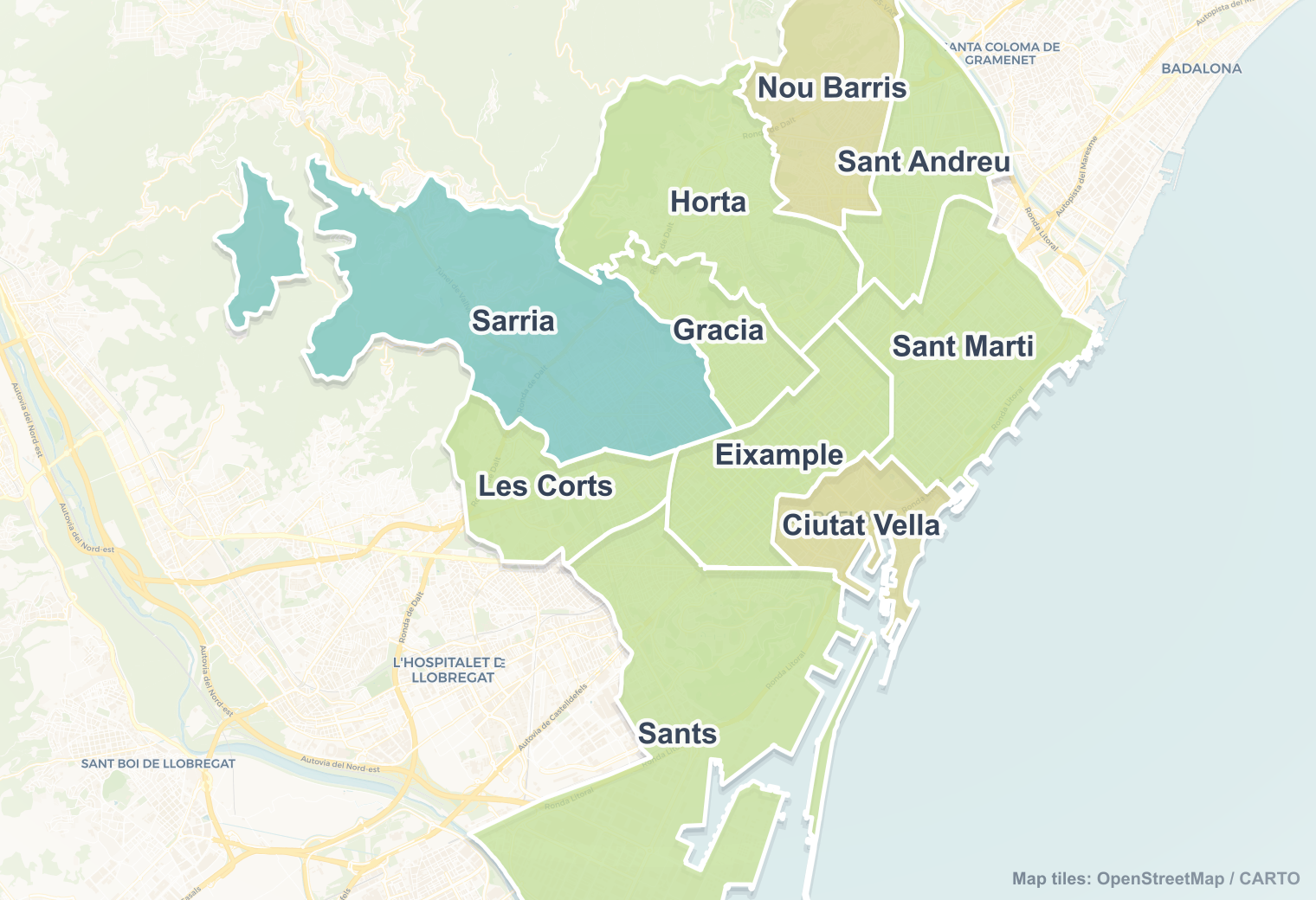
Use the Barcelona map as a decision tool before booking. Compare safety, transport, attraction access, and budget trade-offs district by district.
Interactive map
Click a district to see details, compare scores, and avoid booking in weaker areas. District tooltips show the neighborhood name, and the detail panel updates instantly.
Active district
Sarrià - Sant Gervasi
Excellent | score 90
Barcelona
Sarrià – Sant Gervasi is one of the most affluent and quiet districts in Barcelona, located in the hills northwest of the city center. It is known for residential streets, international schools, embassies and proximity to the Collserola Natural Park, offering a calm and safe environment compared with central tourist districts.
Travel score
90
Safety
92
Transport
82
Community
90
Key strengths
Points to consider
10 results
District Comparison
Choose two districts and compare them side by side before booking. The tool highlights overall score, safety, transport, accommodation, night risk, and the practical trade-offs that matter most for a stay base.
| District | Safety | Vibe | Best for |
|---|---|---|---|
| Sarrià - Sant Gervasi | 92/100 | Local | Families |
| les Corts | 88/100 | Local | Families |
| Gràcia | 82/100 | Local | Value stays |
| Eixample | 72/100 | Lively | Nightlife |
| Horta-Guinardó | 83/100 | Local | Value stays |
Travel score 90/100
Sarrià – Sant Gervasi is one of the most affluent and quiet districts in Barcelona, located in the hills northwest of the city center. It is known for residential streets, international schools, embassies and proximity to the Collserola Natural Park, offering a calm and safe environment compared with central tourist districts.
Strengths
Watch-outs
Travel score 86/100
Les Corts is a relatively upscale and residential district in western Barcelona known for business areas, shopping streets and the presence of Camp Nou. It is quieter and more organized than the historic center, making it a comfortable and generally safe area for visitors.
Strengths
Watch-outs
Overall travel score
Best single read for choosing a low-friction tourist base.
Safety
How comfortable the area is likely to feel for a typical visitor.
Sightseeing convenience
Access to major attractions, useful streets, and visitor-friendly movement.
Transport
How easy it is to arrive, leave, and move around the city.
Accommodation
Hotel and apartment practicality for a short stay.
Night risk
Lower is better. Use this when late returns matter.
Community signal
Extra signal from user reviews where enough data exists.
Stay Decision Guide
For a first visit, Gràcia (safety 82, transport 85) is the most balanced base. Barcelona's transport network scores 85.7/100, so you don't need to sleep on top of the Gothic Quarter to reach it quickly, and Gràcia gives you metro access to central sights while keeping you out of the highest-pickpocketing zones.
Barcelona is easy to navigate because the metro, buses and suburban rail are dense and reliable, but the historic core (Ciutat Vella, safety 55) concentrates almost all of the city's tourist-targeted crime. The strong transport tier is what makes staying outside the center genuinely practical rather than a compromise.
Factor in that night safety drops sharply across 60% of districts. Choose a first-visit base where your nearest metro stop is on a line you'll actually use after dark, not just one that looks close on a map.
Families are best placed in Sarrià – Sant Gervasi (safety 92, transport 82, night 28). The residential streets, low foot traffic and proximity to Collserola make it the quietest district in the city, and although night scores look low everywhere, families typically aren't out late, so the daytime safety and clean transport links matter more.
Solo travelers do well in Gràcia (safety 82, night 38), which has the highest evening score among the recommended districts and a walkable plaza-based layout where you're rarely isolated. Solo visitors should specifically avoid basing in Ciutat Vella, where pickpocketing and tourist-targeted friction concentrate after dark.
Budget travelers should look at outer Gràcia or les Corts (safety 88, transport 86) rather than chasing cheaper beds in Ciutat Vella. Both districts keep you on direct metro lines into the center without dropping into the caution tier.
Ciutat Vella puts you within walking distance of the Gothic Quarter, La Rambla, the waterfront and most landmark sites. The tradeoff is direct: it scores 55 on safety, the lowest in the city, and is the primary zone for pickpocketing and crowd-related incidents.
Central location in Barcelona genuinely does come with a safety cost. The score spread between Ciutat Vella (55) and Sarrià – Sant Gervasi (92) is 37 points, and almost all of that gap is explained by tourist-targeted crime concentrated in the historic core.
Basing slightly further out — Gràcia or les Corts — costs you 10 to 20 minutes on the metro per trip but removes the daily exposure to crowded pickpocketing hotspots. Given Barcelona's excellent transport tier, that's a low price for a meaningfully calmer base.
Les Corts and the outer edges of Gràcia tend to offer better value than the central tourist core while still scoring in the good-to-excellent safety range. Both sit on strong metro connections, so cheaper accommodation here doesn't translate into longer or riskier journeys.
The safety-vs-price line in Barcelona runs roughly along the edge of Ciutat Vella. Inside that district, lower prices reflect higher exposure to pickpocketing and nightlife-zone friction; outside it, prices ease without the safety score collapsing.
Before booking budget accommodation, check the exact metro stop and walk the route from station to door on a map for evening context. A cheap room a few streets into El Raval or near La Rambla nightlife is a very different proposition from a cheap room near a Gràcia or les Corts metro exit.
Cheap stays clustered inside Ciutat Vella (safety 55) — particularly around El Raval, lower La Rambla and parts of La Barceloneta — come with real exposure to pickpocketing, crowd pressure and late-night street friction. Nou Barris (safety 65) is cheaper still but isn't a practical visitor base, sitting far from the main sights with limited tourist infrastructure.
When a price looks unusually low for its location, the underlying reason is usually visible in the data: a caution-flagged district, a low night score, or a street inside a known nightlife corridor. Barcelona's 22-point score spread is moderate, so a sharp price drop often signals you've crossed into the lower end of that range.
The honest question to ask is what the walk from the metro to your door looks like at 11pm with luggage or after a late dinner. If that route runs through a crowded nightlife strip in Ciutat Vella, the saving isn't really a saving.
FAQ
Both sit inside Ciutat Vella, which scores 55/100 and is flagged caution. They're the most central areas but also concentrate the city's pickpocketing and tourist-targeted crime, especially in crowded streets and nightlife zones. Stay there only if you accept that tradeoff knowingly.
Among the recommended districts, Gràcia has the highest night score at 38, followed by les Corts at 32 and Sarrià – Sant Gervasi at 28. Night risk is high across 60% of Barcelona's districts, so even the better-scoring areas warrant planning return routes in advance.
No. It scores 82 on transport and connects to the center via metro and FGC suburban rail. You trade roughly 15–20 minutes of travel each way for the highest safety score in the city (92) and a night score that's still on par with more central options.
Substantially. Pickpocketing in Barcelona concentrates in crowded tourist corridors — La Rambla, metro lines serving the Gothic Quarter, La Barceloneta beachfront — all inside Ciutat Vella. Basing in Gràcia, les Corts or Sarrià – Sant Gervasi means you only pass through those zones intentionally rather than every time you leave your accommodation.