First time
SalamancaSalamanca is the cleanest first base: safety 90/100, transport 90/100, and fewer avoidable arrival mistakes.
Salamanca (safety 90, transport 90) works best for first-timers because it combines top-tier safety with excellent metro access across Madrid's good transport network. Retiro (safety 90, transport 85) offers similar safety with park access but slightly less transport density, while Chamberí (safety 85, transport 85) gives authentic local atmosphere without compromising core safety metrics.
Use this shortlist to choose an area first, then compare the exact district on the map. Madrid is generally safe, but pickpocketing is common in tourist areas.
First time
SalamancaSalamanca is the cleanest first base: safety 90/100, transport 90/100, and fewer avoidable arrival mistakes.
Family
RetiroRetiro gives families the stronger calm-and-access trade-off, with safety 90/100 and night score 30/100.
Budget
ChamartínUse Chamartín as the value check only if the exact stay keeps transport clear; do not trade down toward Puente de Vallecas for price alone.
Explore them on the map:
See safest areas on the mapMadrid safety map
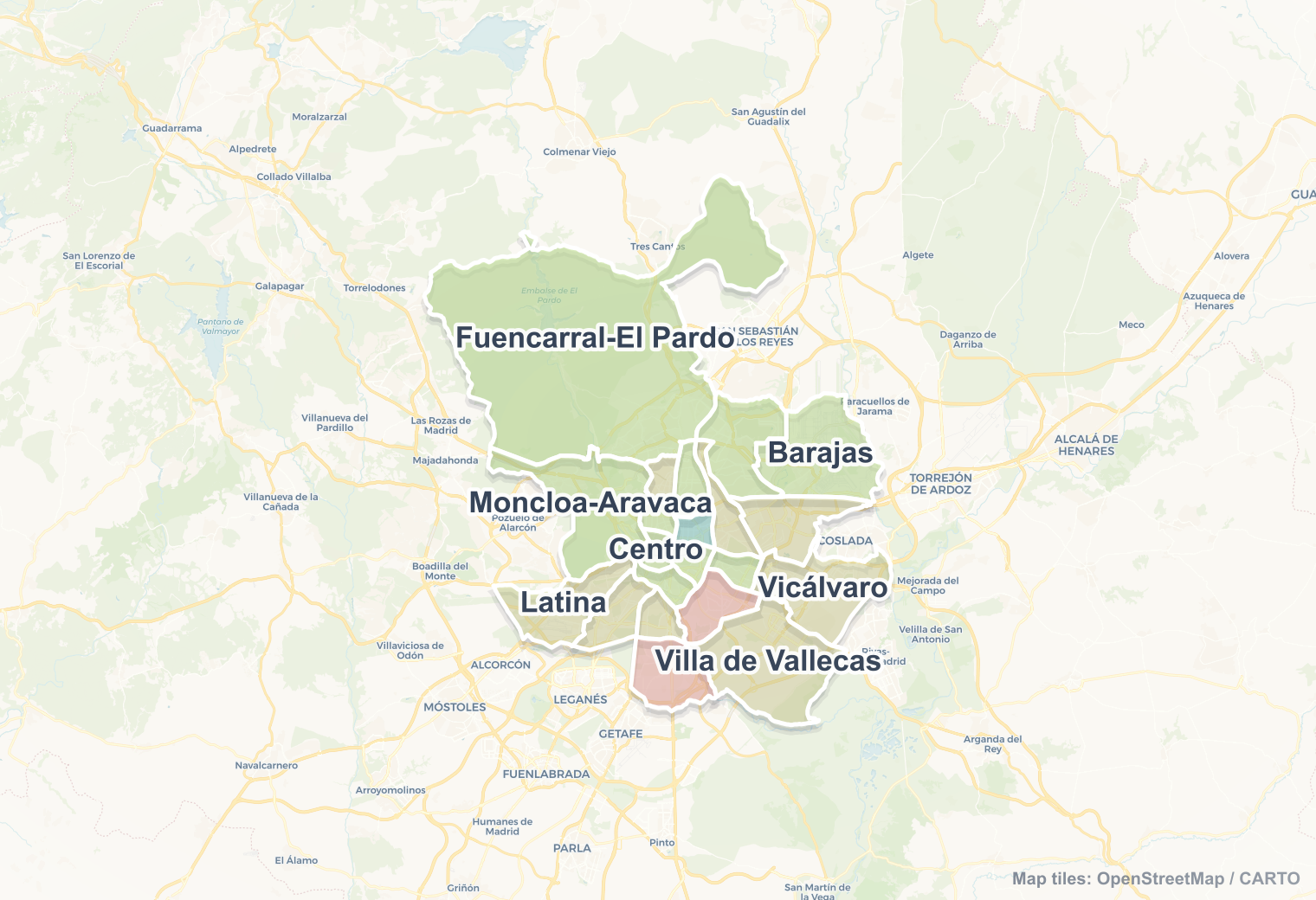
Use the map to compare districts before deciding where to book.
Stay decision guide
First time
SalamancaSalamanca is the cleanest first base: safety 90/100, transport 90/100, and fewer avoidable arrival mistakes.
Family
RetiroRetiro gives families the stronger calm-and-access trade-off, with safety 90/100 and night score 30/100.
Budget
ChamartínUse Chamartín as the value check only if the exact stay keeps transport clear; do not trade down toward Puente de Vallecas for price alone.
Use the Madrid map as a decision tool before booking. Compare safety, transport, attraction access, and budget trade-offs district by district.
Interactive map
Click a district to see details, compare scores, and avoid booking in weaker areas. District tooltips show the neighborhood name, and the detail panel updates instantly.
Active district
Salamanca
Excellent | score 90
Madrid
Luxury district with high-end shopping and very clean environment.
Travel score
90
Safety
90
Transport
90
Community
90
Key strengths
Points to consider
21 results
District Comparison
Choose two districts and compare them side by side before booking. The tool highlights overall score, safety, transport, accommodation, night risk, and the practical trade-offs that matter most for a stay base.
| District | Safety | Vibe | Best for |
|---|---|---|---|
| Salamanca | 90/100 | Quiet | Families |
| Retiro | 90/100 | Lively | Families |
| Chamberí | 85/100 | Local | Families |
| Chamartín | 85/100 | Quiet | Families |
| Moncloa-Aravaca | 80/100 | Local | Value stays |
Travel score 90/100
Luxury district with high-end shopping and very clean environment.
Strengths
Watch-outs
Travel score 87/100
Green, calm district next to the famous Retiro park.
Strengths
Watch-outs
Overall travel score
Best single read for choosing a low-friction tourist base.
Safety
How comfortable the area is likely to feel for a typical visitor.
Sightseeing convenience
Access to major attractions, useful streets, and visitor-friendly movement.
Transport
How easy it is to arrive, leave, and move around the city.
Accommodation
Hotel and apartment practicality for a short stay.
Night risk
Lower is better. Use this when late returns matter.
Community signal
Extra signal from user reviews where enough data exists.
Stay Decision Guide
Salamanca (safety 90, transport 90) works best for first-timers because it combines top-tier safety with excellent metro access across Madrid's good transport network. Retiro (safety 90, transport 85) offers similar safety with park access but slightly less transport density, while Chamberí (safety 85, transport 85) gives authentic local atmosphere without compromising core safety metrics.
Madrid's good transport system (78.8/100) means you can base in safer districts and reach most attractions within 20-30 minutes, but the 48-point safety spread between districts means location choice matters more than in cities with more uniform safety. The city's wide district-to-district gaps create real consequences for choosing poorly, though good metro coverage reduces the pressure to stay hyper-central.
Check your accommodation's position relative to district boundaries in Madrid, since safety can shift dramatically within a 10-minute walk when crossing from high-scoring areas like Salamanca into lower-ranked adjacent zones. The sharp safety gaps make Madrid less forgiving of generic 'near the center' bookings than cities with gradual transitions.
Retiro (safety 90, transport 85, night 30) works best for families because it combines top safety scores with park access and calm streets, though the night score of 30 means planning evening returns before late hours. The green space and residential character reduce street activity stress compared to denser central zones.
Chamberí (safety 85, transport 85) suits solo travelers who want authentic Madrid without venturing into the 10 flagged caution districts, offering solid safety metrics and local dining while keeping good metro access to social areas. Solo visitors should note that 38% of districts score low at night, making Chamberí's 35 night score adequate but not exceptional for late returns.
Chamberí offers budget-friendly options without dropping into caution territory, sitting comfortably above the 50-point threshold where districts like Carabanchel (safety 50) start showing mixed safety profiles. Avoid chasing lower prices in Puente de Vallecas (safety 40) or Villaverde (safety 45), both marked avoid for clear socio-economic challenges.
Centro district sits nearest to major sights like Plaza Mayor and Puerta del Sol, but doesn't appear in the top safety rankings, meaning proximity comes with trade-offs compared to Salamanca or Retiro which require 10-15 minute metro rides. The good transport system (78.8/100) makes basing in higher-safety peripheral districts practical for sightseeing.
Central Madrid doesn't automatically mean top safety scores in this city—the 48-point spread shows that some central zones sit well below Salamanca's 90 or Retiro's 90. Unlike cities where the core is uniformly safe, Madrid's sharp district gaps mean hyper-central bookings need individual address checking against district boundaries.
Basing in Salamanca or Chamberí trades 15-20 minutes of metro time for measurably higher safety scores and better evening comfort, a worthwhile exchange given Madrid's good transport reliability. You give up walking to some sights but gain consistent safety across your accommodation zone and daily routes.
Chamberí (safety 85) offers lower accommodation costs than Salamanca while staying well above the safety threshold where caution districts begin. Districts like Carabanchel (safety 50) technically avoid 'avoid' status but sit at the borderline where mixed reputation and patchy safety become noticeable.
The safety-vs-price line in Madrid sits around the 50-point mark—below this, districts like Puente de Vallecas (safety 40) and Villaverde (safety 45) show clear challenges that make savings costly. The 10 flagged caution/avoid districts out of 21 total means nearly half the city requires scrutiny, making cheap bookings riskier than in cities with narrower safety spreads.
Check whether your specific Madrid address sits within 400 meters of a metro stop that runs past 23:00, since 38% of districts score low at night and good transport becomes essential for safe evening returns. Street-level safety can shift block by block near district boundaries where the 48-point spread creates sharp transitions.
Puente de Vallecas (safety 40) and Villaverde (safety 45) offer the cheapest accommodation but come with avoid ratings due to working-class challenges and peripheral isolation. Carabanchel (safety 50) sits at caution level with mixed safety, meaning budget savings come with evening route concerns and reputation issues that affect daily comfort.
When Madrid prices drop significantly below the Chamberí baseline, check whether the district appears in the 10 flagged zones—scores below 50 typically indicate socio-economic challenges or industrial character that explain the discount. The 48-point spread means cheap accommodation correlates strongly with measurable safety gaps, not just aesthetic differences.
Ask whether you'd feel comfortable walking the 10 minutes from the nearest metro stop to your Madrid accommodation after 22:00, given that 38% of districts score low at night. The sharp district-to-district gaps mean evening return routes can cross from adequate to problematic zones within minutes, making address-level checking essential.
FAQ
Puente de Vallecas (safety 40) and Villaverde (safety 45) carry avoid ratings due to working-class challenges and peripheral location. Carabanchel (safety 50) sits at caution level with mixed safety and reputation concerns. These 3 districts plus 7 others are flagged out of Madrid's 21 total districts, meaning nearly half the city requires careful consideration.
It depends which direction you go—Chamberí (safety 85) offers value while maintaining strong safety scores, but districts like Carabanchel (safety 50) or lower show the 48-point safety spread working against you. Madrid's good transport (78.8/100) makes peripheral high-safety zones workable, but 10 districts carry caution/avoid flags, so cheaper peripheral options need individual checking against the flagged list.
Madrid's 48-point safety spread creates sharper district-to-district gaps than cities with gradual transitions, making location choice more consequential. With 38% of districts scoring low at night and 10 out of 21 districts flagged for caution or avoid, Madrid requires more careful district selection than cities with uniform safety across neighborhoods.
Even top districts like Salamanca and Retiro score 30 on night safety, indicating medium night risk citywide rather than district-specific problems. Madrid's 38% low-night-score rate means planning metro routes for evening returns makes sense across all districts, with good transport (78.8/100) offsetting the medium night risk through reliable late connections.