First time
l'Eixamplel'Eixample is the cleanest first base: safety 83/100, transport 90/100, and fewer avoidable arrival mistakes.
l'Eixample is the strongest first-visit base in Valencia, scoring 83 for safety with excellent transport connections (90) that compensate for the city's patchy coverage in outer areas. The district puts you within walking distance of major sights while maintaining solid daytime security, though its night score of 37 means evening returns require attention.
Use this shortlist to choose an area first, then compare the exact district on the map. Valencia is generally safe, but pickpocketing is common in tourist areas.
First time
l'Eixamplel'Eixample is the cleanest first base: safety 83/100, transport 90/100, and fewer avoidable arrival mistakes.
Family
el Pla del Realel Pla del Real gives families the stronger calm-and-access trade-off, with safety 85/100 and night score 35/100.
Budget
Ciutat VellaUse Ciutat Vella as the value check only if the exact stay keeps transport clear; do not trade down toward Rascanya for price alone.
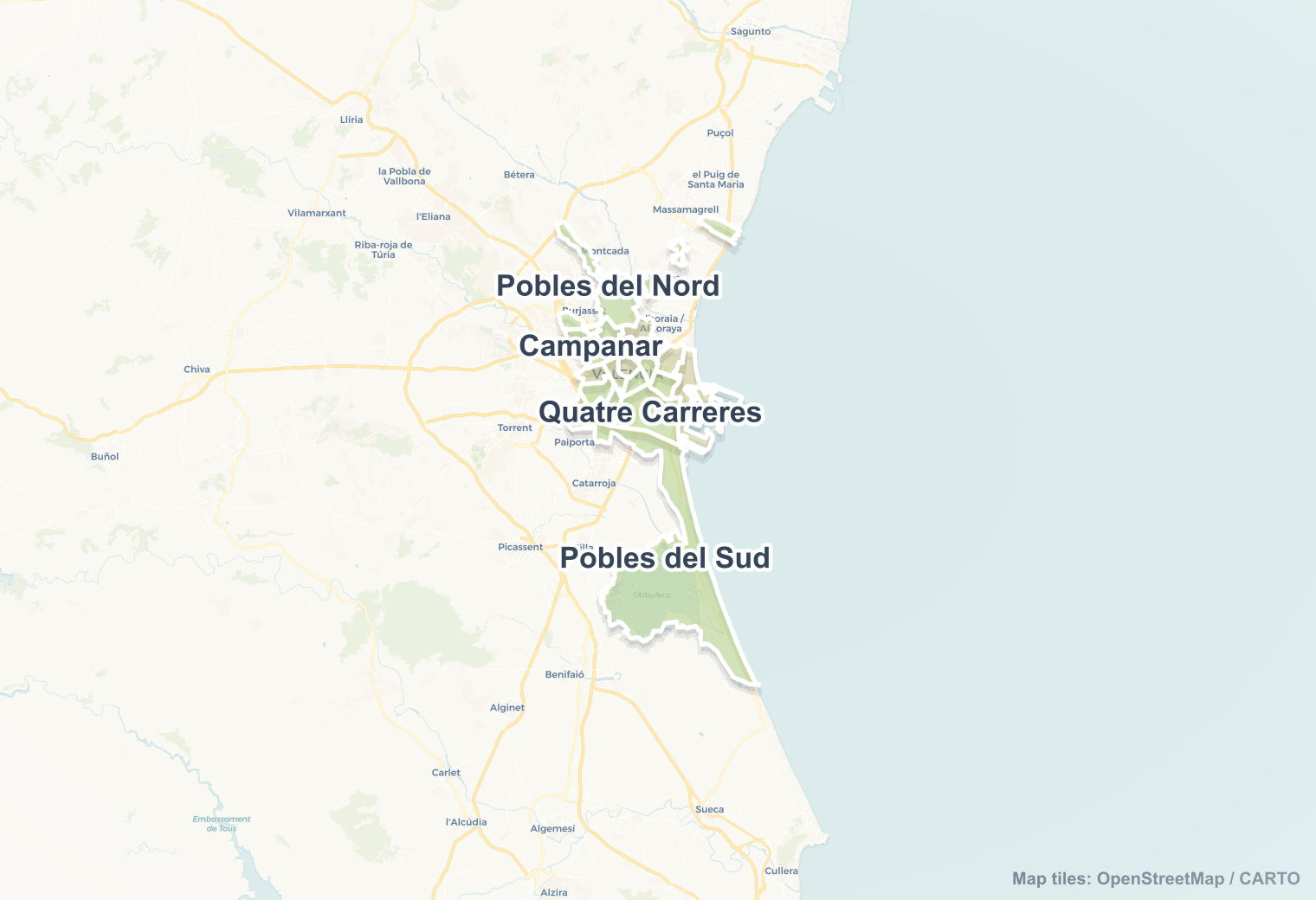
Explore them on the map:
See safest areas on the mapValencia safety map
Use the map to compare districts before deciding where to book.
Stay decision guide
First time
l'Eixamplel'Eixample is the cleanest first base: safety 83/100, transport 90/100, and fewer avoidable arrival mistakes.
Family
el Pla del Realel Pla del Real gives families the stronger calm-and-access trade-off, with safety 85/100 and night score 35/100.
Budget
Ciutat VellaUse Ciutat Vella as the value check only if the exact stay keeps transport clear; do not trade down toward Rascanya for price alone.
Use the Valencia map as a decision tool before booking. Compare safety, transport, attraction access, and budget trade-offs district by district.
Interactive map
Click a district to see details, compare scores, and avoid booking in weaker areas. District tooltips show the neighborhood name, and the detail panel updates instantly.
Active district
l'Eixample
Good | score 86
Valencia
Central district with upscale areas, shops and nightlife.
Travel score
86
Safety
83
Transport
90
Community
86
Key strengths
Points to consider
19 results
District Comparison
Choose two districts and compare them side by side before booking. The tool highlights overall score, safety, transport, accommodation, night risk, and the practical trade-offs that matter most for a stay base.
| District | Safety | Vibe | Best for |
|---|---|---|---|
| l'Eixample | 83/100 | Lively | Nightlife |
| el Pla del Real | 85/100 | Quiet | Families |
| Pobles del Nord | 82/100 | Local | First-time visitors |
| Pobles del Sud | 85/100 | Local | Families |
| Pobles de l'Oest | 78/100 | Local | First-time visitors |
Travel score 86/100
Central district with upscale areas, shops and nightlife.
Strengths
Watch-outs
Travel score 83/100
Upscale district with parks and university buildings.
Strengths
Watch-outs
Overall travel score
Best single read for choosing a low-friction tourist base.
Safety
How comfortable the area is likely to feel for a typical visitor.
Sightseeing convenience
Access to major attractions, useful streets, and visitor-friendly movement.
Transport
How easy it is to arrive, leave, and move around the city.
Accommodation
Hotel and apartment practicality for a short stay.
Night risk
Lower is better. Use this when late returns matter.
Community signal
Extra signal from user reviews where enough data exists.
Stay Decision Guide
l'Eixample is the strongest first-visit base in Valencia, scoring 83 for safety with excellent transport connections (90) that compensate for the city's patchy coverage in outer areas. The district puts you within walking distance of major sights while maintaining solid daytime security, though its night score of 37 means evening returns require attention.
Valencia's good-but-not-excellent transport tier (72.6) means central positioning matters more than in metro-heavy cities—outer districts can leave you reliant on specific bus lines or longer walks. The 25-point safety spread across districts is moderate but meaningful, and with 58% of districts scoring low at night, your return route from dinner or bars becomes a genuine planning factor.
Check whether your accommodation in l'Eixample sits on the upscale northern end or closer to the transport hub—the district spans enough territory that walkability to your actual metro stop varies significantly.
el Pla del Real works best for families in Valencia, with an 85 safety score, 80 transport rating, and parks that provide daytime activity space—the 35 night score means early evenings are manageable, though late returns still warrant cab consideration. The university presence and residential character keep the area calmer than tourist-heavy l'Eixample.
Solo travelers should focus on l'Eixample despite its lower night score (37) because the 90 transport rating provides flexible exit options when assessing situations, and the district's activity level means you're rarely isolated on streets. Valencia's primary risk is pickpocketing and tourist-targeted friction, which solo travelers can mitigate through awareness more easily than structural safety problems.
Pobles del Nord offers budget value with an 82 safety score, but its 55 transport rating means you're committing to longer travel times and evening logistics planning—only viable if you're comfortable with less spontaneous movement. l'Olivereta and Rascanya both score 60 and fall into caution territory despite lower costs.
l'Eixample provides the tightest access to Valencia's historic core and central attractions, with its 90 transport score meaning you can reach the City of Arts and Sciences or beach areas without lengthy walks. The 83 safety rating means central positioning doesn't force you into compromised security during daytime exploration.
Valencia's central districts don't carry the safety penalties seen in some European cities—l'Eixample and el Pla del Real both score above 83, well ahead of the city's 72 average. The cost comes at night, when both districts drop to 37 and 35 respectively, requiring the same evening awareness you'd apply anywhere in Valencia.
Basing in el Pla del Real trades 10-15 minutes of walking distance to major sights for a quieter residential feel and slightly better daytime safety (85 vs 83), while maintaining strong transport (80) that keeps beaches and outer attractions accessible.
Pobles del Nord scores 82 for safety while offering lower accommodation costs due to its peripheral location and village character, but the 55 transport rating means you'll spend more time and planning on connections. This works for travelers who anchor their days around specific outings rather than spontaneous wandering.
Valencia's safety line sits around 60—districts below that threshold (l'Olivereta, Rascanya, parts of Poblats Marítims) move from budget-friendly to caution territory. The 25-point spread means dropping from 82 to 60 represents a measurable shift in street environment and evening comfort, not just statistical noise.
Before booking budget accommodation in Valencia, map the specific walking route from the nearest transport stop to the address and check whether that stretch involves isolated streets—Valencia's night risk affects 58% of districts, so the final 400 meters matter as much as the district average.
Poblats Marítims scores 65 with mixed safety levels across its coastal stretch, l'Olivereta and Rascanya both sit at 60 in working-class and outer residential zones—cheap rates here reflect evening isolation, lower transport frequency, and the working-class character that produces friction with tourist expectations. These aren't dangerous zones, but they require active situational management that undermines the ease of a short stay.
In Valencia, unusually low prices in coastal areas often signal proximity to industrial port sections rather than beach promenades, while cheap rates west or north of center (l'Olivereta, Rascanya) reflect residential districts where evening streets empty early and transport connections thin out. The 58% night risk statistic shows up most clearly in these areas after 22:00.
Before booking anywhere in Valencia, ask whether you'd feel comfortable walking from the address to the nearest metro or bus stop at 23:00 after dinner—if the route involves more than three blocks of purely residential streets with no commercial activity, factor in consistent cab costs that erase the accommodation savings.
FAQ
Poblats Marítims, the coastal district containing Valencia's beaches, scores 65 for safety and carries a caution rating due to mixed conditions—some beach sections are well-trafficked and secure while others near port areas see higher pickpocketing and isolation at night. The district's safety varies significantly by specific neighborhood, so accommodation here requires checking the exact location rather than assuming all beachfront areas are equivalent.
Valencia's transport scores 72.6 (good but not excellent), meaning outer districts with ratings below 60 leave you dependent on specific bus lines with longer waits and limited evening service—Pobles del Nord's 55 transport score, for example, requires planning around schedules. Central districts like l'Eixample (90) and el Pla del Real (80) provide the flexibility to move spontaneously, which matters in a city where 58% of districts score low for night safety.
Six of Valencia's 19 districts carry caution or avoid ratings, with l'Olivereta and Rascanya both scoring 60 for safety in working-class and outer residential areas where evening isolation and lower transport connectivity create friction. Poblats Marítims (65) has mixed safety across its coastal stretch. These aren't dangerous zones, but they require more active situational awareness than el Pla del Real (85) or l'Eixample (83).
Central districts like l'Eixample and el Pla del Real score 37 and 35 for night safety respectively, reflecting Valencia's city-wide pattern where 58% of districts drop significantly after dark—but their strong daytime scores (83-85) and excellent transport (80-90) mean you have better options for evening returns than peripheral areas. The primary night risk across Valencia is pickpocketing in crowds and tourist-targeted friction, not violent crime, so awareness and transport planning matter more than avoiding central areas.