First time
BergenhusBergenhus is the cleanest first base: safety 90/100, transport 92/100, and fewer avoidable arrival mistakes.
Bergenhus is the clear choice for first-time visitors, combining the city's highest transport score (92/100) with strong safety (90/100) and direct access to Bergen's main sights including Bryggen. The central location means shorter evening journeys, which matters in a city where all districts score low for nighttime safety.
Use this shortlist to choose an area first, then compare the exact district on the map. Bergen is generally safe, but pickpocketing is common in tourist areas.
First time
BergenhusBergenhus is the cleanest first base: safety 90/100, transport 92/100, and fewer avoidable arrival mistakes.
Family
KronstadKronstad gives families the stronger calm-and-access trade-off, with safety 86/100 and night score 34/100.
Budget
ÅrstadUse Årstad as the value check only if the exact stay keeps transport clear; do not trade down toward Laksevåg for price alone.
Explore them on the map:
See safest areas on the mapBergen safety map
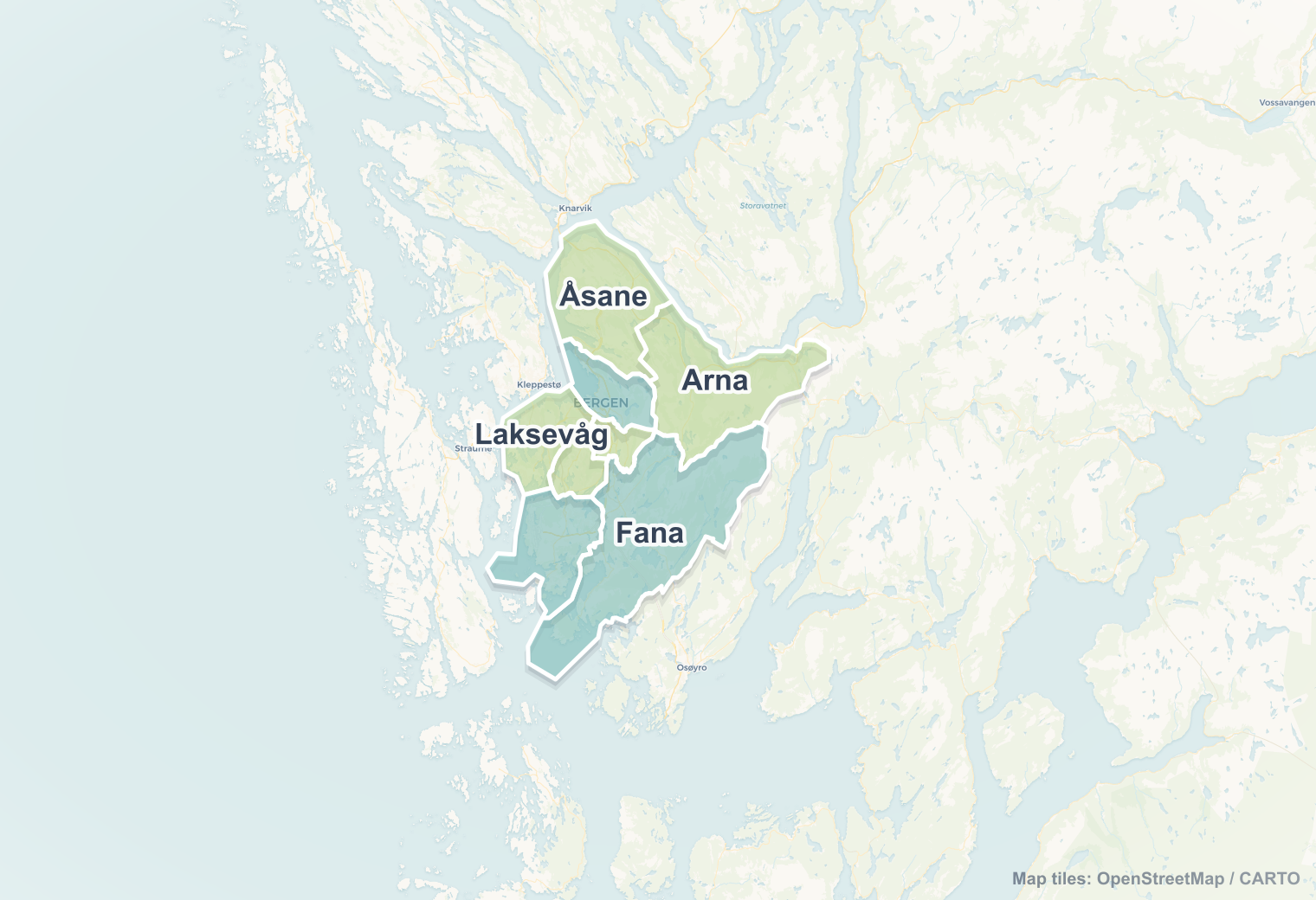
Use the map to compare districts before deciding where to book.
Stay decision guide
First time
BergenhusBergenhus is the cleanest first base: safety 90/100, transport 92/100, and fewer avoidable arrival mistakes.
Family
KronstadKronstad gives families the stronger calm-and-access trade-off, with safety 86/100 and night score 34/100.
Budget
ÅrstadUse Årstad as the value check only if the exact stay keeps transport clear; do not trade down toward Laksevåg for price alone.
Use the Bergen map as a decision tool before booking. Compare safety, transport, attraction access, and budget trade-offs district by district.
Interactive map
Click a district to see details, compare scores, and avoid booking in weaker areas. District tooltips show the neighborhood name, and the detail panel updates instantly.
Active district
Bergenhus
Excellent | score 91
Bergen
Central district of Bergen, including the historic Bryggen area (Bryggen). Main tourist and cultural hub with waterfront views, restaurants, and attractions.
Travel score
91
Safety
90
Transport
92
Community
91
Key strengths
Points to consider
9 results
District Comparison
Choose two districts and compare them side by side before booking. The tool highlights overall score, safety, transport, accommodation, night risk, and the practical trade-offs that matter most for a stay base.
| District | Safety | Vibe | Best for |
|---|---|---|---|
| Bergenhus | 90/100 | Lively | Families |
| Fana | 93/100 | Local | Families |
| Ytrebygda | 92/100 | Local | Families |
| Arna | 90/100 | Local | Families |
| Åsane | 88/100 | Local | Families |
Travel score 91/100
Central district of Bergen, including the historic Bryggen area (Bryggen). Main tourist and cultural hub with waterfront views, restaurants, and attractions.
Strengths
Watch-outs
Travel score 91/100
Large suburban district south of Bergen. Known for low-density housing, greenery, and affluent residential zones. Feels more like a quiet suburb than part of the city center.
Strengths
Watch-outs
Overall travel score
Best single read for choosing a low-friction tourist base.
Safety
How comfortable the area is likely to feel for a typical visitor.
Sightseeing convenience
Access to major attractions, useful streets, and visitor-friendly movement.
Transport
How easy it is to arrive, leave, and move around the city.
Accommodation
Hotel and apartment practicality for a short stay.
Night risk
Lower is better. Use this when late returns matter.
Community signal
Extra signal from user reviews where enough data exists.
Stay Decision Guide
Bergenhus is the clear choice for first-time visitors, combining the city's highest transport score (92/100) with strong safety (90/100) and direct access to Bergen's main sights including Bryggen. The central location means shorter evening journeys, which matters in a city where all districts score low for nighttime safety.
Bergen's good transport network (79.9/100) gives first-timers reasonable flexibility to stay beyond the center, but the system isn't comprehensive enough to ignore proximity completely. The compact historic core around Bergenhus concentrates most attractions within walking distance, reducing reliance on late-route connections.
First-timers should prioritize accommodation within easy walking distance of their evening plans rather than assuming transport will always be convenient after dark. Bergen's universal low night scores mean the walk home matters more than the neighborhood's daytime safety rating.
Fana works well for families visiting Bergen, offering the city's highest safety score (93/100) in a low-density suburban setting with greenery and residential calm. The transport score of 75/100 is adequate for daytime outings, and the quiet suburban character means fewer late-night return concerns than central districts.
Solo travelers should base in Bergenhus for its combination of excellent transport connections (92/100), central location that minimizes solo evening travel, and proximity to other travelers in the tourist hub. The district's slightly lower safety score (90/100) is offset by higher foot traffic and better late-route options than peripheral areas.
Budget travelers can find value in Ytrebygda or Fana without entering caution zones—both score 92-93/100 for safety—but the transport scores (70-75/100) mean longer journeys and more careful evening route planning. No districts in Bergen are flagged for safety concerns, so price alone doesn't indicate danger, just inconvenience.
Bergenhus places visitors directly in Bergen's historic center, with Bryggen, the waterfront, museums, and restaurants all within walking distance. The access is unmatched, and the transport score of 92/100 means easy connections to anything beyond the core.
Central location in Bergenhus comes with no meaningful safety penalty—it scores 90/100, just 3 points below the city's top-rated suburbs. The only tradeoff is that all Bergen districts, including central Bergenhus, score low (30/100) for nighttime safety, so staying central doesn't eliminate evening caution.
Basing in Fana or Ytrebygda gains quieter surroundings and marginally higher daytime safety scores (92-93/100), but you sacrifice 15-20 transport points and add 20-30 minutes to most attraction visits. The tradeoff makes sense for visitors prioritizing residential calm over sightseeing convenience.
Ytrebygda and Fana typically offer lower accommodation costs than central Bergenhus while maintaining excellent safety scores (92-93/100). Both are suburban districts with lower density and fewer tourist services, which drives prices down without introducing risk.
Bergen's safety-price tradeoff is forgiving—the 9-point spread between districts is narrow, and no areas are flagged for caution. The real compromise in budget districts is transport access (70-75/100 vs 92/100 centrally) and longer travel times, not personal safety during the day.
When choosing budget accommodation in Bergen, check the specific route back to your address after dark, not just the district name. Even in very safe districts, Bergen's universal low night scores mean isolated stops or poorly-lit stretches between the station and your door create the city's primary friction points.
Bergen has no hard caution zones, but unusually low prices near Bergen Station or in areas with weak transport connections should prompt closer inspection of the specific street and evening access. The city's primary risk is station-area friction, so proximity to the station doesn't automatically mean convenience.
If accommodation near transport hubs seems cheap, the scores suggest checking whether the immediate surroundings have awkward evening access or require walking through less-trafficked areas. Bergen's good-but-not-excellent transport tier (79.9/100) means gaps exist, and low prices often correlate with those gaps rather than danger.
Before booking anywhere in Bergen, map the evening return from your planned activities to the accommodation door. With 100% of districts scoring low at night, the specific route—not the district average—determines whether a location works, and a cheap place with an indirect or isolated walk creates unnecessary friction.
FAQ
Yes—Fana and Ytrebygda both score 92-93/100 for safety, higher than central Bergenhus at 90/100. The tradeoff is transport access (70-75/100 vs 92/100) and longer travel times, not safety. All Bergen districts score low at night, so evening route planning matters everywhere regardless of daytime safety scores.
Not always—station-area friction is Bergen's primary risk, and proximity to the station doesn't guarantee convenient access to your accommodation. Check the specific walking route from the station to your address, as Bergen's good-but-patchy transport score (79.9/100) means gaps exist even near central hubs.
Bergen's 100% low night scores reflect reduced foot traffic and limited late-night activity across all areas, not specific danger zones. The practical impact is that evening route planning—checking lighting, directness, and transport frequency—matters more than choosing one district over another.
Fana offers higher daytime safety (93/100 vs 90/100), quieter residential surroundings, and greenery, which suits families prioritizing calm over convenience. Bergenhus provides better transport access (92/100 vs 75/100) and shorter evening returns, reducing late-route concerns. The choice depends on whether you value proximity to attractions or a suburban environment.