First time
Eiganes og VålandEiganes og Våland is the cleanest first base: safety 92/100, transport 85/100, and fewer avoidable arrival mistakes.
Eiganes og Våland works best for first-timers, combining a 92 safety score with 85 transport access that lets you move across the city without stress. The district sits centrally with good connections, offsetting Stavanger's patchy night safety (89% of districts score low after dark) by keeping late returns short and well-lit.
Use this shortlist to choose an area first, then compare the exact district on the map. Stavanger is generally safe, but pickpocketing is common in tourist areas.
First time
Eiganes og VålandEiganes og Våland is the cleanest first base: safety 92/100, transport 85/100, and fewer avoidable arrival mistakes.
Family
HinnaHinna gives families the stronger calm-and-access trade-off, with safety 85/100 and night score 35/100.
Budget
StorhaugUse Storhaug as the value check only if the exact stay keeps transport clear; do not trade down toward Storhaug for price alone.
Explore them on the map:
See safest areas on the mapStavanger safety map
Use the map to compare districts before deciding where to book.
Stay decision guide
First time
Eiganes og VålandEiganes og Våland is the cleanest first base: safety 92/100, transport 85/100, and fewer avoidable arrival mistakes.
Family
HinnaHinna gives families the stronger calm-and-access trade-off, with safety 85/100 and night score 35/100.
Budget
StorhaugUse Storhaug as the value check only if the exact stay keeps transport clear; do not trade down toward Storhaug for price alone.
Use the Stavanger map as a decision tool before booking. Compare safety, transport, attraction access, and budget trade-offs district by district.
Interactive map
Click a district to see details, compare scores, and avoid booking in weaker areas. District tooltips show the neighborhood name, and the detail panel updates instantly.
Active district
Eiganes og Våland
Excellent | score 93
Stavanger
Upscale central district with villas, parks and high living standards.
Travel score
93
Safety
92
Transport
85
Community
93
Key strengths
Points to consider
9 results
District Comparison
Choose two districts and compare them side by side before booking. The tool highlights overall score, safety, transport, accommodation, night risk, and the practical trade-offs that matter most for a stay base.
| District | Safety | Vibe | Best for |
|---|---|---|---|
| Eiganes og Våland | 92/100 | Quiet | Families |
| Finnøy | 95/100 | Quiet | Families |
| Rennesøy | 92/100 | Local | Families |
| Hundvåg | 88/100 | Local | Families |
| Hinna | 85/100 | Local | Families |
Travel score 93/100
Upscale central district with villas, parks and high living standards.
Strengths
Watch-outs
Travel score 93/100
Rural island district with scenic landscapes and very low density.
Strengths
Watch-outs
Overall travel score
Best single read for choosing a low-friction tourist base.
Safety
How comfortable the area is likely to feel for a typical visitor.
Sightseeing convenience
Access to major attractions, useful streets, and visitor-friendly movement.
Transport
How easy it is to arrive, leave, and move around the city.
Accommodation
Hotel and apartment practicality for a short stay.
Night risk
Lower is better. Use this when late returns matter.
Community signal
Extra signal from user reviews where enough data exists.
Stay Decision Guide
Eiganes og Våland works best for first-timers, combining a 92 safety score with 85 transport access that lets you move across the city without stress. The district sits centrally with good connections, offsetting Stavanger's patchy night safety (89% of districts score low after dark) by keeping late returns short and well-lit.
Stavanger's good-but-not-excellent transport tier (73.3/100) means you can stay outside the center, but distances add up quickly on evening returns when most districts drop in comfort. The city sprawls across peninsulas and islands, so choosing a district with solid daytime transport becomes critical when night options thin out.
Check your accommodation's walking distance to the nearest bus stop with evening service—Stavanger's transport network contracts significantly after dark, and a 10-minute walk that feels safe at noon can become the weak link in your late-return route.
Families should choose Eiganes og Våland, where the 92 safety score and 85 transport access give flexibility for day trips while keeping evening returns predictable. The low night score (28) matters less when you control your schedule and can plan around early dinners and daylight activities.
Solo travelers benefit most from Eiganes og Våland's transport score of 85, which provides independence without requiring a car in a city where 89% of districts feel less comfortable after dark. The central location minimizes the need to navigate unfamiliar night routes alone, and the 92 safety score holds steady across all hours.
Budget travelers can look at districts slightly outside Eiganes og Våland without hitting caution zones—Stavanger has zero flagged districts, but the 19-point score spread means transport access drops faster than safety. Prioritize districts above 70 on transport if you want to avoid feeling stranded in the evenings when connections thin out.
Eiganes og Våland puts you closest to Stavanger's central museums, harbour district, and old town (Gamle Stavanger), with an 85 transport score that makes reaching outlying attractions like Pulpit Rock base camps manageable. The access tradeoff is minimal here—you gain proximity without sacrificing safety or evening mobility.
Central location in Stavanger carries no meaningful safety cost; the city scores 85.2/100 overall with no caution districts, so staying near the core doesn't require the usual vigilance. The real cost is night comfort (28 night score even in top districts), but that's city-wide rather than a penalty for choosing centrally.
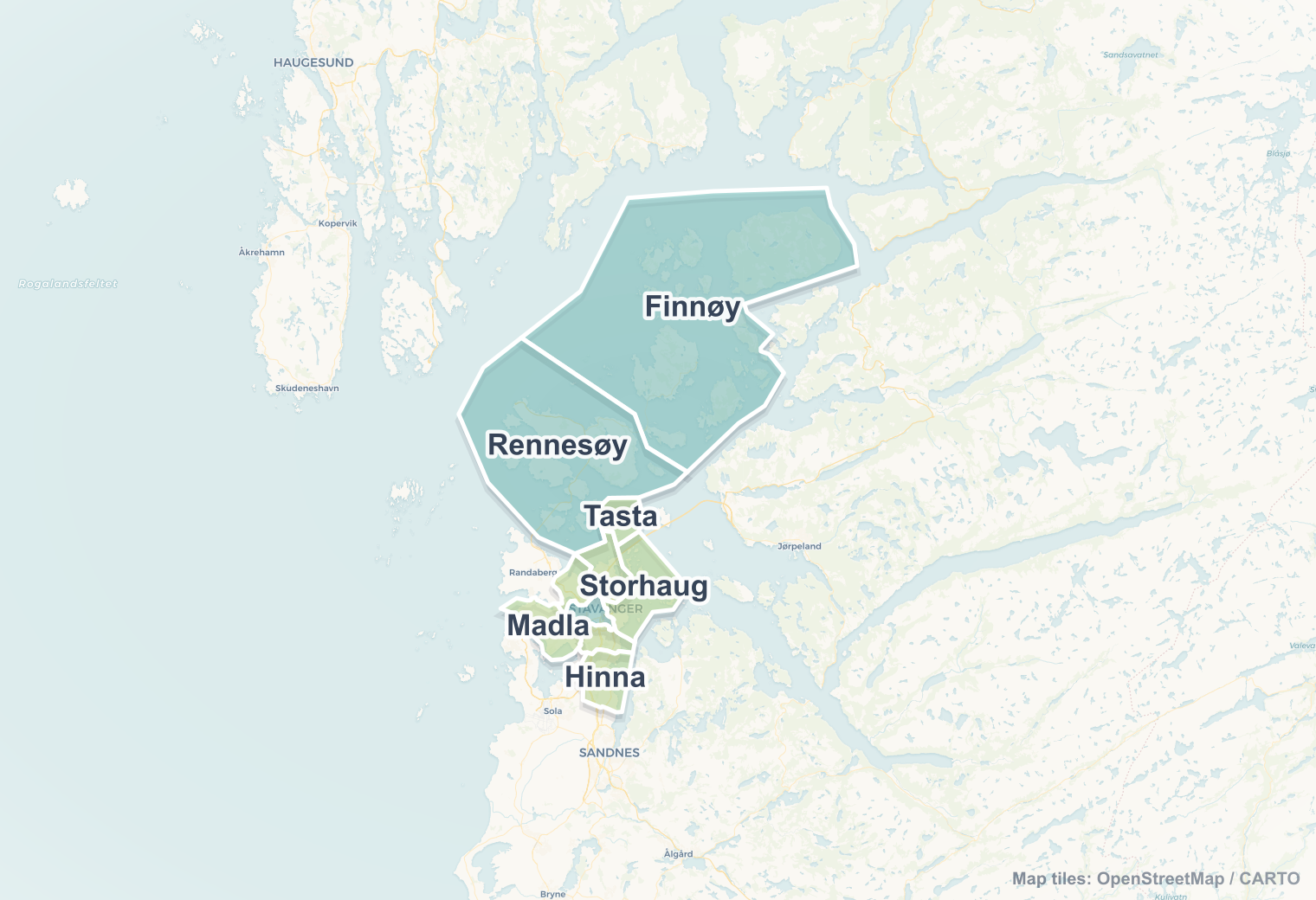
Basing slightly further out on the islands—Finnøy (safety 95, transport 45) or Rennesøy (safety 92, transport 50)—gains scenic peace and marginally higher daytime safety but cuts transport access nearly in half. You'll need a car or careful bus planning, and evening returns become 30–45 minute commitments rather than 10-minute rides.
Districts below the 90-safety threshold but above 80 still avoid caution status in Stavanger, and their lower profile often translates to better accommodation value. The trade-off shows up in transport scores—expect to see numbers in the 60s rather than 80s, adding 10–15 minutes to most journeys.
The safety-vs-price line in Stavanger sits around the 80 safety mark; below that you're not entering dangerous territory (zero caution districts city-wide), but you are moving into areas where transport drops off enough to make evening plans more restrictive. The real cost is flexibility, not personal risk.
Check the evening bus schedule from any budget accommodation address—Stavanger's good daytime transport (73.3/100) doesn't guarantee night service, and a district with hourly buses after 21:00 becomes effectively isolated if you miss your connection.
In districts with transport scores below 60, a low accommodation price usually reflects isolation rather than risk—Finnøy (transport 45) and Rennesøy (transport 50) are among the safest in the city but require car access or tight schedule adherence. If you're booking there without wheels, you're accepting significant mobility limits.
When a price drops noticeably in Stavanger, check the night score and transport score together—89% of districts score low at night, so the price gap often reflects accommodation sitting far from evening-viable bus stops. The safety score may be fine (no caution zones city-wide), but your practical comfort radius shrinks after 20:00.
Before booking anywhere in Stavanger, map the evening return from your planned activities back to that address: does the route involve a 15-minute walk after the last bus, or does it keep you within 5 minutes of a stop with service until 23:00? The city's 28-point night scores across top districts mean even excellent areas feel less comfortable once darkness falls and foot traffic thins.
FAQ
Yes—Stavanger has zero caution districts and an 85.2 safety average, so moving outward doesn't enter unsafe territory. The real trade-off is transport access (scores drop from 85 centrally to 45–50 on outlying islands), which limits evening flexibility more than it affects daytime safety.
89% of Stavanger's districts score low at night (25–28 points), reflecting reduced foot traffic, limited late transport, and darker streets rather than crime risk. The city's overall safety remains very high (85.2/100), but comfort and convenience drop significantly after dark across nearly all areas.
Eiganes og Våland combines a 92 safety score with 85 transport access, making it the only district in Stavanger where both metrics stay strong. This balance matters in a city where good transport (73.3/100) doesn't extend evenly, and most districts show a steep drop in either safety or connections.
Not for safety—both score 92–95 on safety, among the highest in the city. Avoid them if you don't have a car, as their transport scores (45–50) make spontaneous evening trips or last-minute schedule changes difficult. They work well for visitors prioritizing scenery and calm over mobility.