First time
FrognerFrogner is the cleanest first base: safety 92/100, transport 90/100, and fewer avoidable arrival mistakes.
Frogner is the strongest choice for first-time visitors, scoring 92 for safety and 90 for transport while placing you in the central-west heart of the city. The combination of excellent public transport connections and consistently high safety scores means you can explore confidently without needing to master Oslo's layout immediately.
Use this shortlist to choose an area first, then compare the exact district on the map. Oslo is generally safe, but pickpocketing is common in tourist areas.
First time
FrognerFrogner is the cleanest first base: safety 92/100, transport 90/100, and fewer avoidable arrival mistakes.
Family
St. HanshaugenSt. Hanshaugen gives families the stronger calm-and-access trade-off, with safety 88/100 and night score 32/100.
Budget
SentrumUse Sentrum as the value check only if the exact stay keeps transport clear; do not trade down toward Stovner for price alone.
Explore them on the map:
See safest areas on the mapOslo safety map
Use the map to compare districts before deciding where to book.
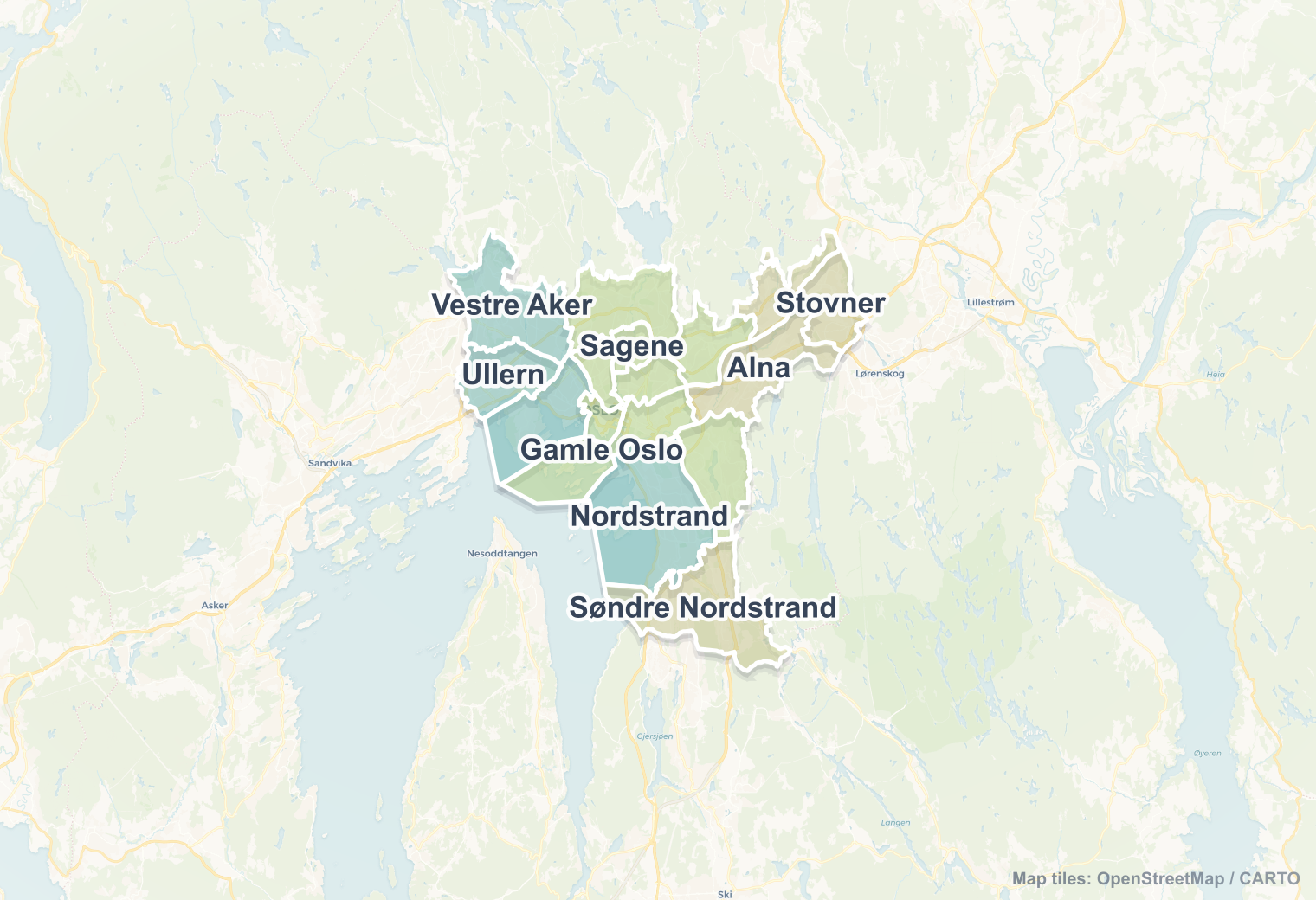
Stay decision guide
First time
FrognerFrogner is the cleanest first base: safety 92/100, transport 90/100, and fewer avoidable arrival mistakes.
Family
St. HanshaugenSt. Hanshaugen gives families the stronger calm-and-access trade-off, with safety 88/100 and night score 32/100.
Budget
SentrumUse Sentrum as the value check only if the exact stay keeps transport clear; do not trade down toward Stovner for price alone.
Use the Oslo map as a decision tool before booking. Compare safety, transport, attraction access, and budget trade-offs district by district.
Interactive map
Click a district to see details, compare scores, and avoid booking in weaker areas. District tooltips show the neighborhood name, and the detail panel updates instantly.
Active district
Frogner
Excellent | score 91
Oslo
Prestigious central-west district with parks, embassies, and upscale living.
Travel score
91
Safety
92
Transport
90
Community
91
Key strengths
Points to consider
16 results
District Comparison
Choose two districts and compare them side by side before booking. The tool highlights overall score, safety, transport, accommodation, night risk, and the practical trade-offs that matter most for a stay base.
| District | Safety | Vibe | Best for |
|---|---|---|---|
| Frogner | 92/100 | Lively | Families |
| Nordstrand | 90/100 | Local | Families |
| Ullern | 90/100 | Local | Families |
| Vestre Aker | 90/100 | Local | Families |
| St. Hanshaugen | 88/100 | Local | Families |
Travel score 91/100
Prestigious central-west district with parks, embassies, and upscale living.
Strengths
Watch-outs
Travel score 90/100
Coastal residential district known for safety and quiet environment.
Strengths
Watch-outs
Overall travel score
Best single read for choosing a low-friction tourist base.
Safety
How comfortable the area is likely to feel for a typical visitor.
Sightseeing convenience
Access to major attractions, useful streets, and visitor-friendly movement.
Transport
How easy it is to arrive, leave, and move around the city.
Accommodation
Hotel and apartment practicality for a short stay.
Night risk
Lower is better. Use this when late returns matter.
Community signal
Extra signal from user reviews where enough data exists.
Stay Decision Guide
Frogner is the strongest choice for first-time visitors, scoring 92 for safety and 90 for transport while placing you in the central-west heart of the city. The combination of excellent public transport connections and consistently high safety scores means you can explore confidently without needing to master Oslo's layout immediately.
Oslo's good transport system (78.4/100) gives first-timers reasonable flexibility, but the city's 69% night risk rate across districts means your base location directly affects evening comfort. The transport network performs well during the day but becomes patchier at night in outer districts, making central or western locations more forgiving for visitors still learning routes.
Factor in your likely return time when choosing where to stay in Oslo—the city's primary risk centers on late-return routes and night-time comfort rather than daytime safety. A district that feels accessible at noon may have sparse transport options after 11pm, particularly in areas beyond the central core.
Families should consider Nordstrand, which combines a 90 safety score with coastal residential calm and a 70 transport score that still connects to central Oslo. The quiet environment and low night risk (30) matter more when traveling with children who keep earlier schedules, and the residential character means fewer crowds and more predictable surroundings.
Solo travelers benefit most from Frogner's combination of 92 safety, 90 transport, and central location—the ability to return late without depending on taxis or long waits matters significantly when traveling alone in a city where 69% of districts score low at night. The district's embassy presence and upscale character create consistent foot traffic and well-lit streets even in evening hours.
Budget travelers should focus on districts just outside the premium central zone but well before the caution threshold—areas in the 75-85 safety range with transport scores above 70. Avoid chasing rock-bottom prices in Grorud (65 safety), Alna (62 safety), or Stovner (60 safety), where the savings come with measurably higher risk and weaker transport links.
Frogner places visitors within walking or short transit distance of Oslo's museum quarter, palace, and harbor districts while maintaining the city's highest combined safety and transport scores. The central-west position means you're near major sights without crossing into the more mixed-character districts that border the eastern approaches.
Central location in Oslo does not carry the safety penalties common in other European capitals—the city's safest district is also among its most central. The 33-point spread between top and bottom districts runs more along an east-versus-west axis than a center-versus-periphery pattern, so staying central actually reduces risk rather than increasing it.
Basing in Vestre Aker makes sense when you value forest access and suburban quiet over hyper-central location, trading 15 transport points (75 vs 90) for proximity to hiking trails while keeping a 90 safety score. You'll add 15-25 minutes to museum trips but gain immediate access to Nordmarka forest and a more residential evening atmosphere.
Districts in the 75-85 safety range with transport scores above 70 offer the best value-to-safety ratio in Oslo, sitting below premium Frogner pricing but well above the 60-65 caution threshold. Look for accommodation in the inner ring of residential districts that score solidly on both metrics rather than chasing the lowest nightly rate.
Oslo's safety-price line sits clearly at the 65-point mark—below this threshold you enter Grorud, Alna, and Stovner territory where accommodation may cost less but night risk increases and transport connections weaken notably. The price difference rarely justifies the measurable drop in evening comfort and route options, particularly given Oslo's high baseline costs make even budget accommodation expensive by global standards.
Check the specific evening transport frequency from any budget accommodation address in Oslo, not just the existence of a nearby stop. A bus route that runs every 8 minutes until midnight is fundamentally different from one that shifts to 30-minute intervals after 8pm, and this distinction matters critically in a city where 69% of districts score low for night safety.
Stovner (60 safety), Alna (62 safety), and Grorud (65 safety) consistently offer Oslo's lowest accommodation prices, but the tradeoff is measurably weaker transport (all scoring 70 or below) and significantly elevated night risk. These outer northeastern districts combine dense housing with social challenges that show clearly in the safety data, and the transport connections don't compensate for the increased evening vulnerability.
When Oslo accommodation pricing drops notably below the city average, check whether the address falls in the eastern or northeastern districts—this is where the score spread becomes starkest and the 69% night risk concentration appears. Low prices in these areas signal genuine gaps in safety and transport infrastructure rather than hidden bargains, particularly for properties more than 20 minutes from the central core.
Before booking any Oslo accommodation, map the specific evening return route from your most likely dinner or activity locations back to the address. A property that looks well-connected on paper may require two bus transfers after 10pm or sit 800 meters from the nearest night-service stop, and Oslo's primary risk—late-return routes and night-time comfort—plays out exactly in this scenario.
FAQ
69% of Oslo's districts score low for night safety primarily due to sparse late-evening transport frequency and reduced street activity rather than violent crime rates. The city's overall safety score of 78.2/100 is solid, but public transport and foot traffic thin significantly after 10pm in residential districts, creating comfort rather than danger concerns. This pattern makes district choice critical for visitors who plan evening activities, as the difference between a well-connected central district and an outer residential area becomes stark after dark.
Oslo's 33-point spread from top districts like Frogner (92) to caution areas like Stovner (60) reflects transport accessibility, evening route options, and social infrastructure more than violent crime rates. The northeastern districts flagged for caution show measurably weaker transit connections and fewer evening services, which compounds perception of risk and reduces practical options for late returns. Norway's overall low crime rates mean the spread indicates comfort and convenience gaps rather than immediate physical danger.
Transport scores help but don't fully offset safety gaps in Oslo's lower-rated districts—Grorud, Alna, and Stovner all score 70 or below for transport alongside their 60-65 safety ratings, meaning the weakness clusters. Even where transport exists, frequency drops significantly at night in these areas, which directly feeds the city's 69% night risk problem. The highest-rated districts like Frogner combine both strong safety (92) and strong transport (90), showing these factors reinforce rather than trade off against each other.
Frogner's 28 night score sits within Oslo's broader pattern of low night ratings but pairs with 92 safety and 90 transport, meaning evening vulnerability is lower despite the score. The night metric reflects reduced activity levels after dark rather than elevated danger, and Frogner's central-west location, embassy presence, and upscale character maintain better lighting and foot traffic than outer districts. The practical difference is frequency of transport options and fallback routes—Frogner offers multiple alternatives where outer districts may have only one thinning bus line.