First time
Centro storicoCentro storico is the cleanest first base: safety 75/100, transport 95/100, and fewer avoidable arrival mistakes.
Centro Storico works best for first-timers despite its lower safety score of 75 because it pairs direct access to landmarks with Florence's highest transport score of 95. The good transport network means you can move efficiently without needing to decode bus routes or walk long distances after dark.
Use this shortlist to choose an area first, then compare the exact district on the map. Florence is generally safe, but pickpocketing is common in tourist areas.
First time
Centro storicoCentro storico is the cleanest first base: safety 75/100, transport 95/100, and fewer avoidable arrival mistakes.
Family
Campo di MarteCampo di Marte gives families the stronger calm-and-access trade-off, with safety 80/100 and night score 40/100.
Budget
RifrediUse Rifredi as the value check only if the exact stay keeps transport clear; do not trade down toward Rifredi for price alone.
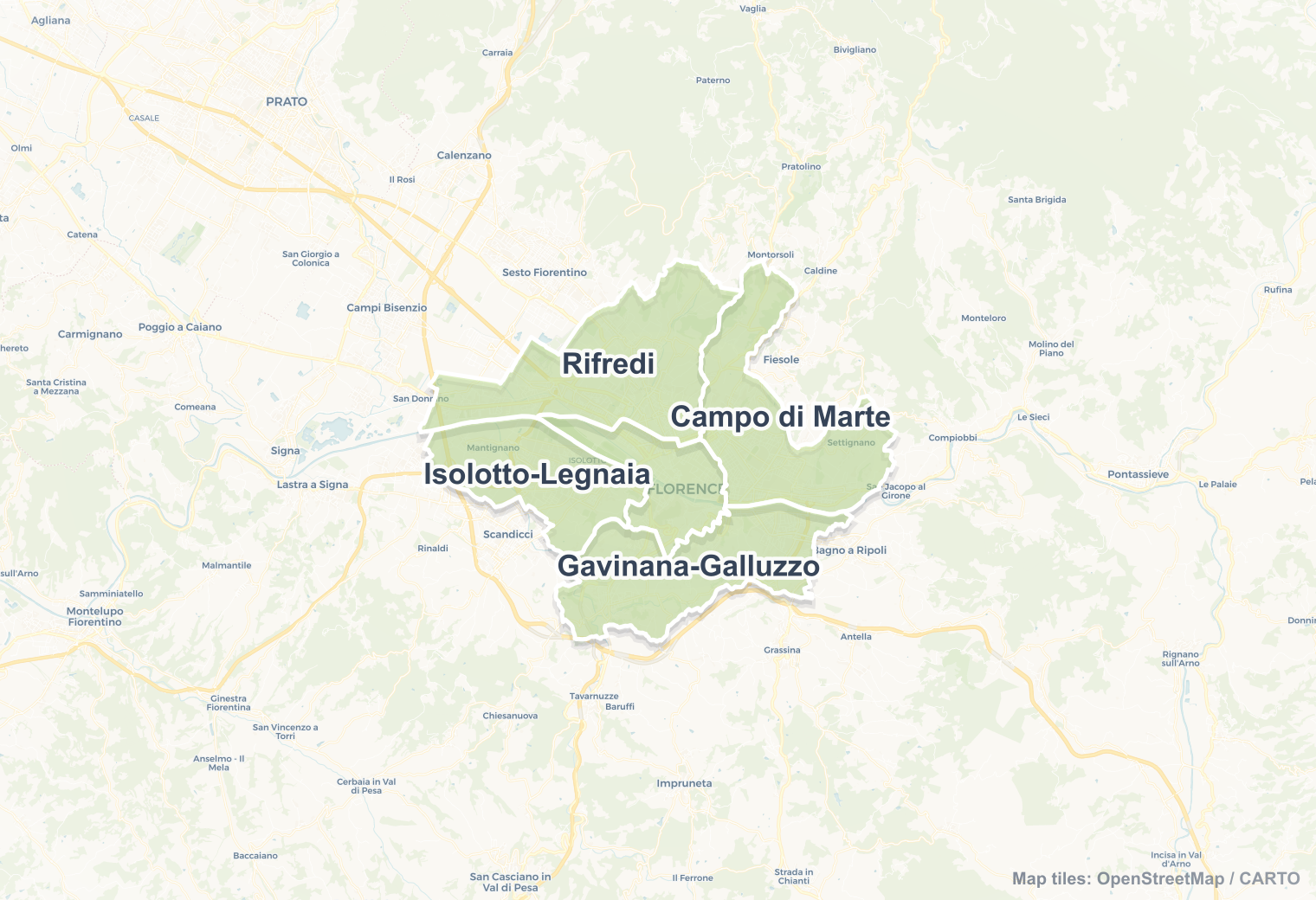
Explore them on the map:
See safest areas on the mapFlorence safety map
Use the map to compare districts before deciding where to book.
Stay decision guide
First time
Centro storicoCentro storico is the cleanest first base: safety 75/100, transport 95/100, and fewer avoidable arrival mistakes.
Family
Campo di MarteCampo di Marte gives families the stronger calm-and-access trade-off, with safety 80/100 and night score 40/100.
Budget
RifrediUse Rifredi as the value check only if the exact stay keeps transport clear; do not trade down toward Rifredi for price alone.
Use the Florence map as a decision tool before booking. Compare safety, transport, attraction access, and budget trade-offs district by district.
Interactive map
Click a district to see details, compare scores, and avoid booking in weaker areas. District tooltips show the neighborhood name, and the detail panel updates instantly.
Active district
Gavinana-Galluzzo
Good | score 82
Florence
Suburban and green area south of center.
Travel score
82
Safety
85
Transport
70
Community
82
Key strengths
Points to consider
5 results
District Comparison
Choose two districts and compare them side by side before booking. The tool highlights overall score, safety, transport, accommodation, night risk, and the practical trade-offs that matter most for a stay base.
| District | Safety | Vibe | Best for |
|---|---|---|---|
| Gavinana-Galluzzo | 85/100 | Local | Families |
| Centro storico | 75/100 | Lively | Nightlife |
| Campo di Marte | 80/100 | Local | First-time visitors |
| Rifredi | 75/100 | Local | First-time visitors |
| Isolotto-Legnaia | 75/100 | Local | First-time visitors |
Travel score 82/100
Suburban and green area south of center.
Strengths
Watch-outs
Travel score 80/100
Historic heart of Florence with all major landmarks.
Strengths
Watch-outs
Overall travel score
Best single read for choosing a low-friction tourist base.
Safety
How comfortable the area is likely to feel for a typical visitor.
Sightseeing convenience
Access to major attractions, useful streets, and visitor-friendly movement.
Transport
How easy it is to arrive, leave, and move around the city.
Accommodation
Hotel and apartment practicality for a short stay.
Night risk
Lower is better. Use this when late returns matter.
Community signal
Extra signal from user reviews where enough data exists.
Stay Decision Guide
Centro Storico works best for first-timers despite its lower safety score of 75 because it pairs direct access to landmarks with Florence's highest transport score of 95. The good transport network means you can move efficiently without needing to decode bus routes or walk long distances after dark.
Florence's compact historic center makes navigation straightforward, but the city's universal low night scores mean every district requires the same evening caution. The good transport tier gives you flexibility to stay slightly outside the tourist core without being stranded, though connections thin out after 23:00.
Factor in that Florence's primary risk is pickpocketing in crowded tourist zones, so staying central means accepting higher daytime friction around major sites even though your accommodation base itself isn't unsafe.
Gavinana-Galluzzo works best for families with its highest safety score of 85 and suburban green spaces, though the lower transport score of 70 means planning return trips before evening services thin. The 35 night score matches the city average, so no district offers a meaningful evening advantage.
Solo travelers should consider Campo di Marte, which balances an 80 safety score with strong 85 transport access and a residential feel that reduces tourist-targeted friction. The area's proximity to parks and the stadium creates local activity without the intense crowding of Centro Storico.
Budget travelers can look at Gavinana-Galluzzo or Campo di Marte without entering caution territory, as both score above 80 for safety and cost less than Centro Storico. No Florence districts are flagged for caution, so the primary concern is transport access rather than safety dropoff.
Centro Storico puts you within walking distance of the Duomo, Uffizi, and Ponte Vecchio, with a 95 transport score ensuring you can reach outlying sites easily. The tradeoff is a safety score of 75 due to constant tourist crowds and the pickpocketing that follows them.
Staying central in Florence costs you 10 safety points compared to suburban districts but doesn't introduce dangerous conditions—the risk is theft and tourist-friction, not personal safety threats. The night score of 45 is actually Florence's highest, though still low enough to require evening awareness.
Basing in Campo di Marte or Gavinana-Galluzzo makes sense when you value quieter surroundings and higher safety scores over walk-to-everything access. You gain 5-10 safety points and green space but give up convenience—Campo di Marte's 85 transport score mitigates this better than Gavinana-Galluzzo's 70.
Gavinana-Galluzzo and Campo di Marte offer lower accommodation costs with safety scores of 85 and 80 respectively, well above Centro Storico's 75. Neither district carries caution flags, so the value proposition is genuine rather than risk-discounted pricing.
Florence's safety-price tradeoff is narrow because the 9-point score spread means no district is meaningfully unsafe—you're choosing between low tourist friction and high convenience rather than safe versus risky. The line is transport access, not safety: Gavinana-Galluzzo's 70 transport score means checking last-bus times if you're out evenings.
Check the walking distance to the nearest bus stop with evening service when booking budget accommodation in any Florence district. The universal low night scores mean your return route matters more than your accommodation's specific street, especially after 23:00 when frequencies drop.
Even without caution zones, unusually low prices near Stazione Santa Maria Novella or the fringes of Centro Storico should prompt checking exact locations—these pockets attract transient crowds and concentrated pickpocketing activity. The district-level 75 safety score masks street-by-street variation in tourist friction.
If a price seems too low in Florence, the scores suggest it's likely reflecting noise, small rooms, or inconvenient transport rather than danger. The narrow 9-point safety spread and zero caution flags mean genuine risk isn't driving discounts, but comfort and access quality vary significantly.
Before booking anywhere in Florence, map the evening walk from the nearest transport stop to your accommodation address. With 100% of districts scoring low at night and pickpocketing as the primary risk, a well-lit 5-minute walk beats a dark 15-minute one regardless of daytime safety scores.
FAQ
Yes—Gavinana-Galluzzo scores 85 for safety and Campo di Marte scores 80, both higher than Centro Storico's 75. The main tradeoff is transport convenience, not safety risk, with Campo di Marte's 85 transport score offering better evening connectivity than Gavinana-Galluzzo's 70.
Florence's universal low night scores reflect concentrated pickpocketing risk and reduced lighting in historic areas rather than violent crime. The city's overall 78 safety average means the primary evening concern is theft prevention—keeping valuables secure and staying alert—not avoiding dangerous areas.
Yes—Centro Storico's 75 safety score reflects constant tourist crowds where pickpockets operate most actively. The district's 95 transport score and 45 night score (Florence's highest) offer practical advantages, but daytime theft friction is the price of staying steps from major landmarks.
Centro Storico with its 95 transport score offers the most frequent and extended service hours, critical given Florence's universal low night scores. Campo di Marte's 85 transport score is second-best, while Gavinana-Galluzzo's 70 means checking last-service times if you're returning after 23:00.