First time
Burano, Mazzorbo, TorcelloBurano, Mazzorbo, Torcello is the cleanest first base: safety 90/100, transport 65/100, and fewer avoidable arrival mistakes.
Murano and San Erasmo (safety score 88, transport score 65) offer first-timers a strong balance of security and accessibility for exploring Venice's main islands via vaporetto. The good-but-not-excellent transport tier means you'll rely on water buses with reasonable frequency, making these lagoon islands workable bases without stranding you far from central attractions.
Use this shortlist to choose an area first, then compare the exact district on the map. Venice is generally safe, but pickpocketing is common in tourist areas.
First time
Burano, Mazzorbo, TorcelloBurano, Mazzorbo, Torcello is the cleanest first base: safety 90/100, transport 65/100, and fewer avoidable arrival mistakes.
Family
Dorsoduro, S. Polo, S. Croce, Giudecca, Sacca FisolaDorsoduro, S. Polo, S. Croce, Giudecca, Sacca Fisola gives families the stronger calm-and-access trade-off, with safety 78/100 and night score 42/100.
Budget
S. Marco, Castello, S. Elena, CannaregioUse S. Marco, Castello, S. Elena, Cannaregio as the value check only if the exact stay keeps transport clear; do not trade down toward Marghera, Catene, Malcontenta for price alone.
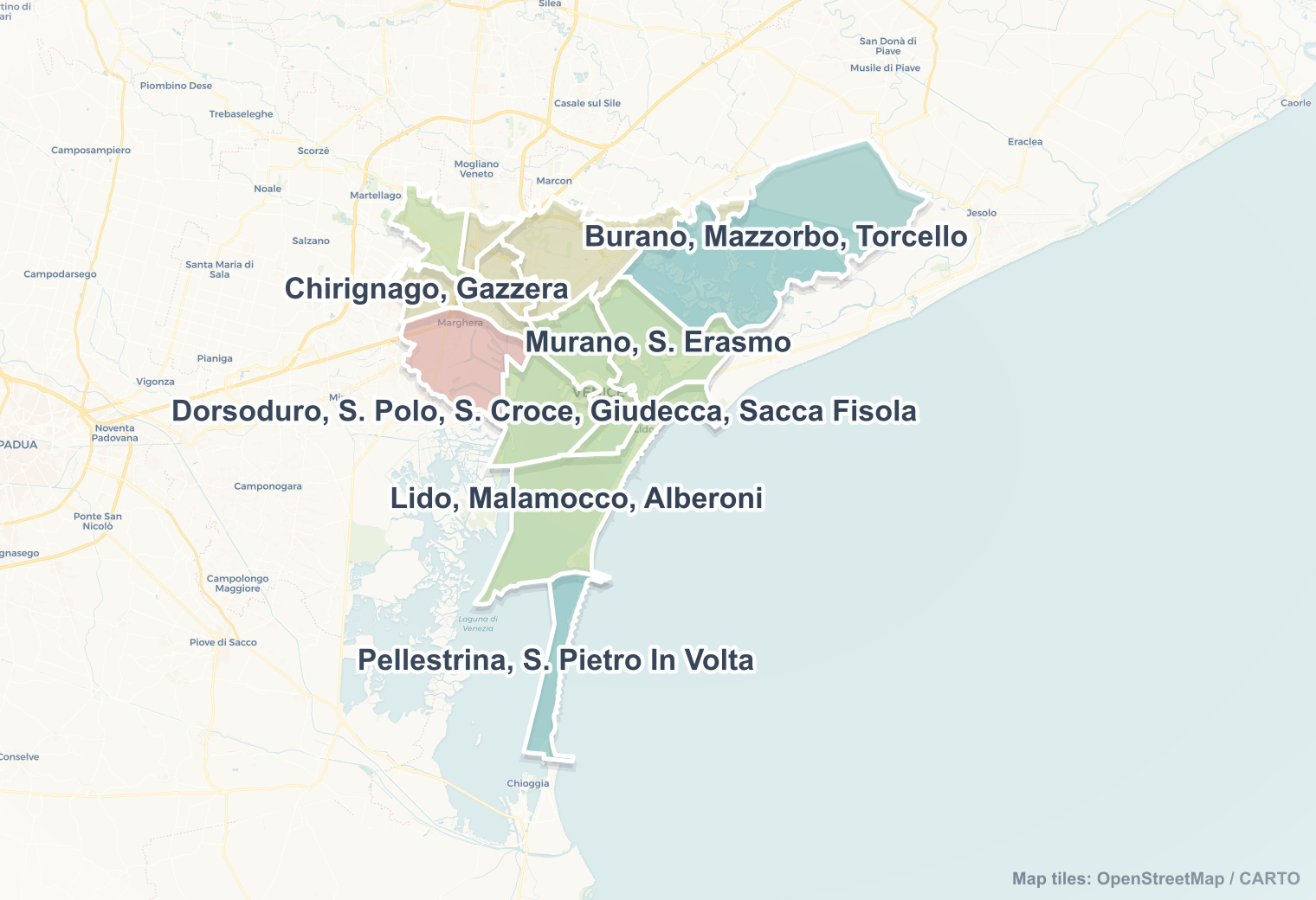
Explore them on the map:
See safest areas on the mapVenice safety map
Use the map to compare districts before deciding where to book.
Stay decision guide
First time
Burano, Mazzorbo, TorcelloBurano, Mazzorbo, Torcello is the cleanest first base: safety 90/100, transport 65/100, and fewer avoidable arrival mistakes.
Family
Dorsoduro, S. Polo, S. Croce, Giudecca, Sacca FisolaDorsoduro, S. Polo, S. Croce, Giudecca, Sacca Fisola gives families the stronger calm-and-access trade-off, with safety 78/100 and night score 42/100.
Budget
S. Marco, Castello, S. Elena, CannaregioUse S. Marco, Castello, S. Elena, Cannaregio as the value check only if the exact stay keeps transport clear; do not trade down toward Marghera, Catene, Malcontenta for price alone.
Use the Venice map as a decision tool before booking. Compare safety, transport, attraction access, and budget trade-offs district by district.
Interactive map
Click a district to see details, compare scores, and avoid booking in weaker areas. District tooltips show the neighborhood name, and the detail panel updates instantly.
Active district
Pellestrina, S. Pietro In Volta
Excellent | score 90
Venice
Narrow lagoon island with fishing villages and very quiet environment.
Travel score
90
Safety
90
Transport
55
Community
90
Key strengths
Points to consider
12 results
District Comparison
Choose two districts and compare them side by side before booking. The tool highlights overall score, safety, transport, accommodation, night risk, and the practical trade-offs that matter most for a stay base.
| District | Safety | Vibe | Best for |
|---|---|---|---|
| Pellestrina, S. Pietro In Volta | 90/100 | Local | Families |
| Burano, Mazzorbo, Torcello | 90/100 | Lively | Families |
| Murano, S. Erasmo | 88/100 | Quiet | Families |
| Lido, Malamocco, Alberoni | 85/100 | Local | Families |
| Dorsoduro, S. Polo, S. Croce, Giudecca, Sacca Fisola | 78/100 | Lively | Nightlife |
Travel score 90/100
Narrow lagoon island with fishing villages and very quiet environment.
Strengths
Watch-outs
Travel score 90/100
Colorful lagoon islands with peaceful atmosphere and unique scenery.
Strengths
Watch-outs
Overall travel score
Best single read for choosing a low-friction tourist base.
Safety
How comfortable the area is likely to feel for a typical visitor.
Sightseeing convenience
Access to major attractions, useful streets, and visitor-friendly movement.
Transport
How easy it is to arrive, leave, and move around the city.
Accommodation
Hotel and apartment practicality for a short stay.
Night risk
Lower is better. Use this when late returns matter.
Community signal
Extra signal from user reviews where enough data exists.
Stay Decision Guide
Murano and San Erasmo (safety score 88, transport score 65) offer first-timers a strong balance of security and accessibility for exploring Venice's main islands via vaporetto. The good-but-not-excellent transport tier means you'll rely on water buses with reasonable frequency, making these lagoon islands workable bases without stranding you far from central attractions.
Venice's fragmented island geography and 42-point safety spread between top and bottom districts mean first-timers face real navigation challenges, especially after dark when 50% of districts score low for night safety. The good transport network compensates somewhat, but expect 15-30 minute water bus journeys between islands and occasional service gaps in evening hours.
First-time visitors should map their evening return route from dinner or evening activities back to their accommodation before booking, since Venice's medium night risk and patchy island-to-island connections can leave you waiting at exposed stops or taking expensive water taxis after vaporetto schedules thin out.
Families should consider Burano, Mazzorbo, or Torcello (safety 90, transport 65, night safety 30) for the exceptionally high daytime security and peaceful atmosphere, though the low night score and 65 transport rating mean you'll need to plan evening activities carefully and accept earlier returns or taxi costs. The colorful, walkable setting works well for children during daylight hours when the islands feel safest.
Solo travelers fit better in Murano or San Erasmo (safety 88, transport 65, night 32) where slightly better evening scores and glassmaking activity create more movement after dark, reducing isolation risk. The transport score of 65 means solo travelers can reach central Venice independently without excessive waits, though you'll want to avoid the lowest-ranked mainland districts like Marghera (safety 50) where solo visibility increases risk.
Budget travelers should target the higher-ranked lagoon islands like Murano (safety 88) rather than chasing lower prices in Mestre Centro (safety 55) or Carpenedo (safety 60), where the 28-33 point safety drop and mixed reputations create real evening vulnerability. The good transport tier means staying on safer islands doesn't completely isolate you from central Venice, though you'll trade some travel time for security.
The historic center islands put visitors closest to St. Mark's Square, the Rialto Bridge, and major museums, but Venice's data shows sharp district-to-district safety gaps that can make some hyper-central areas riskier than slightly outer islands like Murano (safety 88). The good transport tier with a 70.4 score means water buses connect outer islands to central attractions in 15-30 minutes, making proximity less critical than in cities with patchy transit.
Central location in Venice doesn't automatically guarantee high safety scores—the 42-point spread across districts and the fact that 5 of 12 districts flag caution or avoid warnings mean some central mainland areas like Mestre Centro (safety 55) score significantly lower than outer lagoon islands. The medium night risk affecting 50% of districts compounds this, as central proximity won't help if your return route passes through lower-ranked zones after dark.
Basing on outer lagoon islands like Burano (safety 90) or Murano (safety 88) means accepting 20-40 minute vaporetto rides to central attractions and possible evening service limitations, but you gain 30-35 safety points over mainland districts like Marghera (safety 50) and a more predictable security environment. With Venice's good transport tier, this tradeoff works if you're comfortable planning around water bus schedules and occasional waits.
Murano and San Erasmo (safety 88) typically offer lower accommodation costs than the most central Venice islands while staying well above the caution threshold, maintaining a 28-33 point safety advantage over budget mainland options like Mestre Centro (safety 55) or Carpenedo (safety 60). The transport score of 65 for these islands means you'll have workable vaporetto access without the premium prices of hyper-central locations.
In Venice, the safety-versus-price line sits clearly between the lagoon islands (safety 88-90) and the mainland districts (safety 50-60), where a 30-40 point safety drop accompanies lower accommodation costs. The medium night risk makes this tradeoff meaningful—staying in Marghera (safety 50, verdict avoid) to save money puts you in an industrial area with low tourist presence and limited evening safety, while Murano costs more but keeps you in an 88-safety environment.
Before booking budget accommodation in Venice, verify the exact vaporetto stop name and check evening service frequency from that stop back to your accommodation, since the good-but-not-excellent transport tier (70.4) and low night scores (30-32) on even the safest islands mean some locations leave you exposed during service gaps. A 10-minute walk from a stop to your address can cross into lower-safety territory given Venice's sharp district-to-district variations.
Marghera, Catene, and Malcontenta (safety 50, verdict avoid) offer the lowest prices in Venice but sit in an industrial mainland zone with minimal tourist infrastructure and a 40-point safety deficit compared to Burano or Pellestrina. Mestre Centro (safety 55) and Carpenedo (safety 60) look more moderate but still carry caution verdicts and mixed reputations, with the medium night risk making evening movement genuinely problematic from these mainland bases.
When prices drop significantly below lagoon island rates in Venice, the scores reveal you're likely looking at mainland districts with transport scores of 55-65 and safety ratings 28-40 points lower than the top islands. The good transport tier doesn't fully compensate—Marghera's industrial character and low tourist presence mean even decent bus or train connections won't create the secure environment you'd find on Murano (safety 88) or Burano (safety 90).
Before booking anywhere in Venice, map the evening return from your planned dinner or activity areas back to the accommodation address and check whether that route passes through any of the 5 caution/avoid districts or crosses from island to mainland zones after dark. With 50% of districts scoring low at night and sharp safety gaps between areas, a cheap rate in Carpenedo or Mestre Centro can mean 30-40 minutes of exposed travel through lower-ranked zones when you're most vulnerable.
FAQ
Burano, Mazzorbo, Torcello, and Pellestrina score 90 for safety—the highest in Venice—but their night safety scores of 30 and transport scores of 55-65 mean evening returns require planning. These islands offer excellent daytime security but limited activity after dark, so factor in earlier returns or water taxi costs if you'll be out late in central Venice.
Venice shows a 42-point safety gap between top lagoon islands (Burano at 90) and mainland industrial areas (Marghera at 50), with 5 of 12 districts flagged caution or avoid. The primary risk is sharp district-to-district safety variation—crossing from a tourist-focused island to a mainland residential or industrial zone can drop safety scores by 30-40 points within one vaporetto stop.
Mestre Centro scores 55 for safety with a caution verdict, while nearby Carpenedo scores 60—both sit 30-35 points below the lagoon islands like Murano (88) or Burano (90). The medium night risk and mixed reputations in these mainland districts mean budget savings come with real evening vulnerability, especially when returning late from central Venice through areas with low tourist presence.
Venice's good transport tier (70.4) means vaporetto water buses connect most districts with reasonable frequency, giving you flexibility to stay on outer islands like Murano without total isolation. However, the good-but-not-excellent rating means evening service can thin out, and with 50% of districts scoring low for night safety, transport gaps after dark can leave you exposed at stops in lower-ranked areas.