First time
Campo MarzioCampo Marzio is the cleanest first base: safety 82/100, transport 90/100, and fewer avoidable arrival mistakes.
Colonna (safety 82, transport 90) works best for first-timers because its central location pairs excellent metro and bus access with above-average safety, letting you reach major sites without relying on late-night transport. The district's government presence and shopping streets mean consistent foot traffic during day hours, though night scores (38) still require awareness after dark.
Use this shortlist to choose an area first, then compare the exact district on the map. Rome is generally safe, but pickpocketing is common in tourist areas.
First time
Campo MarzioCampo Marzio is the cleanest first base: safety 82/100, transport 90/100, and fewer avoidable arrival mistakes.
Family
LudovisiLudovisi gives families the stronger calm-and-access trade-off, with safety 85/100 and night score 35/100.
Budget
ColonnaUse Colonna as the value check only if the exact stay keeps transport clear; do not trade down toward Esquilino for price alone.
Explore them on the map:
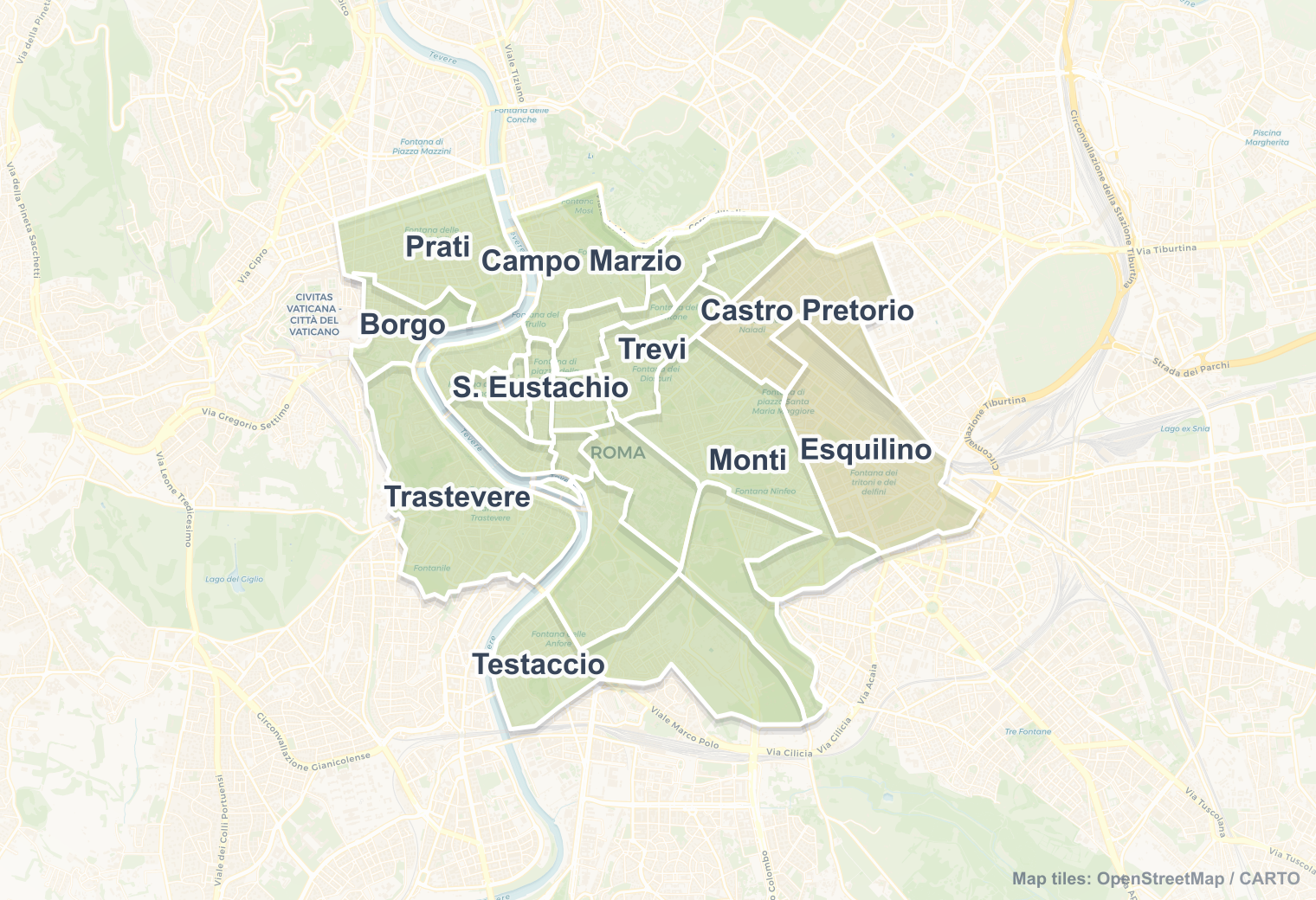
See safest areas on the mapRome safety map
Use the map to compare districts before deciding where to book.
Stay decision guide
First time
Campo MarzioCampo Marzio is the cleanest first base: safety 82/100, transport 90/100, and fewer avoidable arrival mistakes.
Family
LudovisiLudovisi gives families the stronger calm-and-access trade-off, with safety 85/100 and night score 35/100.
Budget
ColonnaUse Colonna as the value check only if the exact stay keeps transport clear; do not trade down toward Esquilino for price alone.
Use the Rome map as a decision tool before booking. Compare safety, transport, attraction access, and budget trade-offs district by district.
Interactive map
Click a district to see details, compare scores, and avoid booking in weaker areas. District tooltips show the neighborhood name, and the detail panel updates instantly.
Active district
Ludovisi
Good | score 85
Rome
Upscale district near Via Veneto with hotels and embassies.
Travel score
85
Safety
85
Transport
85
Community
85
Key strengths
Points to consider
22 results
District Comparison
Choose two districts and compare them side by side before booking. The tool highlights overall score, safety, transport, accommodation, night risk, and the practical trade-offs that matter most for a stay base.
| District | Safety | Vibe | Best for |
|---|---|---|---|
| Ludovisi | 85/100 | Lively | Families |
| San Saba | 88/100 | Local | Families |
| Colonna | 82/100 | Lively | Nightlife |
| Campo Marzio | 82/100 | Lively | Nightlife |
| Prati | 82/100 | Local | Value stays |
Travel score 85/100
Upscale district near Via Veneto with hotels and embassies.
Strengths
Watch-outs
Travel score 85/100
Quiet residential district with village-like feel and greenery.
Strengths
Watch-outs
Overall travel score
Best single read for choosing a low-friction tourist base.
Safety
How comfortable the area is likely to feel for a typical visitor.
Sightseeing convenience
Access to major attractions, useful streets, and visitor-friendly movement.
Transport
How easy it is to arrive, leave, and move around the city.
Accommodation
Hotel and apartment practicality for a short stay.
Night risk
Lower is better. Use this when late returns matter.
Community signal
Extra signal from user reviews where enough data exists.
Stay Decision Guide
Colonna (safety 82, transport 90) works best for first-timers because its central location pairs excellent metro and bus access with above-average safety, letting you reach major sites without relying on late-night transport. The district's government presence and shopping streets mean consistent foot traffic during day hours, though night scores (38) still require awareness after dark.
Rome's good transport network (83.6/100) gives first-timers flexibility to stay in well-connected districts rather than gambling on unfamiliar neighborhoods, but 86% of districts score low at night so your evening return route matters more than daytime convenience. The city's layout rewards choosing districts where you can walk or take direct metro lines back to your accommodation after dinner.
Check the specific metro line and final walking segment from your accommodation before committing—Rome's transport works well until services thin out after 23:30, and that last 400-meter walk through a quiet side street can determine whether your night score is 35 or much lower.
San Saba (safety 88, transport 70, night 32) works for families because its residential character and greenery create a village atmosphere with Rome's highest safety score, though the lower transport score means you'll rely more on taxis or planning bus connections for evening returns with children. The quiet streets and local feel offset the need for slightly more transport planning.
Ludovisi (safety 85, transport 85, night 35) serves solo travelers better than flashier districts because its embassy presence and upscale hotels create passive security without relying on nightlife crowds, and the balanced transport score means you won't get stranded after evening museum visits or dinners. Solo-specific risk in Rome centers on confident navigation of evening routes, which matters more than proximity to bars.
San Saba offers budget value through residential pricing while maintaining an 88 safety score, though its transport score of 70 means confirming bus routes before booking. Avoid chasing the lowest prices near Termini—Castro Pretorio (safety 60) and Esquilino (safety 55) are flagged for caution despite appearing budget-friendly.
Colonna (transport 90) puts you within walking or one-stop metro distance of the Trevi Fountain, Spanish Steps, and Pantheon, with the tradeoff being higher accommodation costs and more tourist density during peak hours. Ludovisi sits just north with similar access but slightly quieter streets away from the immediate crush.
Central location in Rome doesn't compromise safety during the day—Colonna scores 82—but night scores across all central districts hover in the 35-38 range, meaning evening comfort depends on staying on main streets and planning your route back rather than assuming safety comes automatically with location. The real cost of staying central is navigating crowds and managing late returns, not baseline risk.
Basing in San Saba or similar residential districts further from monuments makes sense when you value quiet evenings and higher safety scores (88 vs 82) over shaving 15 minutes off your morning commute. You gain residential calm and better night comfort but give up the spontaneity of walking home from dinner near the Pantheon—good transport (83.6 citywide) makes the tradeoff workable.
San Saba maintains an 88 safety score in a residential setting where accommodation costs less than embassy-district Ludovisi, though its transport score of 70 means you'll spend more time planning connections than in higher-scored districts. The village feel and greenery signal a neighborhood where locals live, not just a tourist overflow zone.
The safety-vs-price line in Rome sits clearly between residential districts like San Saba (88) and mixed-reputation areas near Termini like Castro Pretorio (60) and Esquilino (55). A 25-point score spread across the city means budget hunting can quickly cross from value into caution territory, especially within a 10-minute walk of the main train station.
Before booking budget accommodation, map the evening walking route from the nearest metro or bus stop to the actual address—Rome's night risk is high citywide, but a well-lit 3-minute walk on a residential street in San Saba differs substantially from a 7-minute walk through empty blocks near Termini where scores drop to 55-60.
Castro Pretorio (safety 60) and Esquilino (safety 55) appear budget-friendly because of their proximity to Termini station, but both carry caution flags due to mixed reputations, density, and the reality that cheap accommodation near a major transport hub usually signals underlying comfort issues. The tradeoff isn't just safety scores—it's navigating crowded streets, managing evening returns through areas where 86% of Rome already scores low at night, and dealing with the transient energy around a train station.
When prices near Termini drop well below citywide averages, the scores reveal why: safety in the 55-60 range, night scores in the low 30s, and streets where tourist inexperience becomes visible to opportunists. Rome's moderate 25-point score spread means genuinely safe districts exist at reasonable prices—rock-bottom rates signal you've crossed into the caution zone.
Before booking anywhere in Rome, map your evening return from a typical dinner or attraction closing time: which metro line, what time does service thin out, how far is the walk, and are those final streets residential or empty commercial blocks. With 86% of districts scoring low at night, that 10-minute walk determines whether a good deal becomes a daily stress point.
FAQ
Castro Pretorio and Esquilino near Termini both carry caution ratings with safety scores of 60 and 55 respectively, well below Rome's citywide average of 77.1. The mixed reputations stem from density, transient traffic, and the challenges inherent to major transport hubs—residential districts like San Saba (88) or central Colonna (82) offer better safety profiles with manageable transport connections.
86% of Rome's districts score low at night, so no area offers guaranteed comfort after dark, but Ludovisi (night 35), Colonna (night 38), and San Saba (night 32) perform better than most. The key is planning your specific route—main streets with lighting and residential foot traffic rather than empty side streets—because even top-scoring districts require route awareness after 23:00.
Rome's good transport network (83.6/100) means you don't have to sacrifice safety for access—Colonna offers both with a safety score of 82 and transport score of 90. Choosing cheaper central options near Termini drops safety to 55-60, while residential districts like San Saba (safety 88, transport 70) require slightly more planning but deliver better evening comfort.
With 86% of districts scoring low at night, direct metro access matters more for evening returns than daytime sightseeing, especially since Rome's transport thins out after 23:30. Districts like Colonna (transport 90) let you minimize walking segments after dark, while lower transport scores like San Saba's 70 mean confirming bus frequency and planning taxi options for late returns with luggage or children.