First time
Innere StadtInnere Stadt is the cleanest first base: safety 85/100, transport 95/100, and fewer avoidable arrival mistakes.
Geidorf is the strongest first-visit choice with a safety score of 90 and transport score of 90, placing you near the university and main cultural sites with excellent connections across the city. The district's student population means cafes, restaurants, and services operate predictably, which reduces navigation uncertainty for newcomers.
Use this shortlist to choose an area first, then compare the exact district on the map. Graz is generally safe, but pickpocketing is common in tourist areas.
First time
Innere StadtInnere Stadt is the cleanest first base: safety 85/100, transport 95/100, and fewer avoidable arrival mistakes.
Family
GeidorfGeidorf gives families the stronger calm-and-access trade-off, with safety 90/100 and night score 30/100.
Budget
Sankt LeonhardUse Sankt Leonhard as the value check only if the exact stay keeps transport clear; do not trade down toward Gries for price alone.
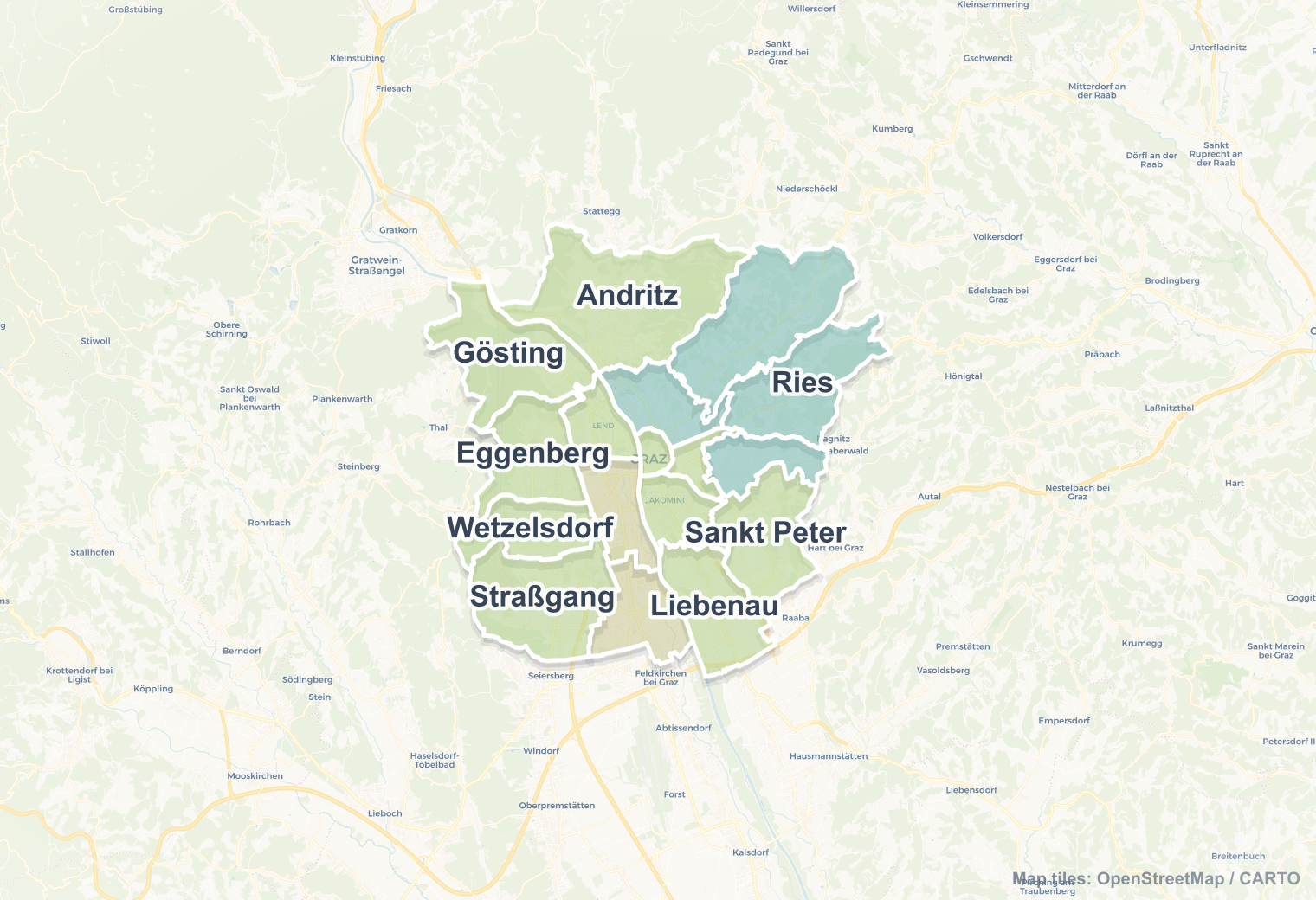
Explore them on the map:
See safest areas on the mapGraz safety map
Use the map to compare districts before deciding where to book.
Stay decision guide
First time
Innere StadtInnere Stadt is the cleanest first base: safety 85/100, transport 95/100, and fewer avoidable arrival mistakes.
Family
GeidorfGeidorf gives families the stronger calm-and-access trade-off, with safety 90/100 and night score 30/100.
Budget
Sankt LeonhardUse Sankt Leonhard as the value check only if the exact stay keeps transport clear; do not trade down toward Gries for price alone.
Use the Graz map as a decision tool before booking. Compare safety, transport, attraction access, and budget trade-offs district by district.
Interactive map
Click a district to see details, compare scores, and avoid booking in weaker areas. District tooltips show the neighborhood name, and the detail panel updates instantly.
Active district
Mariatrost
Excellent | score 90
Graz
Scenic district with basilica and hills.
Travel score
90
Safety
91
Transport
75
Community
90
Key strengths
Points to consider
17 results
District Comparison
Choose two districts and compare them side by side before booking. The tool highlights overall score, safety, transport, accommodation, night risk, and the practical trade-offs that matter most for a stay base.
| District | Safety | Vibe | Best for |
|---|---|---|---|
| Mariatrost | 91/100 | Lively | Families |
| Ries | 90/100 | Local | Families |
| Waltendorf | 90/100 | Local | Families |
| Geidorf | 90/100 | Quiet | Families |
| Innere Stadt | 85/100 | Lively | Families |
Travel score 90/100
Scenic district with basilica and hills.
Strengths
Watch-outs
Travel score 90/100
Rural and hilly outskirts.
Strengths
Watch-outs
Overall travel score
Best single read for choosing a low-friction tourist base.
Safety
How comfortable the area is likely to feel for a typical visitor.
Sightseeing convenience
Access to major attractions, useful streets, and visitor-friendly movement.
Transport
How easy it is to arrive, leave, and move around the city.
Accommodation
Hotel and apartment practicality for a short stay.
Night risk
Lower is better. Use this when late returns matter.
Community signal
Extra signal from user reviews where enough data exists.
Stay Decision Guide
Geidorf is the strongest first-visit choice with a safety score of 90 and transport score of 90, placing you near the university and main cultural sites with excellent connections across the city. The district's student population means cafes, restaurants, and services operate predictably, which reduces navigation uncertainty for newcomers.
Graz's good transport network (80.9/100) gives first-timers flexibility to stay slightly outside the center without losing access, but the city's night risk is high — 76% of districts score low after dark. This means your base should either be central enough to walk home after dinner, or on a well-lit route with reliable late tram service.
Check which tram or bus line serves your accommodation and whether it runs past 10pm — Graz's transport is good but not excellent, so late-evening gaps exist on certain routes and can turn a safe district into an uncomfortable wait.
Families should prioritize Waltendorf (safety 90, transport 75) for its upscale residential character and low-density streets, though the slightly lower transport score means confirming your route to attractions beforehand. The district's quiet nature offsets the night score of 30, since families typically return earlier and benefit from well-lit residential streets.
Solo travelers fit best in Geidorf (safety 90, transport 90, night 30) where the student presence creates social density and the transport score supports independent movement without taxi reliance. The combination matters in Graz specifically because high night risk elsewhere means solo travelers need both safe walking zones and backup transport options.
Budget travelers should focus on Mariatrost (safety 91, transport 75) where residential accommodation costs less than central districts while maintaining excellent safety, though the 75 transport score requires accepting 10-15 minute connections to the city center. Avoid budget options in Puntigam (safety 70) or Gries (safety 60) where industrial surroundings and mixed reputations create evening discomfort.
The Innere Stadt (historic center) places you within walking distance of Schlossberg, Hauptplatz, and the Kunsthaus, but the data shows this central concentration comes with lower evening comfort scores typical of tourist-heavy zones. Geidorf sits just north and gives you 10-minute access to the same sights with higher residential safety and better late-evening walking conditions.
Central Graz does not carry the safety penalties seen in larger cities — the very-safe rating (80.9/100) holds across most districts. The cost is navigational, not criminal: narrow medieval streets and limited signage after dark make wrong turns more likely, which matters when 76% of districts score low at night.
Basing in Mariatrost or Waltendorf makes sense when you value morning and evening quiet over spontaneous sightseeing, trading 15-20 minutes of commute time for dramatically higher safety scores (90-91) and residential calm. You give up walkability to dinner spots but gain predictable, safe return routes on the 1 or 6 tram lines.
Mariatrost and Waltendorf offer lower accommodation costs than Geidorf or the center while holding safety scores of 90-91, making them the value tier that doesn't compromise comfort. Both are residential districts where families live, not transitional zones, so the lower prices reflect distance rather than risk.
The safety-versus-price line in Graz sits clearly between the excellent-tier districts (safety 90-91) and Puntigam (safety 70) or Gries (safety 60). Anything below 70 reflects industrial character, mixed-use zones, or reputational issues that show up as discomfort rather than danger but still affect your evening experience.
Before booking budget accommodation in Graz, confirm the exact tram or bus stop name and check whether that line runs past 10pm — the transport score of 80.9 means good coverage but not comprehensive late service, so some addresses leave you walking 800+ meters in low-scored night zones.
Puntigam (safety 70) appears in budget searches because of its industrial-commercial character south of the city, but the tradeoff is evening isolation and long walks from transport stops through areas with few residents or lit shopfronts. Gries (safety 60) offers central proximity at lower prices but carries a mixed reputation that translates to discomfort walking alone after dark, particularly for solo or first-time visitors.
When a price seems unusually low in Graz, check whether the address sits near the Mur river industrial stretches, large parking areas, or train freight zones — these locations score poorly at night (30 or below across 76% of districts) because of low foot traffic and limited lighting, not crime rates. The safety score remains very-safe citywide, but comfort drops sharply once social density disappears.
Before booking anywhere in Graz, map your likely evening return from the historic center or main restaurant zones and confirm the route includes either a lit pedestrian path or a tram stop within 400 meters — the city's high night risk comes from isolation and poor lighting, not from danger, but the discomfort is real and shapes your entire stay.
FAQ
Graz scores 80.9/100 for safety but 76% of districts drop to low scores at night because of poor lighting, low foot traffic, and wide streets designed for trams rather than pedestrians. The risk is discomfort and isolation, not crime — you're statistically safe but may feel uneasy walking alone after 10pm in areas without active shopfronts or residential density.
Geidorf's night score of 30 reflects Graz's citywide lighting and foot-traffic patterns, not localized danger. The district's safety score of 90 and student population mean streets near the university and main routes stay moderately active until midnight, but side streets and parks empty quickly after dark. Plan routes along Harrachgasse or Heinrichstraße rather than cutting through residential blocks.
Gries (safety 60) functions fine during daylight for visiting the farmers market or passing through, but its mixed reputation and low evening comfort make it unsuitable as a base for accommodation. The district's score reflects inconsistent street conditions and a transitional character rather than acute danger, but solo travelers and families report discomfort walking after dark.
Most Graz tram lines run until 11pm-midnight on weekdays and slightly later on weekends, but frequency drops after 9pm and some peripheral routes end earlier. This matters because Mariatrost (transport 75) and Waltendorf (transport 75) depend on lines 1 and 6 — if you dine late or attend evening events, confirm your return tram runs or budget for taxis, since the 76% night risk makes walking 20+ minutes uncomfortable.