First time
InnsbruckInnsbruck is the cleanest first base: safety 85/100, transport 95/100, and fewer avoidable arrival mistakes.
Innsbruck's compact central district (Innere Stadt) works best for first-timers because good public transport (78.3/100) means you can reach key sights reliably without needing perfect walkability. The city scores 87.8/100 for safety, so daytime navigation is straightforward across all nine districts.
Use this shortlist to choose an area first, then compare the exact district on the map. Innsbruck is generally safe, but pickpocketing is common in tourist areas.
First time
InnsbruckInnsbruck is the cleanest first base: safety 85/100, transport 95/100, and fewer avoidable arrival mistakes.
Family
IglsIgls gives families the stronger calm-and-access trade-off, with safety 95/100 and night score 25/100.
Budget
WiltenUse Wilten as the value check only if the exact stay keeps transport clear; do not trade down toward Pradl for price alone.
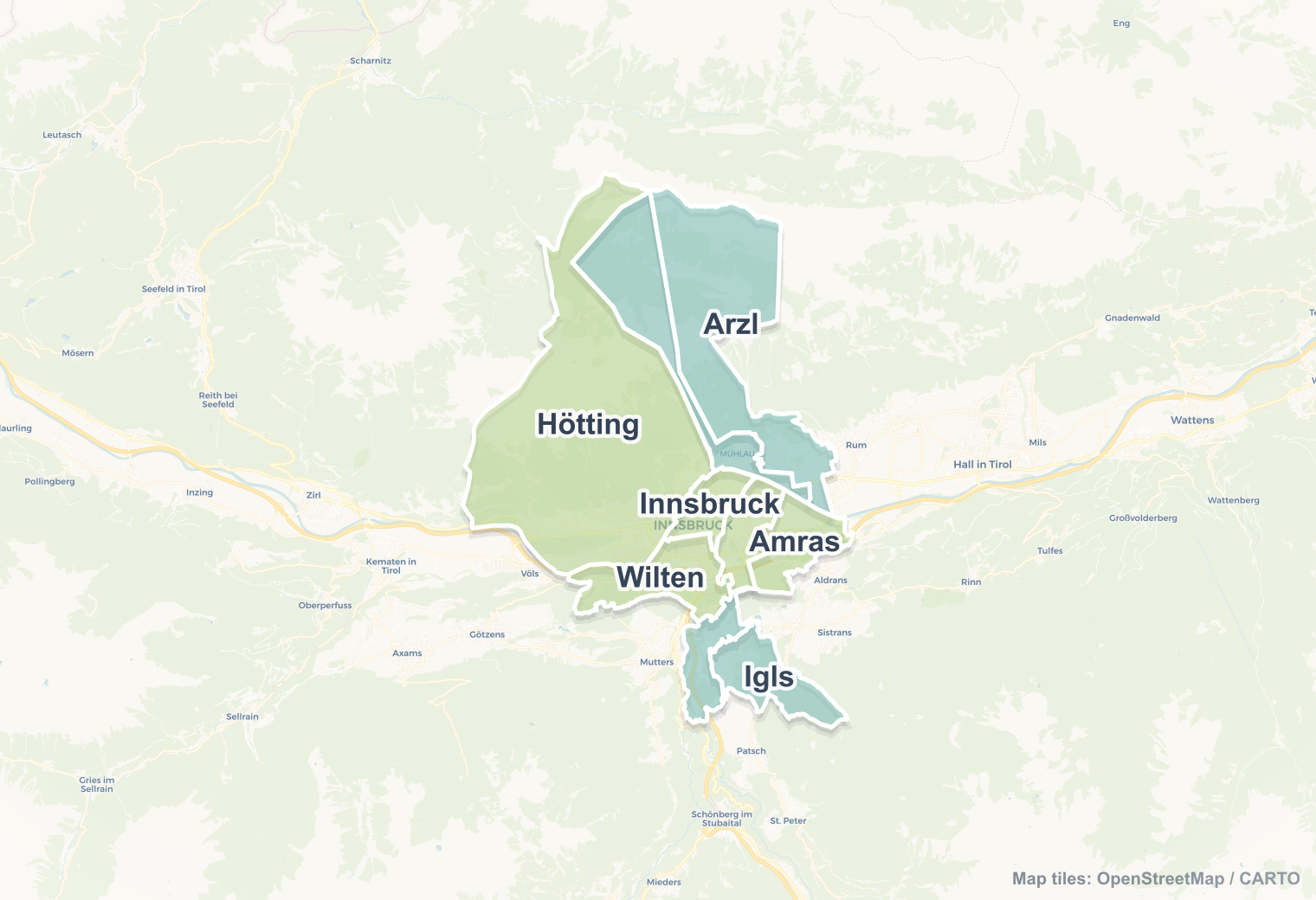
Explore them on the map:
See safest areas on the mapInnsbruck safety map
Use the map to compare districts before deciding where to book.
Stay decision guide
First time
InnsbruckInnsbruck is the cleanest first base: safety 85/100, transport 95/100, and fewer avoidable arrival mistakes.
Family
IglsIgls gives families the stronger calm-and-access trade-off, with safety 95/100 and night score 25/100.
Budget
WiltenUse Wilten as the value check only if the exact stay keeps transport clear; do not trade down toward Pradl for price alone.
Use the Innsbruck map as a decision tool before booking. Compare safety, transport, attraction access, and budget trade-offs district by district.
Interactive map
Click a district to see details, compare scores, and avoid booking in weaker areas. District tooltips show the neighborhood name, and the detail panel updates instantly.
Active district
Igls
Excellent | score 91
Innsbruck
Scenic alpine village and ski area.
Travel score
91
Safety
95
Transport
70
Community
91
Key strengths
Points to consider
9 results
District Comparison
Choose two districts and compare them side by side before booking. The tool highlights overall score, safety, transport, accommodation, night risk, and the practical trade-offs that matter most for a stay base.
| District | Safety | Vibe | Best for |
|---|---|---|---|
| Igls | 95/100 | Lively | Families |
| Vill | 95/100 | Local | Families |
| Mühlau | 90/100 | Local | Families |
| Arzl | 90/100 | Local | Families |
| Innsbruck | 85/100 | Lively | Families |
Travel score 91/100
Scenic alpine village and ski area.
Strengths
Watch-outs
Travel score 91/100
Small, quiet village-like district on outskirts.
Strengths
Watch-outs
Overall travel score
Best single read for choosing a low-friction tourist base.
Safety
How comfortable the area is likely to feel for a typical visitor.
Sightseeing convenience
Access to major attractions, useful streets, and visitor-friendly movement.
Transport
How easy it is to arrive, leave, and move around the city.
Accommodation
Hotel and apartment practicality for a short stay.
Night risk
Lower is better. Use this when late returns matter.
Community signal
Extra signal from user reviews where enough data exists.
Stay Decision Guide
Innsbruck's compact central district (Innere Stadt) works best for first-timers because good public transport (78.3/100) means you can reach key sights reliably without needing perfect walkability. The city scores 87.8/100 for safety, so daytime navigation is straightforward across all nine districts.
Innsbruck's layout clusters most visitor attractions in a tight core, but the transport network is good rather than excellent, meaning you'll want accommodation within reasonable reach of tram or bus lines rather than relying on distant bases. All districts score low for night comfort, so choosing somewhere with a simple evening return route matters more than the specific neighborhood name.
Check the last tram or bus time from your accommodation before booking—Innsbruck's primary risk is night-time comfort and late returns, and good-but-not-excellent transport means service may thin out earlier than in larger cities.
Families should consider Vill (safety 95/100) or Arzl (safety 90/100), both offering quiet residential settings with decent transport access (60-70/100) and high daytime safety scores that offset their low night scores (25-30/100) since families typically return earlier. These hillside and village-like districts provide space and calm without isolation.
Solo travelers benefit most from central districts where good transport connections (78.3/100 citywide) and shorter walking distances reduce reliance on late-night navigation, since all districts score low for night comfort. Staying near tram lines matters more in Innsbruck than picking a specific neighborhood for evening safety.
Budget travelers can look at Arzl or similar residential districts where the 12-point score spread means outer areas don't sacrifice much safety (90/100) compared to top performers, and no districts are flagged for caution. Transport access (70/100) in these areas remains functional for daytime sightseeing.
Innere Stadt places visitors within walking distance of the Golden Roof, Imperial Palace, and Hofburg, eliminating transport dependence for daytime sightseeing. The tradeoff is busier streets and higher accommodation density, not a safety penalty—central Innsbruck scores similarly to outer districts.
Staying central in Innsbruck doesn't cost you safety points—the 12-point spread across all districts means location choice is about convenience and transport access, not avoiding problem zones. The real consideration is evening return simplicity, which affects all districts equally since none score well at night.
Basing in Igls (transport 70/100) or Vill (transport 60/100) gains you alpine scenery and village atmosphere but adds 15-30 minutes to each trip into the center, and you'll rely entirely on bus schedules for evening returns. The safety gain is marginal (95/100 vs 83-87/100 centrally), so choose based on trip style rather than security concerns.
Arzl, Vill, and similar residential hillside districts typically offer lower accommodation costs while maintaining strong safety scores (90-95/100) and avoiding any caution flags. The narrow 12-point score spread means stepping outside the tourist core doesn't drop you into less secure territory.
In Innsbruck, the safety-versus-price line is generous—no districts are flagged for caution, and outer residential areas score within 5-12 points of the safest zones. The real cost of budget districts is transport dependency (60-70/100 scores) rather than security concerns, so focus on bus/tram access when comparing prices.
Before booking budget accommodation, verify the evening transport schedule from that specific stop—Innsbruck's good-but-not-excellent transport tier (78.3/100) and universal low night scores mean the last service time determines whether a bargain becomes an uncomfortable late walk.
Even without caution zones, unusually low prices in any Innsbruck district warrant checking the specific street location relative to the nearest tram or bus stop, especially if it requires a 10+ minute walk through areas with low night scores. The issue isn't danger but comfort and convenience after dark.
When prices drop significantly below comparable options, Innsbruck's data suggests the reason is likely distance from transport nodes (explaining lower transport scores of 60-70/100) rather than safety red flags, since all districts avoid caution status. Look for gaps in evening service frequency rather than neighborhood reputation.
Ask yourself whether you're willing to take a taxi or walk 15-20 minutes if you return after the last scheduled bus or tram—Innsbruck's universal low night scores (25-30/100 even in top districts) mean every accommodation requires planning evening logistics, and good transport (78.3/100) doesn't guarantee late-night coverage.
FAQ
Yes—outer districts like Vill (95/100), Igls (95/100), and Arzl (90/100) score as high or higher for safety than central areas, and none of Innsbruck's nine districts are flagged for caution. The main consideration is transport access (60-70/100 in outer areas vs 78.3/100 citywide average) rather than security concerns.
Low night scores (25-30/100 across all districts) reflect comfort factors like lighting, evening activity, and transport frequency rather than crime risk—Innsbruck's overall safety rating is 87.8/100. The practical impact is that evening returns require planning around transport schedules and well-lit routes regardless of which district you choose.
No—Igls and Vill score identically low for night comfort (25/100) despite their excellent daytime safety (95/100), because the night metric measures infrastructure and transport availability, not danger. Staying in these villages means relying entirely on bus schedules for evening returns rather than gaining night safety advantages.
Good transport (78.3/100) provides reliable daytime connections across districts but isn't excellent enough to ignore location entirely—outer areas like Vill (60/100 transport) require checking bus schedules carefully, and evening service frequency drops citywide. Choose accommodation near your specific tram or bus line rather than assuming coverage is uniform.