First time
Innere StadtInnere Stadt is the cleanest first base: safety 90/100, transport 95/100, and fewer avoidable arrival mistakes.
Innere Stadt is the clear choice for first-timers, scoring 90 for safety and 95 for transport while putting you within walking distance of Vienna's major landmarks. The district's excellent transport connectivity means you can explore beyond the center easily, which matters in a city where good—not excellent—transport elsewhere means some areas require more planning to reach.
Use this shortlist to choose an area first, then compare the exact district on the map. Vienna is generally safe, but pickpocketing is common in tourist areas.
First time
Innere StadtInnere Stadt is the cleanest first base: safety 90/100, transport 95/100, and fewer avoidable arrival mistakes.
Family
WiedenWieden gives families the stronger calm-and-access trade-off, with safety 87/100 and night score 33/100.
Budget
MariahilfUse Mariahilf as the value check only if the exact stay keeps transport clear; do not trade down toward Favoriten for price alone.
Explore them on the map:
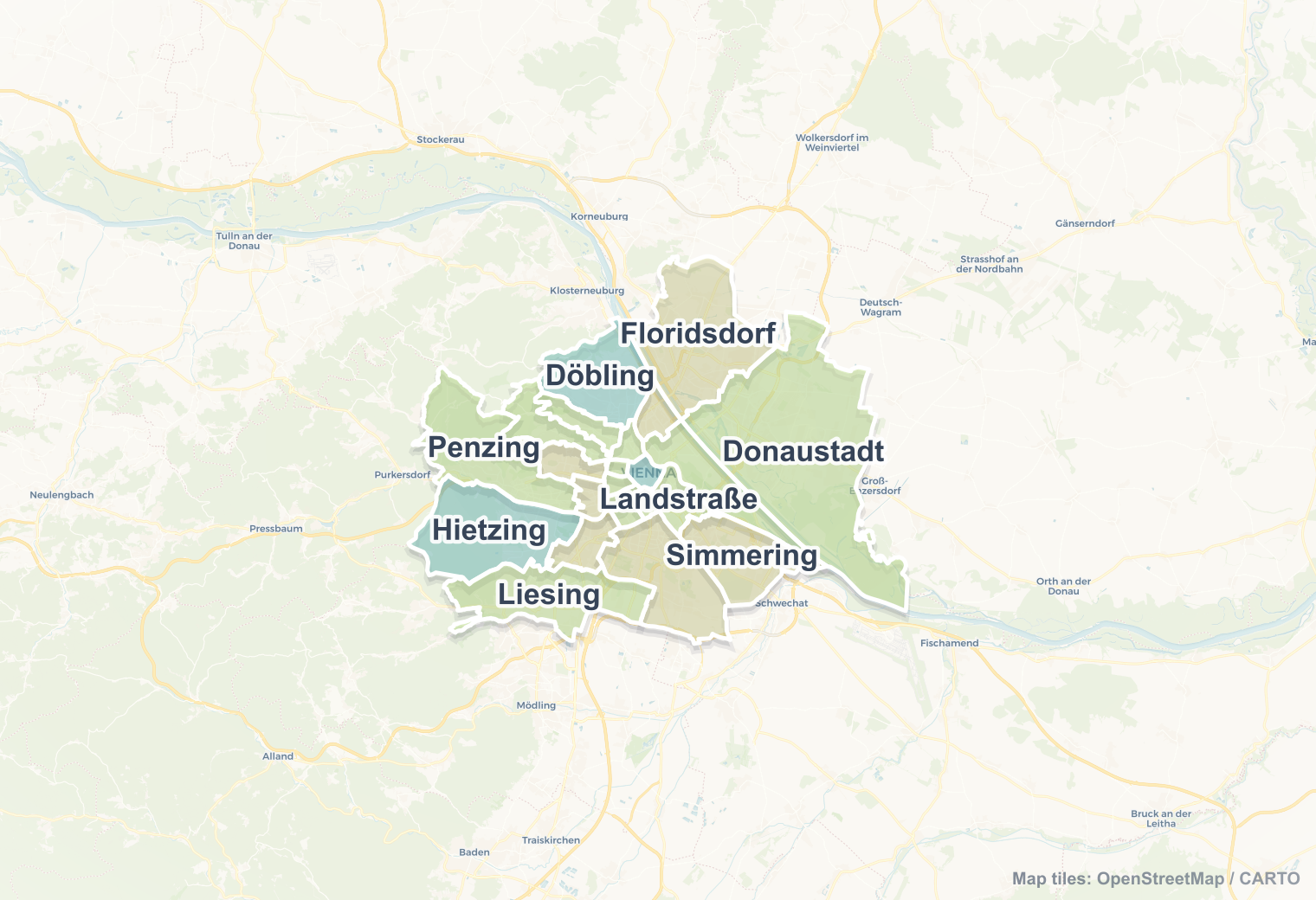
See safest areas on the mapVienna safety map
Use the map to compare districts before deciding where to book.
Stay decision guide
First time
Innere StadtInnere Stadt is the cleanest first base: safety 90/100, transport 95/100, and fewer avoidable arrival mistakes.
Family
WiedenWieden gives families the stronger calm-and-access trade-off, with safety 87/100 and night score 33/100.
Budget
MariahilfUse Mariahilf as the value check only if the exact stay keeps transport clear; do not trade down toward Favoriten for price alone.
Use the Vienna map as a decision tool before booking. Compare safety, transport, attraction access, and budget trade-offs district by district.
Interactive map
Click a district to see details, compare scores, and avoid booking in weaker areas. District tooltips show the neighborhood name, and the detail panel updates instantly.
Active district
Innere Stadt
Excellent | score 93
Vienna
Historic city center with major landmarks and luxury areas.
Travel score
93
Safety
90
Transport
95
Community
93
Key strengths
Points to consider
23 results
District Comparison
Choose two districts and compare them side by side before booking. The tool highlights overall score, safety, transport, accommodation, night risk, and the practical trade-offs that matter most for a stay base.
| District | Safety | Vibe | Best for |
|---|---|---|---|
| Innere Stadt | 90/100 | Lively | Families |
| Hietzing | 92/100 | Lively | Families |
| Döbling | 90/100 | Local | Families |
| Wieden | 87/100 | Quiet | Families |
| Josefstadt | 88/100 | Local | Families |
Travel score 93/100
Historic city center with major landmarks and luxury areas.
Strengths
Watch-outs
Travel score 91/100
Prestigious residential district near Schönbrunn Palace.
Strengths
Watch-outs
Overall travel score
Best single read for choosing a low-friction tourist base.
Safety
How comfortable the area is likely to feel for a typical visitor.
Sightseeing convenience
Access to major attractions, useful streets, and visitor-friendly movement.
Transport
How easy it is to arrive, leave, and move around the city.
Accommodation
Hotel and apartment practicality for a short stay.
Night risk
Lower is better. Use this when late returns matter.
Community signal
Extra signal from user reviews where enough data exists.
Stay Decision Guide
Innere Stadt is the clear choice for first-timers, scoring 90 for safety and 95 for transport while putting you within walking distance of Vienna's major landmarks. The district's excellent transport connectivity means you can explore beyond the center easily, which matters in a city where good—not excellent—transport elsewhere means some areas require more planning to reach.
Vienna's radial layout from the historic center makes navigation straightforward, but the 34-point safety spread across districts means location choice matters more than in cities with uniform safety profiles. Good citywide transport gives first-timers flexibility to stay central without being locked in, though 65% of districts score low at night, which shapes evening logistics significantly.
Factor in your evening plans when choosing where to stay—Innere Stadt's night safety score of 30 reflects Vienna's citywide pattern where even top districts see safety drop after dark. This means planning return routes from restaurants or events, not just proximity to daytime sights.
Hietzing works best for families, with a 92 safety score and proximity to Schönbrunn Palace, though its transport score of 75 means you'll rely more on planning connections than spontaneous hopping. The prestigious residential character provides quieter evening environments, and the 28 night score—while low—is typical for Vienna's safest districts, making evening palace-area walks more viable than in other parts of the city.
Solo travelers should prioritize Innere Stadt for its 95 transport score and central position, which matters when 65% of Vienna's districts present elevated night risk and returning alone after dark requires direct routes. The 90 safety score and density of evening dining options reduce the need to traverse multiple districts, which is the primary solo-specific risk factor in Vienna's pickpocket-heavy environment.
Döbling offers budget-friendly accommodation in an upscale residential setting with a 90 safety score, keeping you out of the seven flagged districts without paying Innere Stadt premiums. The 75 transport score means connections take slightly longer, but good citywide infrastructure keeps most destinations accessible within reasonable travel times.
Innere Stadt places you directly in Vienna's historic core with the Hofburg, St. Stephen's Cathedral, and State Opera within walking distance, eliminating transport time but not the primary risks of pickpocketing and tourist-targeted friction. The 95 transport score means you can easily reach Schönbrunn Palace and other outer attractions, making this location a true access hub.
Central location in Vienna carries minimal safety costs if you choose Innere Stadt—the 90 safety score puts it among the city's top three districts. The comfort tradeoff is the 30 night score, which reflects Vienna's citywide evening safety drop rather than a district-specific problem, meaning you'll plan evening routes regardless of where you stay.
Basing in Hietzing near Schönbrunn makes sense if palace access matters more than being steps from the Innere Stadt cluster, giving you a 92 safety score versus 90 while trading a 95 transport score for 75. You gain quieter residential surroundings and equivalent night safety while adding 15-20 minutes to reach central landmarks.
Döbling and outer areas of Hietzing provide lower accommodation costs while maintaining 90+ safety scores, keeping you well above the seven caution districts. These residential areas offer the same fundamental safety profile as Innere Stadt without the tourist-center premium, though transport scores of 75 mean you'll spend more time on connections.
The safety-versus-price line in Vienna sits clearly between districts scoring 90+ and those dropping to 60-65 like Rudolfsheim-Fünfhaus and Favoriten. Good citywide transport means a 75 transport score in a safe district outweighs saving money in a 60-safety district with slightly better connections, especially given Vienna's night risk pattern.
Check the evening route from your specific address to the nearest U-Bahn or tram stop—65% of districts score low at night, so the 200-meter walk between accommodation and transport determines real-world safety more than district averages. A well-lit main street near a station in Döbling beats a side street deal in Rudolfsheim-Fünfhaus near Westbahnhof.
Favoriten (safety 55), Rudolfsheim-Fünfhaus (safety 60), and Simmering (safety 65) offer cheaper accommodation but sit at the bottom of Vienna's 34-point safety spread with mixed-to-poor evening safety. The tradeoff isn't distance or inconvenience—good citywide transport connects these areas—but elevated risk of the city's primary concerns: pickpocketing, crowds near transport hubs, and tourist-targeted friction in transitional neighborhoods.
When prices drop significantly near Westbahnhof or in the 10th and 15th districts, the safety scores reveal why: these areas have lower tourist appeal, denser mixed-use character, and the low night scores that affect 65% of Vienna. A too-low price typically signals you're in one of the seven caution districts where the environment shifts noticeably after dark.
Before booking anywhere in Vienna, map your evening return from central dining and entertainment areas—will you walk 10 minutes through side streets in a district with a 28 night score, or emerge from a U-Bahn into a well-trafficked station area? The answer matters more than daytime safety scores in a city where nighttime risk is the dominant pattern.
FAQ
Yes, Hietzing and Döbling both score 90+ for safety, matching or exceeding Innere Stadt's profile. The seven caution districts represent specific areas—Favoriten, Simmering, Rudolfsheim-Fünfhaus—not everywhere outside the center, so district choice matters more than simple proximity.
65% of Vienna's districts score low at night, including top areas like Innere Stadt (30), Hietzing (28), and Döbling (30), reflecting citywide patterns where streets quiet after dark rather than district-specific problems. This means planning evening return routes and staying on main thoroughfares matters everywhere, not avoiding specific neighborhoods.
Rudolfsheim-Fünfhaus surrounding Westbahnhof scores 60 for safety and carries a caution verdict due to dense mixed character and lower tourist appeal. The station itself is well-connected with good transport, but basing accommodation in this district means accepting Vienna's below-average safety tier and elevated pickpocketing risk near the transit hub.
Good transport (82.2/100) provides flexibility but doesn't override the 34-point safety spread between top districts and the seven caution areas. Transport scores vary by district—Innere Stadt's 95 versus Hietzing and Döbling's 75—so staying in a high-safety, lower-transport district works better than risking a 55-60 safety score for marginally better connections.