First time
LindenthalLindenthal is the cleanest first base: safety 90/100, transport 85/100, and fewer avoidable arrival mistakes.
Innenstadt is the most practical first-visit base in Cologne, with perfect transport access (100/100) and direct proximity to the cathedral, old town, and Rhine promenade. The district scores 75/100 for safety—solid but not exceptional—which reflects the busy tourist-center reality with crowds and some petty crime risk. Lindenthal offers a quieter alternative with higher safety (90/100) and strong transport links (85/100), ideal for first-timers wanting a residential feel within easy reach of the center.
Use this shortlist to choose an area first, then compare the exact district on the map. Cologne is generally safe, but pickpocketing is common in tourist areas.
First time
LindenthalLindenthal is the cleanest first base: safety 90/100, transport 85/100, and fewer avoidable arrival mistakes.
Family
InnenstadtInnenstadt gives families the stronger calm-and-access trade-off, with safety 75/100 and night score 45/100.
Budget
RodenkirchenUse Rodenkirchen as the value check only if the exact stay keeps transport clear; do not trade down toward Chorweiler for price alone.
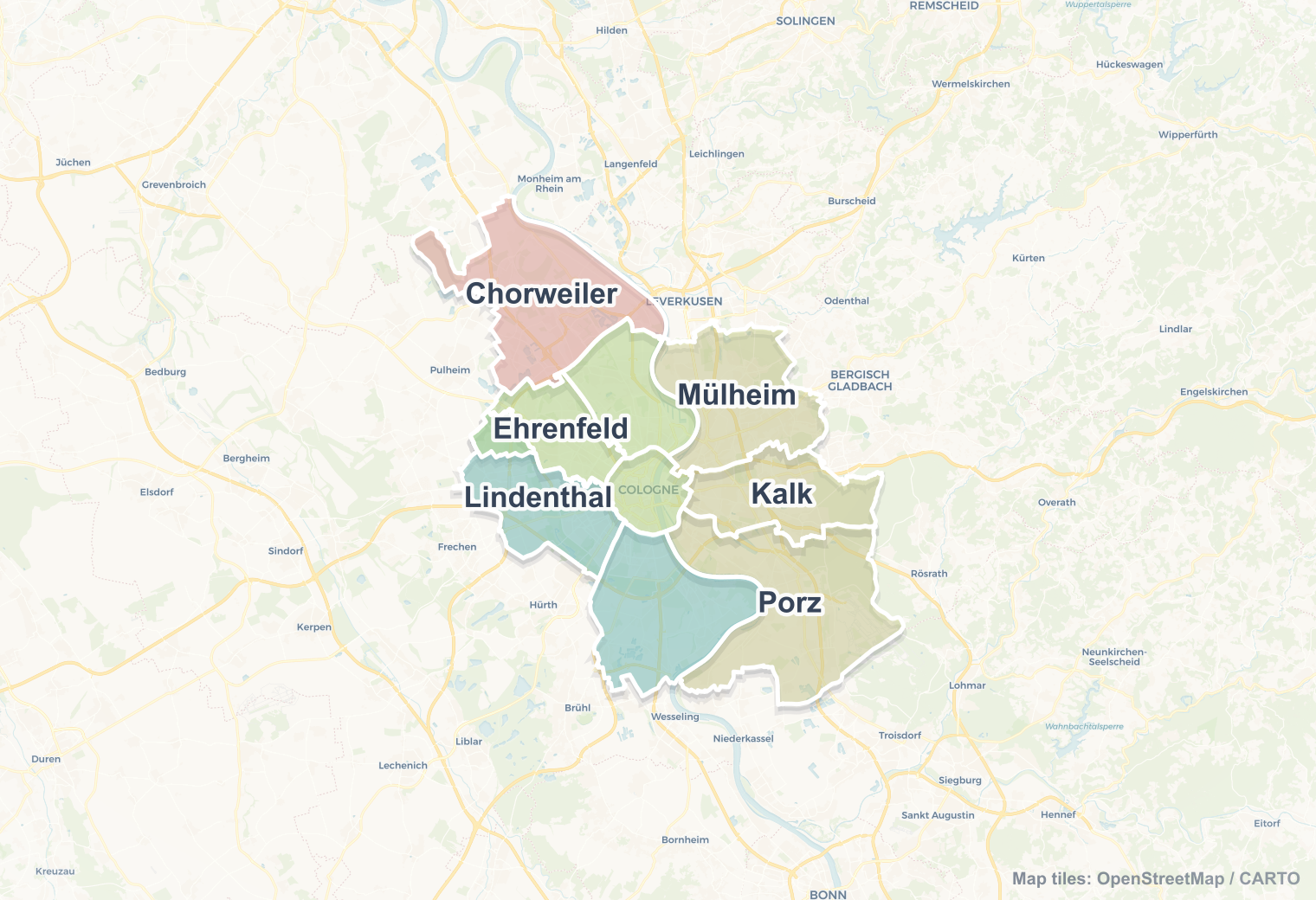
Explore them on the map:
See safest areas on the mapCologne safety map
Use the map to compare districts before deciding where to book.
Stay decision guide
First time
LindenthalLindenthal is the cleanest first base: safety 90/100, transport 85/100, and fewer avoidable arrival mistakes.
Family
InnenstadtInnenstadt gives families the stronger calm-and-access trade-off, with safety 75/100 and night score 45/100.
Budget
RodenkirchenUse Rodenkirchen as the value check only if the exact stay keeps transport clear; do not trade down toward Chorweiler for price alone.
Use the Cologne map as a decision tool before booking. Compare safety, transport, attraction access, and budget trade-offs district by district.
Interactive map
Click a district to see details, compare scores, and avoid booking in weaker areas. District tooltips show the neighborhood name, and the detail panel updates instantly.
Active district
Lindenthal
Excellent | score 90
Cologne
Upscale residential area near university and park.
Travel score
90
Safety
90
Transport
85
Community
90
Key strengths
Points to consider
10 results
District Comparison
Choose two districts and compare them side by side before booking. The tool highlights overall score, safety, transport, accommodation, night risk, and the practical trade-offs that matter most for a stay base.
| District | Safety | Vibe | Best for |
|---|---|---|---|
| Lindenthal | 90/100 | Local | Families |
| Rodenkirchen | 90/100 | Local | Families |
| Widdersdorf | 85/100 | Local | Families |
| Innenstadt | 75/100 | Lively | Nightlife |
| Nippes | 80/100 | Local | First-time visitors |
Travel score 90/100
Upscale residential area near university and park.
Strengths
Watch-outs
Travel score 90/100
Upscale riverside district south of center.
Strengths
Watch-outs
Overall travel score
Best single read for choosing a low-friction tourist base.
Safety
How comfortable the area is likely to feel for a typical visitor.
Sightseeing convenience
Access to major attractions, useful streets, and visitor-friendly movement.
Transport
How easy it is to arrive, leave, and move around the city.
Accommodation
Hotel and apartment practicality for a short stay.
Night risk
Lower is better. Use this when late returns matter.
Community signal
Extra signal from user reviews where enough data exists.
Stay Decision Guide
Innenstadt is the most practical first-visit base in Cologne, with perfect transport access (100/100) and direct proximity to the cathedral, old town, and Rhine promenade. The district scores 75/100 for safety—solid but not exceptional—which reflects the busy tourist-center reality with crowds and some petty crime risk. Lindenthal offers a quieter alternative with higher safety (90/100) and strong transport links (85/100), ideal for first-timers wanting a residential feel within easy reach of the center.
Cologne's good transport network (80/100 average) gives first-timers reasonable flexibility to stay beyond the immediate center without isolation. The challenge is the city's sharp district-to-district safety variation—a 48-point spread between top and bottom—which means moving just a few stops in the wrong direction can shift your experience significantly. Half of Cologne's districts score low for nighttime safety, so understanding which neighborhoods connect to your accommodation matters more here than in more uniformly safe cities.
Check which side of the Rhine your accommodation sits on and how the evening return works from Innenstadt if you plan to stay out late. The Rhine creates a natural east-west divide, and districts like Mülheim and Kalk on the eastern bank score lower (55/100) despite appearing close to the center on a map. Night transport frequency drops off considerably in outer districts, turning a short daytime journey into a longer or less comfortable late-evening return.
Rodenkirchen works best for families in Cologne, combining the city's highest safety score (90/100) with a riverside location and residential calm. Transport is adequate (75/100) rather than excellent, meaning you'll rely on buses or S-Bahn for sightseeing trips, but the evening return to a quiet, safe neighborhood offsets the daytime commute. The district's low night score (30/100) reflects limited after-dark activity rather than danger—it simply goes to sleep early, which suits family schedules.
Solo travelers should favor Lindenthal for the combination of high safety (90/100), strong transport (85/100), and proximity to university life and cafes along Aachener Strasse. The district offers independent exploration options without the tourist-center crowds of Innenstadt, and the transport score means late returns remain straightforward. Avoid solo stays in Mülheim or Kalk (both 55/100), where the industrial-residential character and lower scores create unnecessary risk management for travelers navigating alone.
Budget travelers can consider the southern parts of Innenstadt or neighborhoods bordering Lindenthal without crossing into Mülheim. Nippes (not in the top list but mid-tier) offers cheaper options north of the center with acceptable safety and transport, but requires checking exact street locations. Chorweiler (45/100) and Kalk (55/100) may show the lowest accommodation prices but come with genuine safety tradeoffs and poor evening transport—savings disappear quickly if you're taking taxis to feel secure.
Innenstadt places you within walking distance of Cologne Cathedral, the Römisch-Germanisches Museum, Ludwig Museum, and the Altstadt bar district. The perfect transport score (100/100) means every train and tram line converges here, but the safety score of 75/100 reflects pickpocket risk around Hauptbahnhof and the cathedral square. The nighttime score of 45/100 indicates you'll encounter drunk crowds and occasional aggressive behavior around the station area after dark, particularly on weekends.
Central location in Cologne doesn't require sacrificing safety entirely—Innenstadt remains in the 'good' category overall—but it does mean accepting the urban friction of a busy train station district. The cathedral and Hauptbahnhof area specifically concentrate both tourists and the social issues common to major German rail hubs. If you stay in the southern part of Innenstadt near the old town or along the Rhine, the experience improves noticeably compared to the immediate station surroundings.
Basing in Lindenthal or Rodenkirchen makes sense when you want higher safety (90/100 in both) and quieter evenings, trading 15-25 minutes of transport time to reach major sights. You gain genuine residential peace and eliminate petty crime worry, but you give up the ability to walk home after dinner in the Altstadt or stumble back after evening drinks. Cologne's good transport tier makes this tradeoff reasonable for travelers who plan their days in structured blocks rather than wandering spontaneously between accommodation and attractions.
The edges of Innenstadt away from Hauptbahnhof, the southern parts of Lindenthal, and neighborhoods like Nippes north of the center offer mid-range accommodation prices without dropping below the 70/100 safety threshold. These areas maintain decent transport connections and avoid the caution-category districts (Mülheim, Kalk, Chorweiler) where scores fall to 55/100 or below. Rodenkirchen rarely offers budget options due to its upscale character, but searching in the less central parts of Lindenthal can yield value without entering risky territory.
The safety-versus-price line in Cologne sits clearly between the mid-tier districts (Nippes, Ehrenfeld) and the caution districts east and north (Mülheim at 55/100, Chorweiler at 45/100). Accommodation significantly cheaper than the Innenstadt average usually means you're crossing into these lower-ranked areas with genuinely worse evening conditions and patchier transport. The 48-point spread between Cologne's best and worst districts isn't cosmetic—it represents real differences in street environment, lighting, and the presence of social problems around certain housing estates.
Before booking budget accommodation in Cologne, map the exact address to the nearest tram or S-Bahn stop and check whether that line runs past 11pm. Many cheaper listings sit in the residential outskirts of Mülheim or near the high-rises in Chorweiler where bus service stops early and walking from the nearest night-line stop can mean 15 minutes through poorly lit streets. If the address is more than 5 minutes' walk from a reliable transport stop and the district scores below 60/100, the price savings create more hassle than value.
Chorweiler (45/100, verdict: avoid) and Kalk (55/100, verdict: caution) consistently show the cheapest accommodation in Cologne, but both come with genuine safety and comfort tradeoffs. Chorweiler is a peripheral high-rise district with concentrated social housing, poor evening atmosphere, and weak transport connections—cheap rates reflect the fact that few visitors choose to stay there voluntarily. Kalk is a working-class, multicultural district east of the Rhine with industrial edges and lower nighttime safety, where budget listings often sit in the least desirable pockets far from the livelier streets near Kalk Kapelle.
When Cologne accommodation prices drop significantly below the Innenstadt baseline, check whether the address falls in Mülheim's industrial zones, Kalk's eastern edges, or anywhere in Chorweiler. These areas score 55/100 or lower specifically because of limited evening infrastructure, weaker policing presence, and concentrations of social problems around certain housing blocks. The low scores aren't about tourist crime but rather about the overall environment—poorly lit streets, groups loitering near stations, and a general absence of the activity that makes city neighborhoods feel secure after dark.
The honest question before booking anywhere in Cologne: if you're out in Innenstadt or the Altstadt until 11pm or midnight, what does the journey back to this address look like? Half of Cologne's districts score low for nighttime safety, and the city's 80/100 transport average masks significant variation—outer areas lose frequency and connections after 10pm. If the answer involves a bus replacement route, a long walk from the last tram stop, or passing through Mülheim or Kalk late at night, the cheap rate isn't delivering actual value for a visitor-focused stay.
FAQ
The western bank (where Innenstadt, Lindenthal, and Rodenkirchen sit) consistently scores higher for safety than the eastern bank districts like Mülheim and Kalk, which both rate 55/100. The Rhine creates a real divide in Cologne's safety profile—western districts average 85/100 while the eastern working-class and industrial neighborhoods drop to caution territory. If you're choosing between similarly priced options, prioritize the western side unless you have a specific reason to stay east.
The immediate Hauptbahnhof area in Innenstadt scores 75/100 overall with a night score of 45/100, making it acceptable but not trouble-free. The station surroundings concentrate the usual German rail hub issues—pickpockets, aggressive panhandling, drunk crowds on weekends, and occasional confrontations—especially on the Breslauer Platz side. Staying 5-10 minutes' walk south toward the old town or along the Rhine improves the environment noticeably while keeping cathedral proximity.
The 48-point spread between Rodenkirchen at 90/100 and Chorweiler at 45/100 represents a significant real-world difference in street environment and evening comfort. Half of Cologne's 10 districts score low for nighttime safety, and 4 districts carry caution or avoid verdicts. This isn't a uniformly safe city with minor variations—district choice genuinely affects your daily experience, particularly after dark, more than in cities with tighter score clustering.
Cologne's good transport score (80/100 average) gives you real flexibility to stay in Lindenthal or Rodenkirchen without isolation, but it's not excellent enough to ignore location entirely. Transport frequency drops off significantly after 10pm in outer districts, and the 15-25 minute commute to Innenstadt becomes a planning factor rather than an afterthought. You don't need to stay central, but choosing a district with 80+ transport score (Lindenthal or Innenstadt itself) makes evening logistics simpler than basing in areas with 75/100 or below.