First time
Stadtbezirk 4Stadtbezirk 4 is the cleanest first base: safety 90/100, transport 85/100, and fewer avoidable arrival mistakes.
Stadtbezirk 4 works best for first-timers with its 90 safety score and strong 85 transport rating, putting you on the upscale riverside with reliable connections across the city. The good transport network (80.5/100 citywide) means you can stay central without being locked into a single area, giving first-visitors flexibility to explore.
Use this shortlist to choose an area first, then compare the exact district on the map. Dusseldorf is generally safe, but pickpocketing is common in tourist areas.
First time
Stadtbezirk 4Stadtbezirk 4 is the cleanest first base: safety 90/100, transport 85/100, and fewer avoidable arrival mistakes.
Family
Stadtbezirk 1Stadtbezirk 1 gives families the stronger calm-and-access trade-off, with safety 80/100 and night score 40/100.
Budget
Stadtbezirk 2Use Stadtbezirk 2 as the value check only if the exact stay keeps transport clear; do not trade down toward Stadtbezirk 3 for price alone.
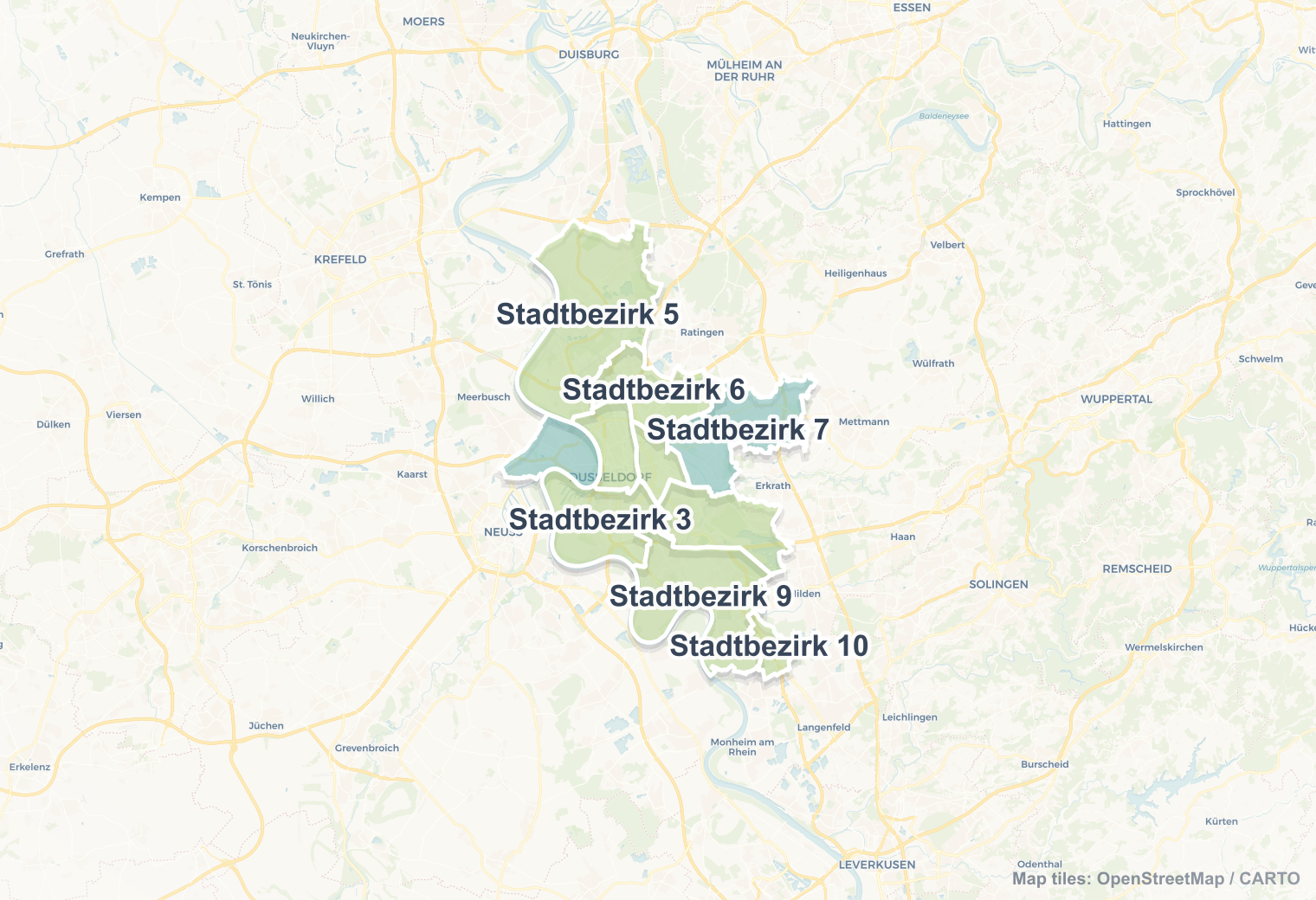
Explore them on the map:
See safest areas on the mapDusseldorf safety map
Use the map to compare districts before deciding where to book.
Stay decision guide
First time
Stadtbezirk 4Stadtbezirk 4 is the cleanest first base: safety 90/100, transport 85/100, and fewer avoidable arrival mistakes.
Family
Stadtbezirk 1Stadtbezirk 1 gives families the stronger calm-and-access trade-off, with safety 80/100 and night score 40/100.
Budget
Stadtbezirk 2Use Stadtbezirk 2 as the value check only if the exact stay keeps transport clear; do not trade down toward Stadtbezirk 3 for price alone.
Use the Dusseldorf map as a decision tool before booking. Compare safety, transport, attraction access, and budget trade-offs district by district.
Interactive map
Click a district to see details, compare scores, and avoid booking in weaker areas. District tooltips show the neighborhood name, and the detail panel updates instantly.
Active district
Stadtbezirk 7
Excellent | score 90
Dusseldorf
Green, residential outskirts with suburban feel.
Travel score
90
Safety
90
Transport
70
Community
90
Key strengths
Points to consider
10 results
District Comparison
Choose two districts and compare them side by side before booking. The tool highlights overall score, safety, transport, accommodation, night risk, and the practical trade-offs that matter most for a stay base.
| District | Safety | Vibe | Best for |
|---|---|---|---|
| Stadtbezirk 7 | 90/100 | Local | Families |
| Stadtbezirk 4 | 90/100 | Quiet | Families |
| Stadtbezirk 5 | 85/100 | Local | Families |
| Stadtbezirk 2 | 80/100 | Local | Value stays |
| Stadtbezirk 6 | 80/100 | Local | First-time visitors |
Travel score 90/100
Green, residential outskirts with suburban feel.
Strengths
Watch-outs
Travel score 90/100
Upscale riverside area with modern living.
Strengths
Watch-outs
Overall travel score
Best single read for choosing a low-friction tourist base.
Safety
How comfortable the area is likely to feel for a typical visitor.
Sightseeing convenience
Access to major attractions, useful streets, and visitor-friendly movement.
Transport
How easy it is to arrive, leave, and move around the city.
Accommodation
Hotel and apartment practicality for a short stay.
Night risk
Lower is better. Use this when late returns matter.
Community signal
Extra signal from user reviews where enough data exists.
Stay Decision Guide
Stadtbezirk 4 works best for first-timers with its 90 safety score and strong 85 transport rating, putting you on the upscale riverside with reliable connections across the city. The good transport network (80.5/100 citywide) means you can stay central without being locked into a single area, giving first-visitors flexibility to explore.
Dusseldorf's moderate score spread of 17 points means district choice matters less than in many cities, but the high night risk (90% of districts score low after dark) means your accommodation's proximity to well-lit transport stops becomes the real decision factor. Good daytime transport doesn't fully compensate for the citywide evening vulnerability.
Check the evening route from your accommodation to the nearest metro or tram stop before booking anywhere in Dusseldorf, even in top-scoring districts—night scores of 30-35 across most areas mean that final 200-meter walk matters more than the district ranking.
Families should consider Stadtbezirk 7 with its 90 safety score and residential suburban character, though the lower 70 transport rating means you'll rely more on planning trips rather than spontaneous exploration. The 30 night score is standard for Dusseldorf, so the green, quieter environment offsets the evening caution you'd need anywhere in the city.
Solo travelers benefit most from Stadtbezirk 4's combination of 90 safety and 85 transport, since the stronger connections reduce late-night exposure time when returning from evening activities. The upscale riverside setting provides well-trafficked streets without the station-area friction that affects other central zones.
Budget travelers can look at Stadtbezirk 5 (85 safety, 75 transport) in the northern suburban area near the airport, where no districts are flagged for caution but you'll trade some transit convenience for lower accommodation costs. The 17-point score spread means mid-tier districts still maintain solid safety foundations.
Stadtbezirk 4 puts you nearest the riverside attractions and central sights with 85 transport access, though you're paying for location with upscale accommodation stock rather than safety concerns. The primary risk in Dusseldorf centers on station-area friction rather than district-level danger, so central doesn't mean compromised.
Central location in Dusseldorf doesn't carry the safety penalties seen in other cities—the 90 safety score in Stadtbezirk 4 matches outlying areas. The real cost is the identical low night score (30) you'll find almost everywhere, meaning proximity to attractions doesn't help evening safety but does reduce late-night travel distance.
Basing in Stadtbezirk 7 trades 15 transport points for a residential suburban environment with the same 90 daytime safety, which makes sense if your itinerary allows planned trips rather than constant central access. You gain quieter surroundings but sacrifice spontaneity given Dusseldorf's good-not-excellent transport tier.
Stadtbezirk 5 near the airport offers 85 safety and 75 transport without entering caution territory, positioning budget-conscious visitors in a northern suburban zone that's 5 points below top districts but still firmly in good range. Stadtbezirk 7 provides similar value with even higher 90 safety but lower 70 transport.
The safety-vs-price line in Dusseldorf sits at the 85 safety threshold with zero districts flagged for caution, meaning budget options exist across the moderate 17-point spread without crossing into risk zones. The real tradeoff comes in transport scores (70-85 range) rather than safety degradation, so cheaper areas cost you in travel time rather than security.
Check the specific tram or metro line serving your accommodation's address in budget districts, since the good-not-excellent 80.5 citywide transport score means coverage can be patchy in outer areas like Stadtbezirk 7. Late-route frequency matters more than daytime connections given the high night risk affecting 90% of districts.
Accommodation clustered immediately around the main station should trigger extra checking despite no formal caution flags, since station-area friction is Dusseldorf's primary risk and low prices there likely reflect proximity to transient traffic. The citywide very-safe 81/100 rating masks localized friction points that won't show in district-level scores.
A suspiciously low price in any Dusseldorf district often signals poor transport access (below the 70-75 range seen in outer areas) or location on streets far from well-lit stops, which becomes critical when 90% of districts score 30-35 for night safety. The moderate score spread means dramatic price drops aren't justified by safety differences alone.
Before booking anywhere in Dusseldorf, map the actual evening walk from your accommodation door to the nearest transport stop and check its service hours—the universal low night scores mean that final stretch matters more than whether you're in a 90-rated or 85-rated district. Station-area friction and late-route gaps create more real risk than district rankings suggest.
FAQ
Station-area friction is Dusseldorf's primary risk, so accommodation immediately around Hauptbahnhof requires closer checking of the specific street and evening foot traffic patterns. Districts aren't formally flagged, but the localized friction won't appear in citywide scores.
Dusseldorf's good 80.5/100 transport network supports basing in outer districts like Stadtbezirk 7 (safety 90, transport 70) if you're comfortable planning trips rather than relying on constant spontaneous access. The moderate 17-point score spread means outlying areas don't sacrifice safety, just some transit convenience.
No districts are flagged for caution, but 90% score 30-35 for night safety, meaning evening vulnerability is citywide rather than district-specific. The risk comes from late-route exposure and the final walk from transport stops, not from choosing the wrong neighborhood.
The 17-point score spread means budget areas like Stadtbezirk 5 (85 safety) sit only 5 points below top-tier Stadtbezirk 4 (90 safety), with the real difference showing in transport scores (75 vs 85) rather than safety degradation. No districts drop into caution territory regardless of price.