First time
EimsbüttelEimsbüttel is the cleanest first base: safety 85/100, transport 90/100, and fewer avoidable arrival mistakes.
Eimsbüttel is the strongest first-visit choice with a safety score of 85 and excellent transport connections (90). Hamburg's transport system ranks 87.9/100 citywide, meaning you can base yourself in residential districts like Eimsbüttel or Hamburg-Nord without sacrificing access to major sights.
Use this shortlist to choose an area first, then compare the exact district on the map. Hamburg is generally safe, but pickpocketing is common in tourist areas.
First time
EimsbüttelEimsbüttel is the cleanest first base: safety 85/100, transport 90/100, and fewer avoidable arrival mistakes.
Family
Hamburg-NordHamburg-Nord gives families the stronger calm-and-access trade-off, with safety 85/100 and night score 35/100.
Budget
Hamburg-MitteUse Hamburg-Mitte as the value check only if the exact stay keeps transport clear; do not trade down toward Harburg for price alone.
Explore them on the map:
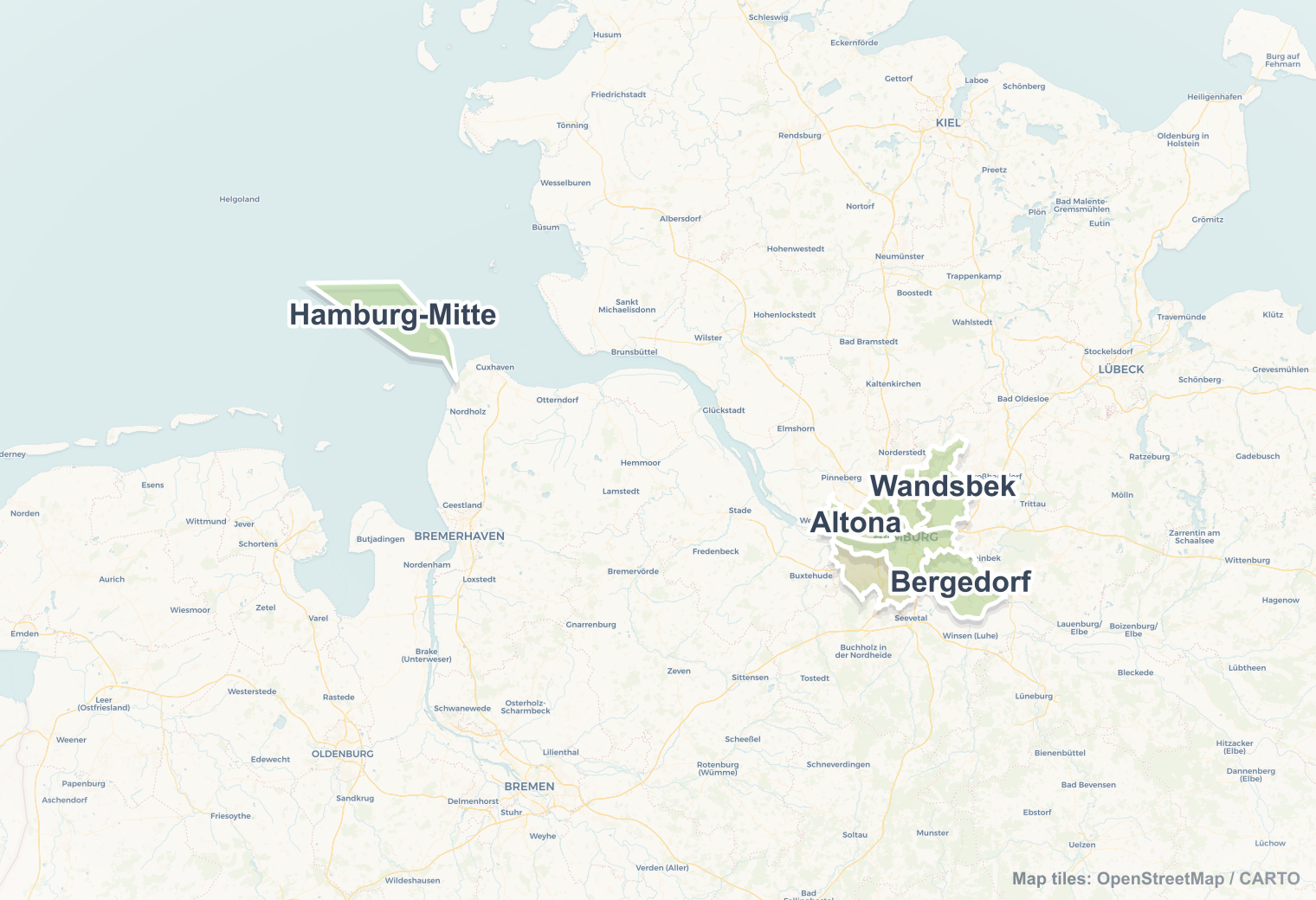
See safest areas on the mapHamburg safety map
Use the map to compare districts before deciding where to book.
Stay decision guide
First time
EimsbüttelEimsbüttel is the cleanest first base: safety 85/100, transport 90/100, and fewer avoidable arrival mistakes.
Family
Hamburg-NordHamburg-Nord gives families the stronger calm-and-access trade-off, with safety 85/100 and night score 35/100.
Budget
Hamburg-MitteUse Hamburg-Mitte as the value check only if the exact stay keeps transport clear; do not trade down toward Harburg for price alone.
Use the Hamburg map as a decision tool before booking. Compare safety, transport, attraction access, and budget trade-offs district by district.
Interactive map
Click a district to see details, compare scores, and avoid booking in weaker areas. District tooltips show the neighborhood name, and the detail panel updates instantly.
Active district
Hamburg-Nord
Good | score 83
Hamburg
Residential district with parks and airport access.
Travel score
83
Safety
85
Transport
90
Community
83
Key strengths
Points to consider
7 results
District Comparison
Choose two districts and compare them side by side before booking. The tool highlights overall score, safety, transport, accommodation, night risk, and the practical trade-offs that matter most for a stay base.
| District | Safety | Vibe | Best for |
|---|---|---|---|
| Hamburg-Nord | 85/100 | Local | Families |
| Eimsbüttel | 85/100 | Local | Families |
| Bergedorf | 85/100 | Local | Families |
| Altona | 75/100 | Lively | Nightlife |
| Wandsbek | 80/100 | Local | First-time visitors |
Travel score 83/100
Residential district with parks and airport access.
Strengths
Watch-outs
Travel score 83/100
Popular residential district with cafés and student vibe.
Strengths
Watch-outs
Overall travel score
Best single read for choosing a low-friction tourist base.
Safety
How comfortable the area is likely to feel for a typical visitor.
Sightseeing convenience
Access to major attractions, useful streets, and visitor-friendly movement.
Transport
How easy it is to arrive, leave, and move around the city.
Accommodation
Hotel and apartment practicality for a short stay.
Night risk
Lower is better. Use this when late returns matter.
Community signal
Extra signal from user reviews where enough data exists.
Stay Decision Guide
Eimsbüttel is the strongest first-visit choice with a safety score of 85 and excellent transport connections (90). Hamburg's transport system ranks 87.9/100 citywide, meaning you can base yourself in residential districts like Eimsbüttel or Hamburg-Nord without sacrificing access to major sights.
Hamburg's excellent transport tier removes the pressure to stay hyper-central, but 71% of districts score low for night safety. This means your primary concern shifts from daytime connectivity to checking your specific evening route from accommodation back to the nearest reliable transport stop.
Check the walking distance between your accommodation and the nearest S-Bahn or U-Bahn station specifically for evening returns—Hamburg's transport runs well, but the walk to and from stops after dark is where most friction occurs.
Hamburg-Nord works best for families with its 85 safety score, 90 transport rating, and access to parks—the low night score (35) matters less when traveling with children on earlier schedules. The residential character and green spaces offset the evening limitations.
Eimsbüttel suits solo travelers who want a 85 safety baseline with the flexibility to explore—Hamburg's 87.9 transport score means solo visitors can stay in this café-filled district and still reach any part of the city efficiently. The student vibe provides evening activity without requiring long late-night commutes.
Bergedorf offers budget-conscious travelers an 85 safety score in a quieter suburban setting, though the transport score drops to 75. You'll spend slightly more time on connections, but you avoid the caution-tier districts entirely while accessing lower accommodation costs than Eimsbüttel or Hamburg-Nord.
The central districts around Hamburg's harbor and main station put you closest to sights but overlap with the city's primary risk zones—station-area friction is the leading concern in Hamburg. You gain walking access to attractions but inherit the transit-hub safety dynamics that affect most major European cities.
Staying hyper-central in Hamburg doesn't cost you safety catastrophically (the city averages 76.4/100), but the evening walk dynamic shifts—you're closer to sights but also to the station areas where late-route checks matter most. The moderate 19-point score spread across districts means you don't sacrifice much by choosing Eimsbüttel over the absolute center.
Basing in Eimsbüttel or Hamburg-Nord makes sense when Hamburg's 87.9 transport score means a 15-minute S-Bahn ride doesn't feel like a barrier. You trade a short walk for a short train ride, gain residential calm and higher night-safety baselines, and only add minimal travel time to your daily sightseeing loop.
Bergedorf maintains an 85 safety score while offering suburban pricing—you're trading Eimsbüttel's cafés and student energy for a quieter historic center and lower accommodation costs. The 75 transport score still works in a city where the overall system ranks 87.9/100.
Hamburg's safety line sits clearly above Harburg (60 safety, caution verdict)—the three good-verdict districts all score 85, while the caution district drops 25 points. Budget hunting in Eimsbüttel, Hamburg-Nord, or Bergedorf keeps you well above that threshold without requiring premium central addresses.
Before booking budget accommodation anywhere in Hamburg, map the evening walk from your specific address to the nearest U-Bahn or S-Bahn stop—71% of districts score low at night, so the route matters more than the district average. A well-lit 400-meter walk beats a dark 800-meter path even if both addresses share the same district code.
Harburg shows a 60 safety score with a caution verdict—cheap accommodation here comes with a mixed safety reputation and a 25-point gap below the good-verdict districts. The southern location also adds commute time to most major sights without the transport infrastructure offset that makes Bergedorf's suburban position workable.
When Hamburg accommodation pricing seems unusually low, check proximity to the main station or transport hubs—station-area friction is the city's primary risk factor. A bargain address next to a major interchange likely reflects the evening dynamics and foot traffic that affect that specific block.
Ask yourself whether you've walked the evening route on a map: from your accommodation's exact address, which direction is the nearest reliable transport stop, and what does that 10-minute walk look like after 22:00. Hamburg's excellent daytime transport doesn't automatically cover the last 500 meters to your door.
FAQ
Hamburg's primary risk is station-area friction, meaning the blocks immediately surrounding major transport hubs see more late-night activity and require route awareness. The city averages 76.4/100 for safety, but station proximity shifts that baseline—check your specific walking route to accommodation rather than relying on district-level scores.
Eimsbüttel and Hamburg-Nord both score 85 for overall safety with excellent transport (90), but both score 35 for night safety—71% of Hamburg districts score low after dark. The key is choosing accommodation close to your S-Bahn or U-Bahn stop to minimize evening walking distance rather than expecting any district to feel fully comfortable for long late walks.
Harburg holds a caution verdict with a 60 safety score and mixed reputation—it's not an absolute avoid, but it sits 25 points below Eimsbüttel, Hamburg-Nord, and Bergedorf. Unless you have a specific reason to stay in the southern district, the other three offer better safety baselines without major cost or convenience penalties.
Hamburg's 87.9/100 transport score gives you flexibility to base in residential districts like Eimsbüttel or suburban Bergedorf without connectivity problems, but it doesn't override the night-risk dynamic—71% of districts score low after dark. Excellent transport means the district choice matters less; the walk between your door and the nearest stop matters more.