First time
Charlottenburg-WilmersdorfCharlottenburg-Wilmersdorf is the cleanest first base: safety 88/100, transport 90/100, and fewer avoidable arrival mistakes.
Mitte works best for first-time visitors to Berlin, scoring 75 for safety and 98 for transport, which means you can reach major sights quickly and return late without complex connections. The district covers the historical center and Brandenburg Gate area, giving you walkable access to core attractions while Berlin's good transport network (83.2/100) lets you branch out easily.
Use this shortlist to choose an area first, then compare the exact district on the map. Berlin is generally safe, but pickpocketing is common in tourist areas.
First time
Charlottenburg-WilmersdorfCharlottenburg-Wilmersdorf is the cleanest first base: safety 88/100, transport 90/100, and fewer avoidable arrival mistakes.
Family
PankowPankow gives families the stronger calm-and-access trade-off, with safety 87/100 and night score 33/100.
Budget
MitteUse Mitte as the value check only if the exact stay keeps transport clear; do not trade down toward Neukölln for price alone.
Explore them on the map:
See safest areas on the mapBerlin safety map
Use the map to compare districts before deciding where to book.
Stay decision guide
First time
Charlottenburg-WilmersdorfCharlottenburg-Wilmersdorf is the cleanest first base: safety 88/100, transport 90/100, and fewer avoidable arrival mistakes.
Family
PankowPankow gives families the stronger calm-and-access trade-off, with safety 87/100 and night score 33/100.
Budget
MitteUse Mitte as the value check only if the exact stay keeps transport clear; do not trade down toward Neukölln for price alone.
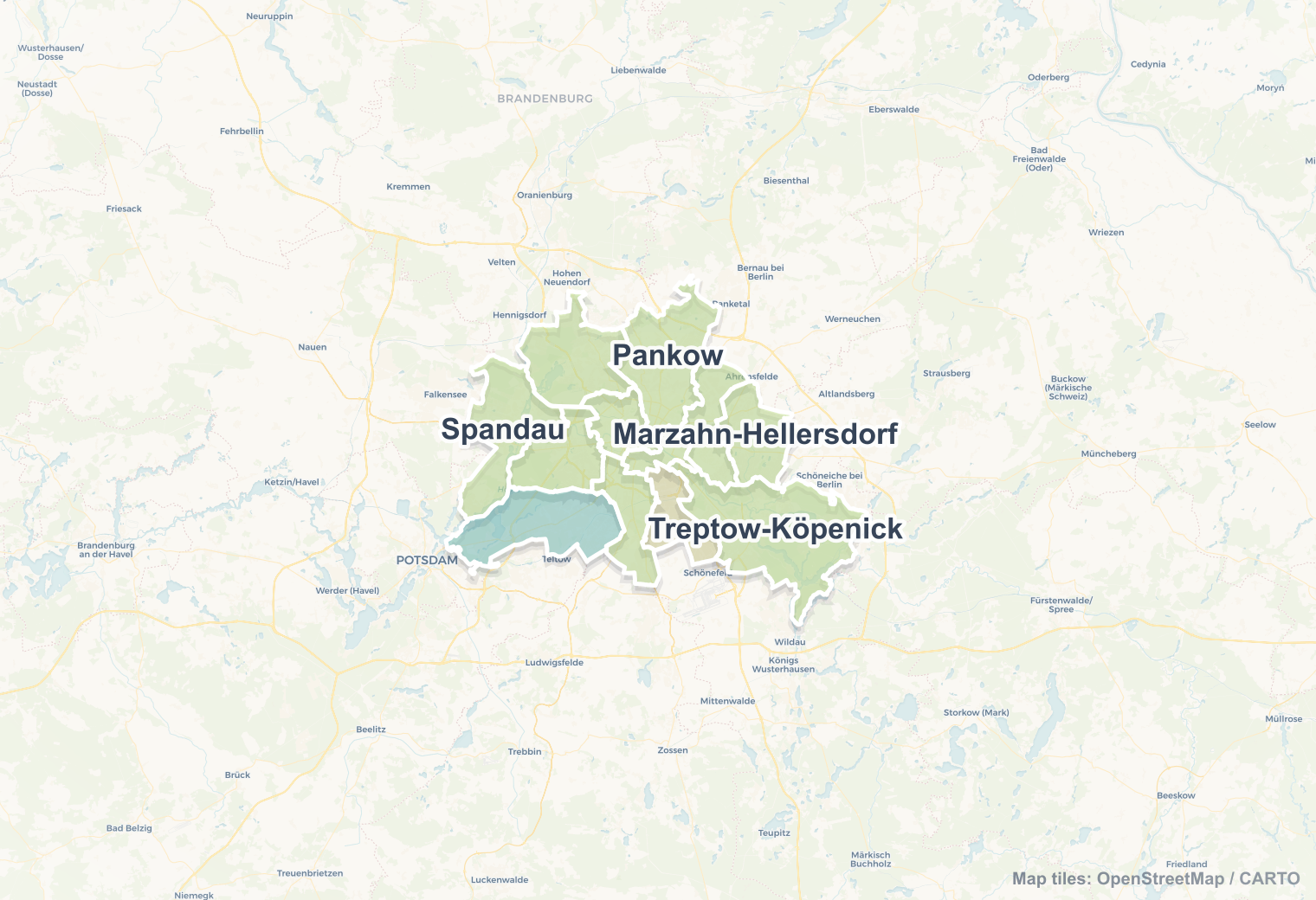
Use the Berlin map as a decision tool before booking. Compare safety, transport, attraction access, and budget trade-offs district by district.
Interactive map
Click a district to see details, compare scores, and avoid booking in weaker areas. District tooltips show the neighborhood name, and the detail panel updates instantly.
Active district
Steglitz-Zehlendorf
Excellent | score 90
Berlin
Affluent southwestern district of Berlin, known for villas, lakes (like Wannsee), and green spaces. Very residential, quiet, and upscale.
Travel score
90
Safety
92
Transport
80
Community
90
Key strengths
Points to consider
12 results
District Comparison
Choose two districts and compare them side by side before booking. The tool highlights overall score, safety, transport, accommodation, night risk, and the practical trade-offs that matter most for a stay base.
| District | Safety | Vibe | Best for |
|---|---|---|---|
| Steglitz-Zehlendorf | 92/100 | Local | Families |
| Mitte | 75/100 | Lively | Nightlife |
| Charlottenburg-Wilmersdorf | 88/100 | Lively | Families |
| Treptow-Köpenick | 88/100 | Local | Families |
| Pankow | 87/100 | Local | Families |
Travel score 90/100
Affluent southwestern district of Berlin, known for villas, lakes (like Wannsee), and green spaces. Very residential, quiet, and upscale.
Strengths
Watch-outs
Travel score 88/100
Mitte w Berlin ma dobry profil ogolny, chociaz slabsza strona pozostaje komfort wieczorem.
Strengths
Watch-outs
Overall travel score
Best single read for choosing a low-friction tourist base.
Safety
How comfortable the area is likely to feel for a typical visitor.
Sightseeing convenience
Access to major attractions, useful streets, and visitor-friendly movement.
Transport
How easy it is to arrive, leave, and move around the city.
Accommodation
Hotel and apartment practicality for a short stay.
Night risk
Lower is better. Use this when late returns matter.
Community signal
Extra signal from user reviews where enough data exists.
Stay Decision Guide
Mitte works best for first-time visitors to Berlin, scoring 75 for safety and 98 for transport, which means you can reach major sights quickly and return late without complex connections. The district covers the historical center and Brandenburg Gate area, giving you walkable access to core attractions while Berlin's good transport network (83.2/100) lets you branch out easily.
Berlin is a sprawling city where neighborhoods feel distinct and distances are real, but the good transport system means you're not locked into staying ultra-central. First-timers benefit from understanding that Berlin's layout rewards choosing a district with strong transit links over pure proximity, since you'll be moving between scattered sights rather than circling one compact old town.
Factor in your evening plans when choosing where to stay in Berlin, since 75% of districts score low for night safety and even well-connected areas like Mitte drop to 45 for nighttime comfort. Pickpocketing and tourist-targeted friction peak around transit hubs and major sights, so staying one or two stops away from the absolute center can reduce daily exposure without sacrificing access.
Families should consider Steglitz-Zehlendorf, which scores 92 for safety and offers green spaces like Wannsee, though its transport score of 80 and night score of 28 mean you'll need to plan return journeys carefully after dark. The residential, villa-lined streets provide a quiet base with significantly lower risk than inner districts, and Berlin's good overall transport network makes daytime sightseeing trips manageable despite the southwestern location.
Solo travelers fit best in Mitte, where the 98 transport score means maximum flexibility to move around independently and the 75 safety score sits above Berlin's average of 78.8. The night score of 45 is higher than most districts, and the concentration of hostels and active evening zones reduces the isolation factor, though you'll still need to stay alert around crowds and transport stops where pickpocketing concentrates.
Budget travelers should target the edges of Charlottenburg-Wilmersdorf, where the safety score of 88 stays well clear of caution territory and the transport score of 90 ensures you're not stranded. Avoid drifting into Neukölln (safety 60, flagged caution) purely for cheaper rates, since the social contrasts and rough zones create friction that outweighs any savings, especially for visitors unfamiliar with which blocks to navigate.
Mitte places you closest to Brandenburg Gate, Museum Island, and the Reichstag, with a transport score of 98 that connects you to everything else within minutes. The tradeoff is a safety score of 75—below the safer residential districts—and higher exposure to pickpocketing and tourist-targeted scams in the crowded central zones.
Staying central in Mitte does come with comfort costs: the night score of 45 reflects increased activity and friction after dark, and the concentration of visitors means you're navigating crowds and watching belongings constantly. The safety profile is manageable but not effortless, especially around Alexanderplatz and major transit interchanges where petty crime clusters.
Basing in Charlottenburg-Wilmersdorf makes sense when you want a calmer evening environment (safety 88, night 32) while still accessing sights efficiently via its 90 transport score. You give up the ability to walk home from dinner in Mitte, but you gain significantly lower pickpocketing exposure and quieter streets after 10pm, which matters in a city where 75% of districts score poorly at night.
The outer edges of Charlottenburg-Wilmersdorf and the better-connected parts of Steglitz-Zehlendorf offer lower accommodation costs while maintaining safety scores of 88 and 92 respectively. These districts stay residential and quiet, reducing both rates and the daily friction you'd face in heavily touristed zones, though you'll add 15-20 minutes to your commute into central Mitte.
The safety-versus-price line in Berlin sits clearly above Neukölln's score of 60—anything cheaper in that district or similar southern zones comes with real tradeoffs in social contrasts and rough urban pockets. Charlottenburg-Wilmersdorf at 88 represents the floor for comfortable budget stays, while dropping into the mid-60s or below means navigating gentrifying areas where block-by-block conditions vary sharply.
Check the evening route from your accommodation to the nearest U-Bahn or S-Bahn stop in Berlin, especially since 75% of districts score low at night and transport hub proximity doesn't guarantee well-lit, populated walking paths. A budget place that saves 30 euros but requires a 10-minute walk through empty residential streets after dark creates friction that erodes the value, particularly in districts with night scores below 35.
Neukölln (safety 60, verdict: caution) offers the cheapest accommodation in Berlin but comes with strong social contrasts and rough urban zones that create unpredictable block-by-block conditions. The multicultural, rapidly gentrifying character means trendy cafes sit alongside areas where visitors face higher friction and discomfort, especially after dark when the already low city-wide night scores drop further in southern inner-city zones.
When a price in Berlin seems unusually low, cross-reference the district name against the caution list and check whether it clusters near Neukölln or other southern/eastern edges where the 21-point score spread reveals significant safety variation. Cheap rates in these areas reflect the social environment and evening unpredictability, not just distance from sights, since Berlin's good transport network (83.2/100) means location alone doesn't justify steep discounts.
Before booking anywhere in Berlin, map the evening return route from your most likely dinner or nightlife zone back to the accommodation address, since 75% of districts score poorly at night and even well-connected areas like Mitte (night 45) require active awareness. If the route involves changing trains at major hubs like Alexanderplatz after 10pm or walking more than five minutes through unlit residential blocks, the accommodation price should reflect that friction—if it doesn't, you're absorbing risk for someone else's margin.
FAQ
Mitte scores 75 for safety, which sits slightly below Berlin's average of 78.8 but remains manageable for first-timers who stay alert around crowds and transport hubs. The primary risks are pickpocketing and tourist-targeted friction in heavily visited zones like Alexanderplatz, not violent crime, and the district's 98 transport score means you can return quickly from anywhere in the city without extended late-night exposure.
Neukölln is flagged as caution with a safety score of 60, reflecting strong social contrasts and rough urban zones that create unpredictable conditions block by block. If you're unfamiliar with Berlin and prioritizing ease over exploration, staying in districts scoring above 75 eliminates the need to navigate which streets feel comfortable, especially since 75% of Berlin's districts already score low at night and Neukölln's evening profile is weaker than most.
Berlin's good transport network (83.2/100) means you can base yourself in safer residential districts like Charlottenburg-Wilmersdorf (transport 90, safety 88) or Steglitz-Zehlendorf (transport 80, safety 92) without sacrificing access to central sights. The system gives you flexibility to prioritize safety and evening comfort over pure proximity, which matters in a city where 75% of districts score poorly at night and central zones like Mitte concentrate pickpocketing and crowds.
Map the evening walking route from the nearest U-Bahn or S-Bahn stop to your accommodation address, since 75% of Berlin's districts score low for night safety and even short walks through empty residential streets create friction. Check whether the route is well-lit and passes active businesses or residential windows, and confirm the stop serves multiple lines so you're not dependent on a single connection that reduces service after 11pm, especially in outer districts with lower transport scores.