First time
DegerlochDegerloch is the cleanest first base: safety 90/100, transport 80/100, and fewer avoidable arrival mistakes.
Degerloch works best for first-timers with its excellent safety score of 90/100, strong transport connectivity at 80/100, and elevated position that offers orientation value when learning the city layout. The combination of reliable access and residential calm gives newcomers a secure base without sacrificing mobility across Stuttgart's spread-out attractions.
Use this shortlist to choose an area first, then compare the exact district on the map. Stuttgart is generally safe, but pickpocketing is common in tourist areas.
First time
DegerlochDegerloch is the cleanest first base: safety 90/100, transport 80/100, and fewer avoidable arrival mistakes.
Family
SillenbuchSillenbuch gives families the stronger calm-and-access trade-off, with safety 90/100 and night score 30/100.
Budget
Stuttgart-MitteUse Stuttgart-Mitte as the value check only if the exact stay keeps transport clear; do not trade down toward Bad Cannstatt for price alone.
Explore them on the map:
See safest areas on the mapStuttgart safety map
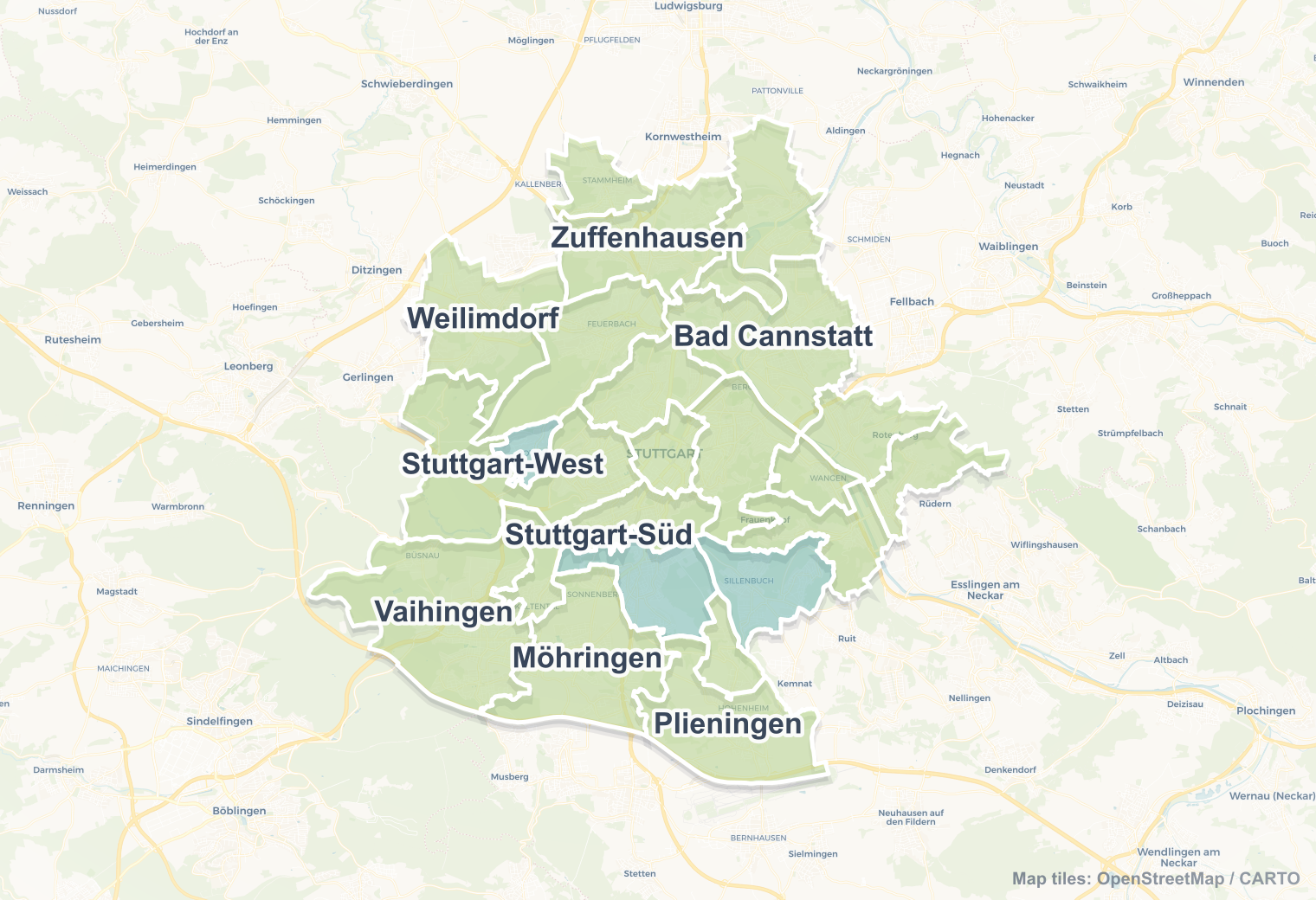
Use the map to compare districts before deciding where to book.
Stay decision guide
First time
DegerlochDegerloch is the cleanest first base: safety 90/100, transport 80/100, and fewer avoidable arrival mistakes.
Family
SillenbuchSillenbuch gives families the stronger calm-and-access trade-off, with safety 90/100 and night score 30/100.
Budget
Stuttgart-MitteUse Stuttgart-Mitte as the value check only if the exact stay keeps transport clear; do not trade down toward Bad Cannstatt for price alone.
Use the Stuttgart map as a decision tool before booking. Compare safety, transport, attraction access, and budget trade-offs district by district.
Interactive map
Click a district to see details, compare scores, and avoid booking in weaker areas. District tooltips show the neighborhood name, and the detail panel updates instantly.
Active district
Degerloch
Excellent | score 90
Stuttgart
Elevated residential area with great views and good living quality.
Travel score
90
Safety
90
Transport
80
Community
90
Key strengths
Points to consider
23 results
District Comparison
Choose two districts and compare them side by side before booking. The tool highlights overall score, safety, transport, accommodation, night risk, and the practical trade-offs that matter most for a stay base.
| District | Safety | Vibe | Best for |
|---|---|---|---|
| Degerloch | 90/100 | Local | Families |
| Botnang | 90/100 | Local | Families |
| Sillenbuch | 90/100 | Local | Families |
| Vaihingen | 85/100 | Quiet | Families |
| Möhringen | 85/100 | Local | Families |
Travel score 90/100
Elevated residential area with great views and good living quality.
Strengths
Watch-outs
Travel score 90/100
Quiet residential district surrounded by forests.
Strengths
Watch-outs
Overall travel score
Best single read for choosing a low-friction tourist base.
Safety
How comfortable the area is likely to feel for a typical visitor.
Sightseeing convenience
Access to major attractions, useful streets, and visitor-friendly movement.
Transport
How easy it is to arrive, leave, and move around the city.
Accommodation
Hotel and apartment practicality for a short stay.
Night risk
Lower is better. Use this when late returns matter.
Community signal
Extra signal from user reviews where enough data exists.
Stay Decision Guide
Degerloch works best for first-timers with its excellent safety score of 90/100, strong transport connectivity at 80/100, and elevated position that offers orientation value when learning the city layout. The combination of reliable access and residential calm gives newcomers a secure base without sacrificing mobility across Stuttgart's spread-out attractions.
Stuttgart's good transport network (79.1/100) means first-timers have real flexibility to stay beyond the immediate center, but the city's hilly terrain and valley-ridge layout require more planning than flat urban grids. The moderate score spread of just 17 points across districts means most areas are genuinely viable, reducing the pressure to pinpoint one perfect neighborhood.
Factor in your latest planned return time before choosing any district in Stuttgart—96% of areas score low for night-time comfort, so even safe daytime neighborhoods shift character after dark and may require taxi budgeting for evening activities.
Sillenbuch ranks strongest for families with its top-tier safety score of 90/100, quiet residential character, and green surroundings that provide outdoor space, though its moderate transport score of 75/100 means families should plan daytime outings with slightly longer connection times in mind. The low night score of 30/100 is less critical for family schedules that typically end earlier.
Degerloch serves solo travelers best by balancing excellent safety (90/100) with the strongest transport access (80/100) among top districts, giving independent explorers both security and the mobility to move freely during daytime hours. Solo visitors should still plan evening returns deliberately given Stuttgart's widespread night discomfort across 96% of districts.
Botnang offers budget-conscious travelers a high safety score of 90/100 in a less central location, where accommodation costs typically run lower than hilltop Degerloch or embassy-area Sillenbuch without dropping into any flagged caution zones. The tradeoff is the lowest transport score (70/100) among top districts and forest-edge positioning that adds connection time to central attractions.
Stuttgart-Mitte and Bad Cannstatt provide the shortest physical distance to major sights like Schlossplatz, the State Gallery, and Mercedes-Benz Museum, though neither ranks among the top safety scorers and both share the city-wide pattern of reduced night-time comfort. The access advantage is real—you can walk to museums and transit hubs—but expect more urban density and evening activity that some travelers find less comfortable.
Central Stuttgart locations don't carry safety warnings in this city's data (zero districts flagged for caution), but the moderate 17-point score spread means hilltop residential areas like Degerloch genuinely outscore the center for daytime safety while sacrificing only 10-15 minutes in connection time. The cost is inconvenience, not danger.
Basing in Degerloch or Sillenbuch makes sense when you value residential quiet and peak safety scores over walk-to-everything convenience, particularly if your trip includes early starts and evening downtime rather than spontaneous late-night exploration. You gain 5-10 safety points and residential atmosphere; you lose immediate proximity and add 20-30 minutes to some journeys on Stuttgart's good-but-not-excellent transport network.
Botnang, Möhringen, and Feuerbach offer lower typical accommodation costs than hilltop favorites while maintaining respectable safety profiles with no caution flags, making them genuine budget alternatives rather than compromises. These districts sit further from tourist centers and carry forest-edge or light-industrial character that reduces demand and therefore price.
Stuttgart's safety-price tradeoff is forgiving compared to cities with hard avoid zones—the 17-point score spread and zero caution districts mean budget hunters aren't forced into genuinely risky areas to save money. The real tradeoff is transport convenience and residential character rather than safety itself, though all districts still show the city-wide pattern of reduced night comfort.
Check the specific tram or S-Bahn stop proximity and last-service times before booking budget accommodation in Stuttgart, since the good-not-great transport rating (79.1/100) means peripheral locations can have longer connection gaps and earlier final departures that restrict evening plans. A 10-minute walk to a stop matters more here than in cities with excellent coverage.
Unusually cheap accommodation in Bad Cannstatt, Zuffenhausen, or neighborhoods bordering industrial zones should prompt checking for traffic noise, distance from actual transport stops, and whether the specific street sits in a residential pocket or faces commercial strips. Stuttgart has no outright danger zones, but low prices often signal compromised comfort or inconvenient micro-locations rather than true value.
When a Stuttgart price seems disproportionately low, the scores reveal it's typically distance from transport nodes, placement near industrial areas, or positioning on busy through-roads rather than safety red flags—the city simply doesn't have extreme danger differentials. The 96% night discomfort rate is city-wide, so cheap accommodation won't be notably worse after dark than pricier options in that specific dimension.
Ask yourself honestly: what does the evening return look like from this specific address in Stuttgart, given that virtually all districts score low for night comfort and transport is good but not comprehensive enough to cover every gap? If your accommodation requires a 15-minute walk from the last transport stop through quiet residential streets, budget for taxis after evening activities regardless of the daytime safety score.
FAQ
Yes—Stuttgart has zero districts flagged for caution and only a 17-point spread between top and bottom safety scores, meaning peripheral residential areas like Sillenbuch and Botnang actually score higher (90/100) than many central locations. The real consideration is transport convenience rather than safety, since Stuttgart's good-but-not-excellent network (79.1/100) means outer districts add connection time without adding meaningful risk.
Stuttgart's night discomfort is city-wide rather than concentrated in specific problem zones—even high-safety residential areas like Degerloch and Sillenbuch score just 30/100 at night due to reduced street activity, limited late transport options, and the city's hilly, spread-out geography that creates quiet stretches after dark. This pattern means planning evening returns matters everywhere in Stuttgart, not just in budget or central districts.
These hilltop districts add 20-30 minutes to journeys compared to central Stuttgart-Mitte, which is manageable given Stuttgart's good transport rating (79.1/100) but requires accepting you won't walk to major sights. Degerloch's transport score of 80/100 means connections are reliable during operating hours, but spontaneous late-night mobility is limited city-wide, so the location disadvantage for evening activities isn't dramatically worse than staying central.
No—Stuttgart's data shows zero districts flagged for caution or avoidance, with all 23 areas falling into safe or very-safe categories. The decision framework here is about optimizing transport convenience, residential character, and budget rather than eliminating unsafe options, though all districts share the city-wide pattern of reduced night-time comfort that requires planning evening logistics regardless of where you stay.